- Animals
- ›Chordates
- ›Vertebrates
- ›Mammals
- ›Therians
- ›Placental Mammals
- ›Ungulates, Carnivorans, and Allies
- ›Carnivorans
- ›Mongooses
- ›Solitary Mongooses
- ›Urva
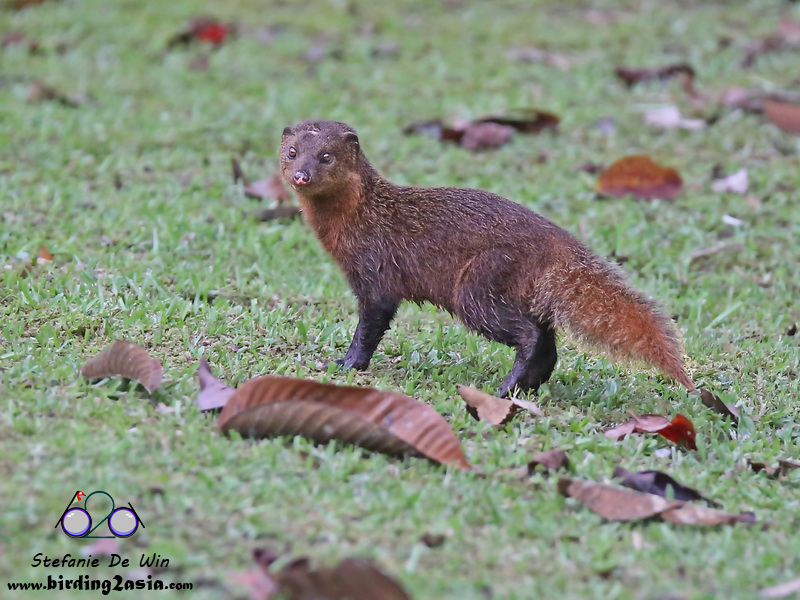
Collared Mongoose
Urva semitorquata
The collared mongoose (Urva semitorquata) is a mongoose species native to Borneo and Sumatra in Indonesia, and a possible presence in the Philippines. It is classified as Near Threatened on the IUCN Red List.
From the article Collared mongoose on Wikipedia (CC BY-SA), quoted section by section
Description
The collared mongoose has a body length of up to 43 cm (17 in), and weighs up to 1.5 kg (3.3 lb). There are two colour forms– a rarer reddish form and common brown skinned variant. The fur on the throat is lighter than on the rest of the body, with a unique pale stripe below the ear. The fur on the legs is noticeably darker, with a long, stout tail.
Wikipedia: “Appearance”
Range & habitat
The collared mongoose is distributed in Southeast Asia, including the Malay Peninsula, Sumatra, Borneo, and nearby smaller islands, and possibly in the Philippines. It inhabits lowland and hill forests, mangroves, and sometimes plantations, favoring dense vegetation near streams or wetlands. It inhabits in lowlands and lower montane habitats up to 1,400 m (4,600 ft) elevation. It also inhabits wet swamps, and degraded forests, and is scarcely found in agricultural areas. The collared mongoose is listed as least concern by the IUCN, given its relatively wide distribution.
Wikipedia: “Distribution and habitat”
What it does
The collared mongoose is nocturnal mammal, which largely dwells on the ground. It remains mostly solitary, though can sometimes forage in pairs. It is a carnivore and feeds on small mammals, reptiles, birds, and insects.
== References ==
Wikipedia: “Behaviour”
Listen
Looking for field recordings…
Where it lives
Recorded sightings
—
geo-referenced records in GBIF, from museums, herbaria and field observers.
Drag the globe to turn it. Dots are where records exist, not a range map; darker means more records.
In the stacks
Searching the stacks…
Every page naming Urva semitorquata in the Biodiversity Heritage Library →
This page is assembled live from iNaturalist, GBIF, Wikipedia, the Source Library and the Internet Archive. It is not yet part of the hand-edited codex. iNaturalist taxon 925972.