On eBird ↗
Citril Finch
Live sightings near you, the range map, bar charts of when it is seen, and Macaulay Library photos and recordings.
Citril Finch
Carduelis citrinella
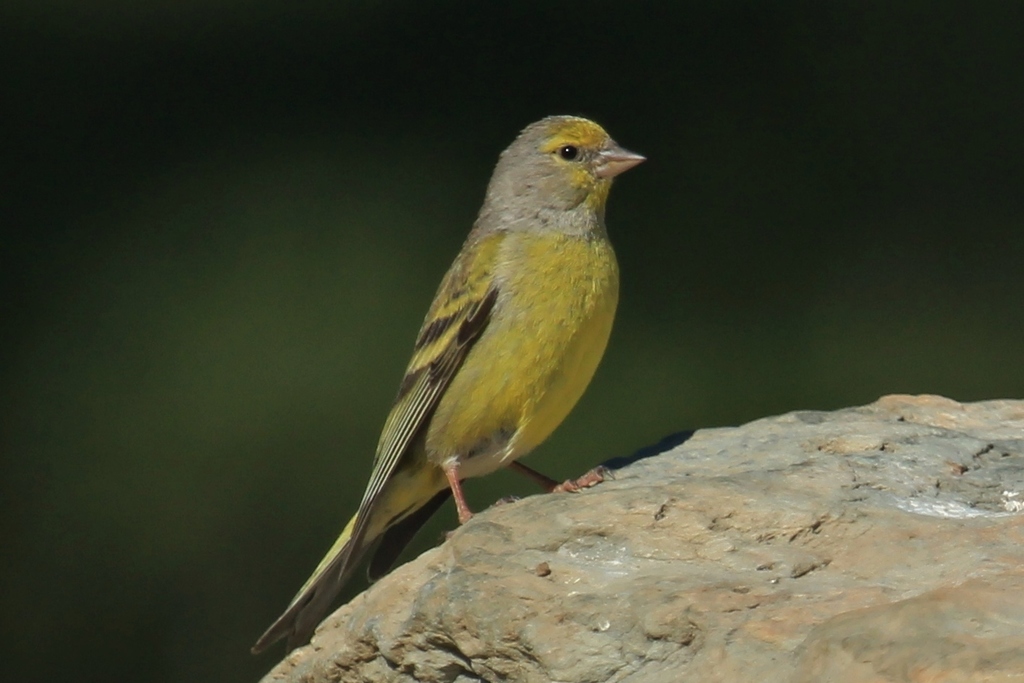
The citril finch (Carduelis citrinella), also known as the Alpine citril finch, is a small songbird, a member of the true finch family, Fringillidae.
This bird is a resident breeder in the mountains of southwestern Europe from Spain to the Alps. Its northernmost breeding area is found in the Black Forest of southwestern Germany.
From the article Citril finch on Wikipedia (CC BY-SA), quoted section by section
Description
The citril finch has an overall length of 12 cm (4.7 in) and weighs around 12.5 g (0.44 oz). It is greyish above, with a brown tinge to the back which also has black streaks. The underparts and the double wing bars are yellow. It shares with its relatives a bright face mask which in this species is also yellow. The sexes are similar, although young females may be duller below, and juvenile birds, unlike in the European Serinus species, are brown, lacking any yellow or green in the plumage. The song is a silvery twittering resembling that of the European goldfinch (C. carduelis) and that of the European serin (Serinus serinus). The main call is a tee-ee, quite similar to the Eurasian siskin (Spinus spinus).
Wikipedia: “Description and systematics”
What it does
The citril finch (Carduelis citrinella) differs from the Corsican finch (C. corsicana) in habitat selection. While the mainland citril finch is rather restricted to subalpine coniferous forests and Alpine meadows, the insular Corsican finch may be found in different habitats from sea level to the highest mountain slopes. The citril finch nests mainly in conifers such as pines (Pinus) and spruces (Picea) while the Corsican finch uses also lower bushes such as tree Heath (Erica arborea), juniper (Juniperus) and bramble (Rubus). Ranging more widely than its Corsican relative, the citril finch is currently classified as a Species of Least Concern by the IUCN. However, it has only a narrow ecological and climatic tolerance, and is now in severe decline due to global warming and agricultural intensification.
Wikipedia: “Ecology”
In human culture
Carduelis is the Latin word for the European goldfinch, and the specific epithet citrinella is the Italian word for a small yellow bird, from a diminutive of the Latin citrinus, citrine or light greenish-yellow. The phylogenetic relationships among the Carduelis species are shown below, based on the data by the Cornell Lab of Ornithology.
Wikipedia: “Etymology”
Listen
Looking for field recordings…
Where it lives
Recorded sightings
—
geo-referenced records in GBIF, from museums, herbaria and field observers.
Drag the globe to turn it. Dots are where records exist, not a range map; darker means more records.
In the stacks
Searching the stacks…
Every page naming Carduelis citrinella in the Biodiversity Heritage Library →
This page is assembled live from iNaturalist, GBIF, Wikipedia, the Source Library and the Internet Archive. It is not yet part of the hand-edited codex. iNaturalist taxon 9237.