On eBird ↗
Somali Bunting
Live sightings near you, the range map, bar charts of when it is seen, and Macaulay Library photos and recordings.
Somali Bunting
Emberiza poliopleura
The Somali bunting or Somali golden-breasted bunting (Emberiza poliopleura) is a species of bird in the family Emberizidae.
It is found in Ethiopia, Kenya, Somalia, South Sudan, Tanzania, and Uganda. Its natural habitats are dry savannah and subtropical or tropical dry shrubland, typically observed in pairs.
From the article Somali bunting on Wikipedia (CC BY-SA), quoted section by section
Description
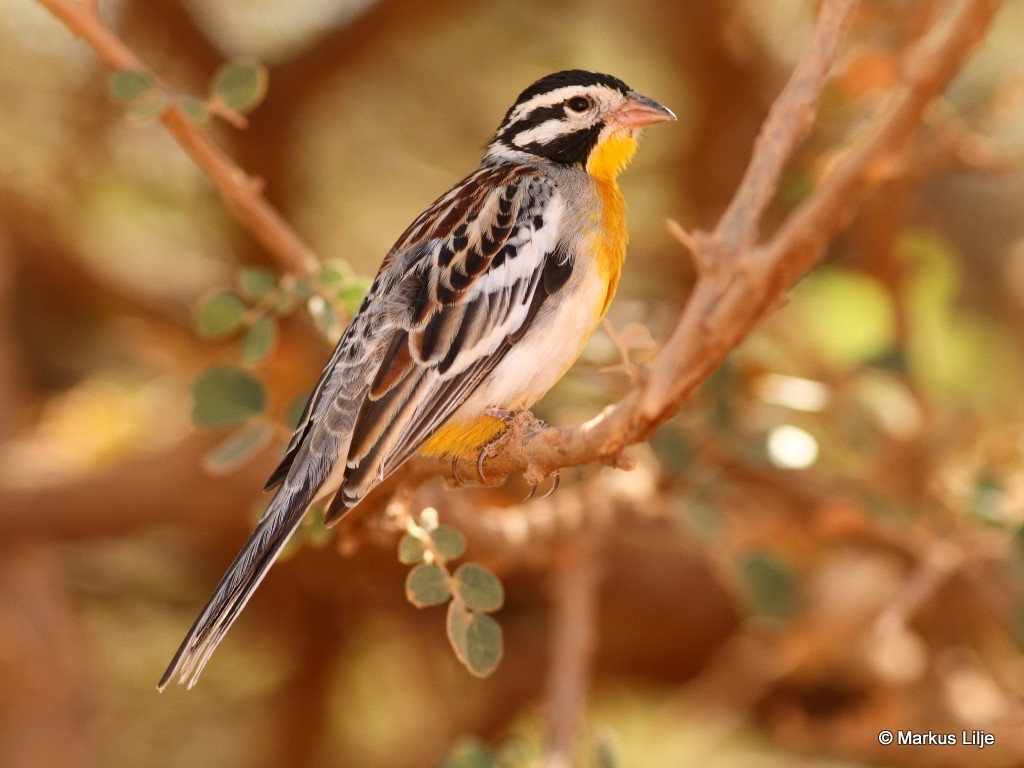
The Somali Bunting is a medium-large bunting, 14–15 cm (5.5–5.9 in) long, and weigh 14–18 g (0.49–0.63 oz). It is an attractive passerine, its distinctive features include a striking black-and-white facial pattern, a grey back streaked with russet, a grey rump, and a bright yellow breast with pale flanks. Females are duller than males, with brown wash on head. Juveniles are similar to females. Similar to the closely related Golden-breasted Bunting, but the Somali Bunting exhibits a generally paler coloration, narrower black facial stripes, a more subdued gray back and rump, and pronounced pale sides. In addition, its preferred habitat is drier, and range overlap with the Golden-breasted Bunting is minimal. Vocalization includes a repeated series of short, whistled phrases, each composed of two distinct notes; one of which is a long ascending whistle.
== References ==
Listen
Looking for field recordings…
Where it lives
Recorded sightings
—
geo-referenced records in GBIF, from museums, herbaria and field observers.
Drag the globe to turn it. Dots are where records exist, not a range map; darker means more records.
In the stacks
Searching the stacks…
Every page naming Emberiza poliopleura in the Biodiversity Heritage Library →
This page is assembled live from iNaturalist, GBIF, Wikipedia, the Source Library and the Internet Archive. It is not yet part of the hand-edited codex. iNaturalist taxon 9209.