- Plants
- ›Vascular Plants
- ›flowering plants
- ›Dicots
- ›Sunflowers, Bellflowers, Fanflowers, and Allies
- ›Sunflowers, Daisies, Asters, and Allies
- ›chicories, dandelions, and allies
- ›Lettuce, Chicory, Dandelion and Salsify Tribe
- ›Hyoseridinae
- ›Sonchus
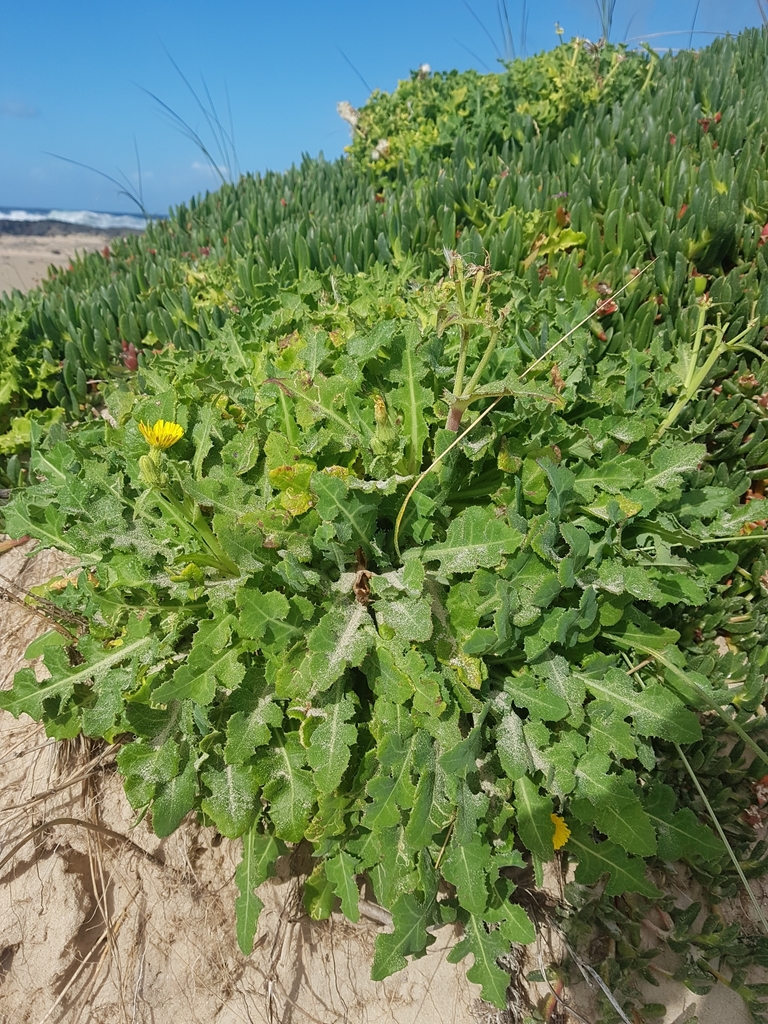
dune thistle
Sonchus megalocarpus
Actites, commonly known as the dune thistle, beach thistle or coastal sow thistle, is a genus of flowering plants in the family Asteraceae. It is endemic to Australia and contains only one species, Actites megalocarpus. It is a large, clumping herb with yellow flowers. Although accepted by Australian sources, others treat Actites as a synonym of Sonchus and the species as Sonchus macrocarpus.
From the article Actites on Wikipedia (CC BY-SA), quoted section by section
Description
Actites megalocarpus is a fleshy perennial herb. The leaves are stiff, prominently veined, margins toothed and wavy, elliptic to oblanceolate shaped, 1.5–26 cm (0.59–10.24 in) long, 0.5–4.5 cm (0.20–1.77 in) wide, either tapering at the base or heart-shaped and sessile. The yellow dandelion-like flowers are 1–2 cm (0.39–0.79 in) in diameter, occasionally pale purple near the base, and on a peduncle 1–10 mm (0.039–0.394 in) long. The bracts are narrow-triangular shaped, the lower midrib of outer bracts has spines. Flowering occurs from September to June and the fruit is a compressed, light to dark brown one-seeded achene, 4–8 mm (0.16–0.31 in) long with 3 longitudinal ribs.
Range & habitat
Dune thistle is usually found on coastal dunes and cliffs from Toorbul in Queensland to Middleton Beach in Western Australia and the south-east coast of Tasmania.
== References ==
Wikipedia: “Distribution and habitat”
Where it lives
Recorded sightings
—
geo-referenced records in GBIF, from museums, herbaria and field observers.
Drag the globe to turn it. Dots are where records exist, not a range map; darker means more records.
In the stacks
Searching the stacks…
Every page naming Sonchus megalocarpus in the Biodiversity Heritage Library →
This page is assembled live from iNaturalist, GBIF, Wikipedia, the Source Library and the Internet Archive. It is not yet part of the hand-edited codex. iNaturalist taxon 903022.