On eBird ↗
Black-faced Antthrush
Live sightings near you, the range map, bar charts of when it is seen, and Macaulay Library photos and recordings.
Black-faced Antthrush
Formicarius analis
The black-faced antthrush (Formicarius analis) is a species of passerine bird in the family Formicariidae. It is found in Central America from Honduras through Panama, on Trinidad, and in every mainland South American country except Argentina, Chile, Paraguay, and Uruguay.
From the article Black-faced antthrush on Wikipedia (CC BY-SA), quoted section by section
Description
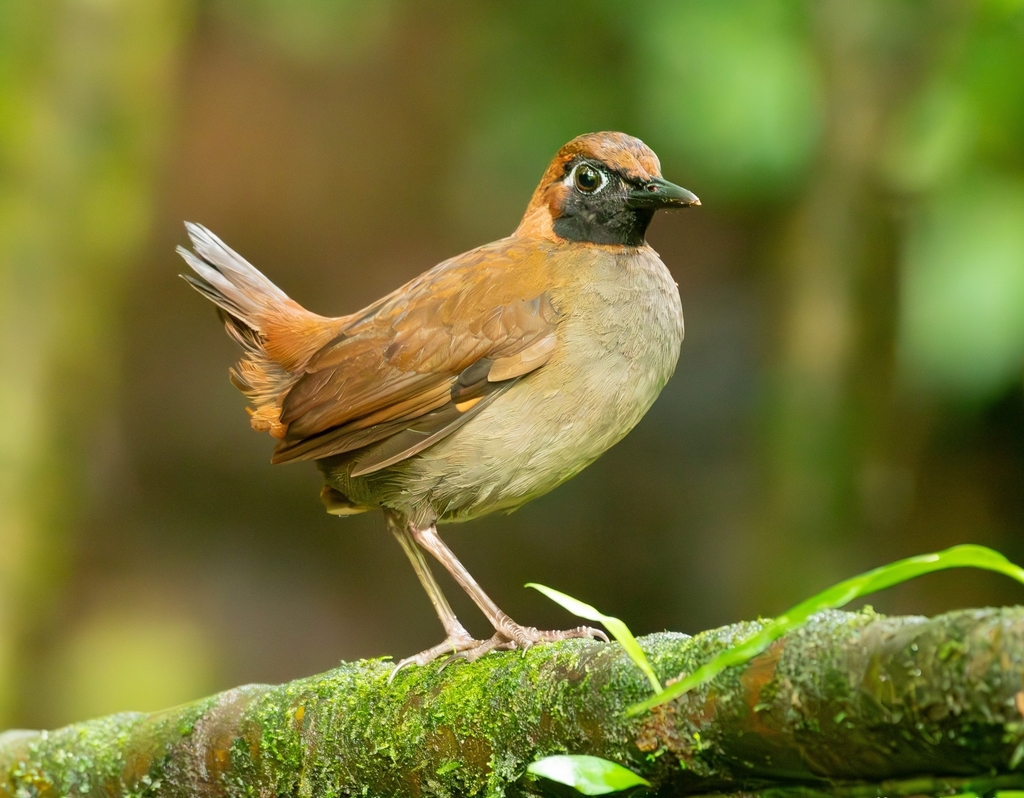
The black-faced antthrush is 15 to 19 cm (5.9 to 7.5 in) long and weighs about 50 to 75 g (1.8 to 2.6 oz). The sexes have the same plumage. Adults of the nominate subspecies F. a. analis have a dusky brown crown. They have a small white spot on their lores and bare bluish skin around their eye. Their face from their bill to their eye is black that extends down to include the chin and throat. The rest of their face, their nape, back, and rump are brown. Their flight feathers are brown with dusky inner edges and a wide cinnamon band at the base; their wing coverts are brown with a rufescent tinge. Their tail is blackish brown. Their upper breast is dark gray and most of the rest of their underparts are a lighter gray that is lightest in the center of their belly. Their flanks have a brown wash and their undertail coverts are rufous. They have a dark brown iris, a black bill, and gray to bluish legs and feet. The other subspecies of the black-faced antthrush differ from the nominate and each other thus:
F. a. umbrosus: like the nominate but with brownish undertail coverts F. a. hoffmanni: pale rufescent or cinnamon crown, little or no white lores spot, and dark cinnamon wash on undertail coverts F. a. panamensis: pale rufescent or cinnamon crown, little or no white lores spot, olive-tinged brownish breast, and tawny undertail coverts F. a. …
Range & habitat
The black-faced antthrush has a disjunct distribution, with a large gap north of the Amazon in northwestern Brazil, southern Venezuela, and eastern Colombia. The subspecies are found thus:
F. a. umbrosus: Caribbean slope from eastern Honduras through Nicaragua and Costa Rica into western Panama F. a. hoffmanni: Pacific slope from central Costa Rica to southwestern Panama F. a. panamensis: from eastern Panama's Darién Province into northwestern Colombia F. a. virescens: Sierra Nevada de Santa Marta in northeastern Colombia F. a. saturatus: Colombia's Magdalena River Valley, northwestern Venezuela north of the Orinoco River, and Trinidad F. a. griseoventris: Serranía del Perijá and nearby on the northeastern Colombia and northwestern Venezuela border F. a. connectens: east of the Andes in eastern Colombia F. a. zamorae: eastern Ecuador, northern Peru, and northwestern Brazil F. a. crissalis: on the Guianan Shield from eastern Venezuela's Bolívar state east through the Guianas into northeastern Brazil north of the Amazon F. a. analis: Amazon Basin of eastern and southeastern Peru, northern Bolivia, and central Brazil F. a. paraensis: southeastern Amazonian Brazil The black-faced antthrush inhabits primary forest and mature secondary forest, primarily várzea and transitional forest and to a much smaller extent terra firme. In parts of Brazil it is associated with bamboo. …
Wikipedia: “Distribution and habitat”
What it does
The black-faced antthrush feeds primarily on a variety of arthropods and also includes small vertebrates such as frogs and lizards in its diet. It is almost entirely terrestrial. It walks slowly and deliberately with its tail cocked like a little rail, sweeping or flicking aside leaf litter with its bill, and often moves in circles. It very rarely deviates from this behavior by leaping into the air to capture fleeing prey. It often but not regularly attends army ant swarms to capture prey fleeing the ants.
Wikipedia: “Feeding”
Listen
Looking for field recordings…
Where it lives
Recorded sightings
—
geo-referenced records in GBIF, from museums, herbaria and field observers.
Drag the globe to turn it. Dots are where records exist, not a range map; darker means more records.
In the stacks
Searching the stacks…
Every page naming Formicarius analis in the Biodiversity Heritage Library →
This page is assembled live from iNaturalist, GBIF, Wikipedia, the Source Library and the Internet Archive. It is not yet part of the hand-edited codex. iNaturalist taxon 9017.