On eBird ↗
Grauer's Broadbill
Live sightings near you, the range map, bar charts of when it is seen, and Macaulay Library photos and recordings.
Grauer's Broadbill
Pseudocalyptomena graueri
Grauer's broadbill (Pseudocalyptomena graueri), also known as the African green broadbill, is a species of bird in the family Eurylaimidae, and is monotypic within the genus Pseudocalyptomena. Its name commemorates the German zoologist Rudolf Grauer who collected natural history specimens in the Belgian Congo.
From the article Grauer's broadbill on Wikipedia (CC BY-SA), quoted section by section
Description
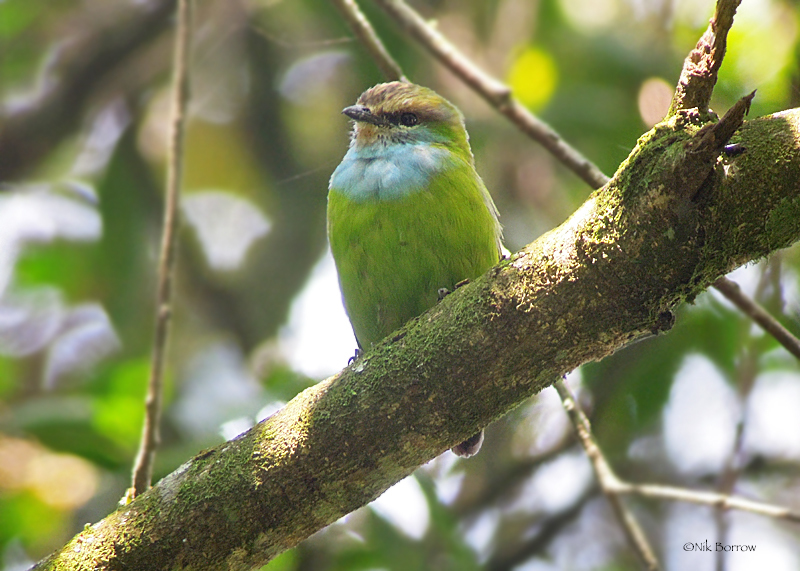
It is bright green with a blue throat and vent and a small bill, quite unlike those of other broadbill species. Adults have finely black-streaked buff crowns and narrow black eyestripes.
Range & habitat
It occurs in tropical moist montane forest, and is endemic to the Albertine Rift Mountains of the Democratic Republic of Congo and Uganda. In Uganda it is a rare resident at 2,100 to 2,200 metres in the Bwindi Impenetrable Forest. Density is probably less than one individual per km2.
Wikipedia: “Habitat and range”
What it does
Grauer's broadbill feeds on seeds and fruit, flowers and flower buds, and some invertebrates.
Wikipedia: “Diet”
In human culture
Baron Walter Rothschild, who described this species, considered it to be a flycatcher only superficially similar to the Asian broadbills of the genus Calyptomena, hence the name pseudo- or "false" Calyptomena. It is currently regarded as an actual broadbill, one of only a few African representatives of a primarily Asian family.
Wikipedia: “Etymology and taxonomy”
Listen
Looking for field recordings…
Where it lives
Recorded sightings
—
geo-referenced records in GBIF, from museums, herbaria and field observers.
Drag the globe to turn it. Dots are where records exist, not a range map; darker means more records.
In the stacks
Searching the stacks…
Every page naming Pseudocalyptomena graueri in the Biodiversity Heritage Library →
This page is assembled live from iNaturalist, GBIF, Wikipedia, the Source Library and the Internet Archive. It is not yet part of the hand-edited codex. iNaturalist taxon 9010.