On eBird ↗
Black-tipped Cotinga
Live sightings near you, the range map, bar charts of when it is seen, and Macaulay Library photos and recordings.
Black-tipped Cotinga
Carpodectes hopkei
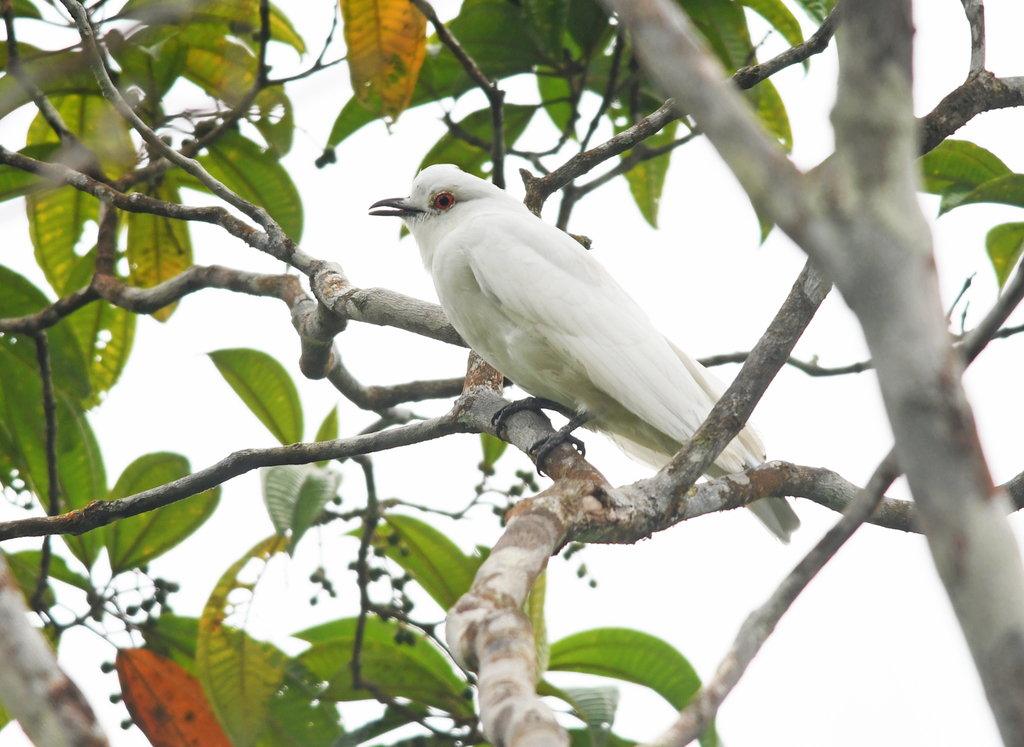
The black-tipped cotinga (Carpodectes hopkei), also known as the white cotinga, is a species of bird in the family Cotingidae. It is found in Colombia, Ecuador, and Panama where its natural habitat is subtropical or tropical moist lowland forests. The male, being white, is conspicuous, but in general it is an uncommon species.
From the article Black-tipped cotinga on Wikipedia (CC BY-SA), quoted section by section
Description
The black-tipped cotinga is 22 to 25 cm (8.7 to 9.8 in) long. The species is sexually dimorphic. Adult males are almost entirely white. They have a very faint gray tinge on their crown, back, and tail and small blackish spots on the tips of the outer primaries and innermost pair of tail feathers. Their flight feathers are wide and have rounded tips. Adult females have a dark grayish head and upperparts and a blackish tail. Their wings are mostly blackish with white edges on the coverts and inner flight feathers. Their breast is pale gray that fades to white towards the vent. Their secondaries are much thinner than the male's. Both sexes have an orange to dark red iris and blackish legs and feet. Their black bill has a wide base, a ridged culmen, and a notch on the tip of the maxilla. Immature birds of both sexes resemble adult females. Subadult males have almost adult plumage but have more dark markings on the wing feathers and black tips on most tail feathers.
Range & habitat
The black-tipped cotinga is found from Darién Province in southeastern Panama south in the lowlands through western Colombia into northwestern Ecuador as far as northern Pichincha Province. There are also scattered sightings further south in Ecuador. It primarily inhabits the canopy of humid forest in the tropical zone and occasionally is found in nearby secondary woodland. In elevation it ranges from sea level to 1,000 m (3,300 ft) in Panama and to 1,200 m (3,900 ft) in Colombia; it is found mostly below 500 m (1,600 ft) in Ecuador.
Wikipedia: “Distribution and habitat”
What it does
The black-tipped cotinga feeds mostly on fruits though details are lacking. It does seem to favor those of Cecropia trees. It sometimes forages in groups of up to about six individuals.
Wikipedia: “Feeding”
Listen
Looking for field recordings…
Where it lives
Recorded sightings
—
geo-referenced records in GBIF, from museums, herbaria and field observers.
Drag the globe to turn it. Dots are where records exist, not a range map; darker means more records.
In the stacks
Searching the stacks…
Every page naming Carpodectes hopkei in the Biodiversity Heritage Library →
This page is assembled live from iNaturalist, GBIF, Wikipedia, the Source Library and the Internet Archive. It is not yet part of the hand-edited codex. iNaturalist taxon 8925.