On eBird ↗
Yellow-billed Cotinga
Live sightings near you, the range map, bar charts of when it is seen, and Macaulay Library photos and recordings.
Yellow-billed Cotinga
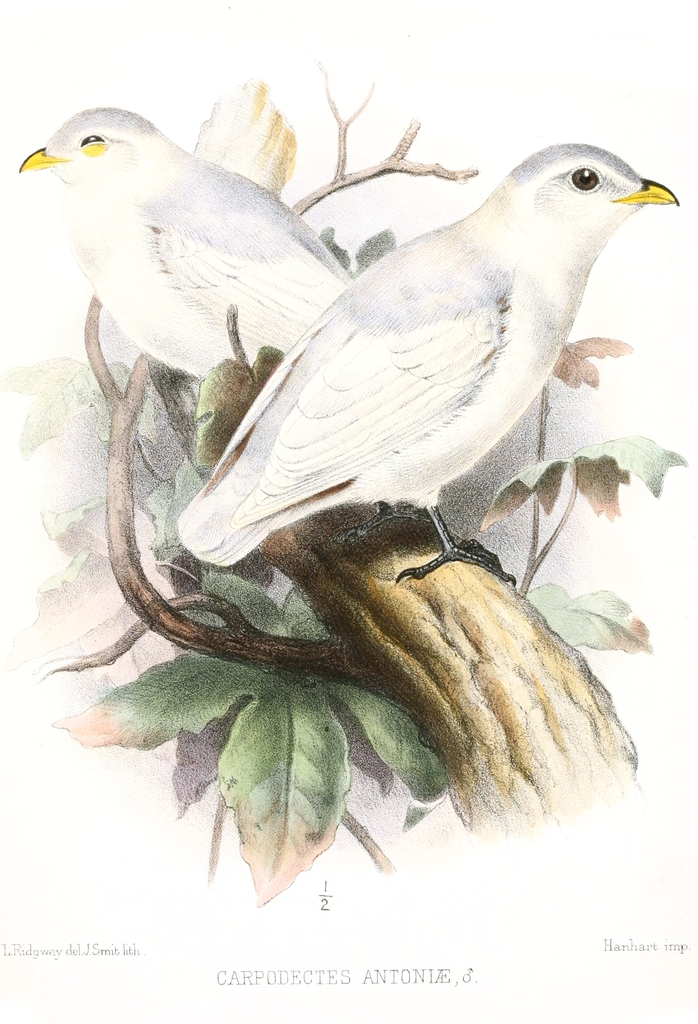
Carpodectes antoniae
The yellow-billed cotinga (Carpodectes antoniae) is a species of bird in the family Cotingidae. It is found near the coast in Costa Rica and the extreme western part of Panama. Its natural habitats are subtropical or tropical moist lowland forest, subtropical or tropical mangrove forest, and subtropical or tropical moist shrubland. It is threatened by habitat destruction.
From the article Yellow-billed cotinga on Wikipedia (CC BY-SA), quoted section by section
Description
The yellow-billed cotinga grows to an adult length of about 8 inches (20 cm). The male has the crown of the head suffused with pearly-grey, but otherwise the plumage closely resembles the much more common snowy cotinga (Carpodectes nitidus), being pure white. However, this bird has a yellow beak, rather than the bluish-grey bill of the snowy cotinga. The female resembles the female snowy cotinga, with its pale brownish-grey upper parts, and greyish-white underparts; it also has a yellow beak.
Range & habitat
The yellow-billed cotinga is endemic to the Pacific coast of Costa Rica and the extreme west of Panama. It occurs in a number of small, separate enclaves, the most northerly of which is in Costa Rica at the mouth of the Tárcoles River and in the Carara National Park nearby. The largest populations are in the area of the Golfo Dulce and the Osa Peninsula, and the main nesting area is at the mouth of the Sierpe River. There are several other locations in Costa Rica where it occurs and it has been seen in Panama, but sightings there are sporadic. It mostly inhabits mangrove forests but is sometimes seen in scrubland and adjacent lowland forests, and occasionally in isolated trees in more open countryside.
Wikipedia: “Distribution and habitat”
What it does
The behaviour of this bird has been little studied. The males (and sometimes the females) perch high in trees by the Sierpe River and fly back and forth low over the water. A swooping form of flight has been observed which is possibly a courtship display.
Wikipedia: “Behaviour”
Listen
Looking for field recordings…
Where it lives
Recorded sightings
—
geo-referenced records in GBIF, from museums, herbaria and field observers.
Drag the globe to turn it. Dots are where records exist, not a range map; darker means more records.
In the stacks
Searching the stacks…
Every page naming Carpodectes antoniae in the Biodiversity Heritage Library →
This page is assembled live from iNaturalist, GBIF, Wikipedia, the Source Library and the Internet Archive. It is not yet part of the hand-edited codex. iNaturalist taxon 8923.