- Animals
- ›Arthropods
- ›Hexapods
- ›Insects
- ›Winged and Once-winged Insects
- ›Butterflies and Moths
- ›Lasiocampoidea
- ›Lappet Moths
- ›Borocera
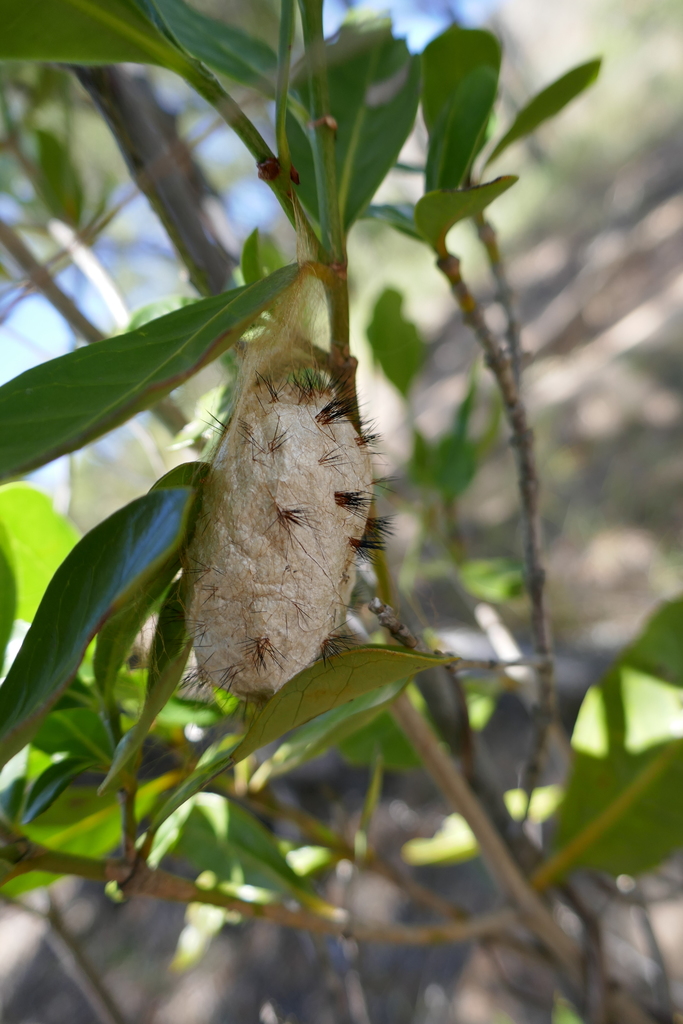
Borocera cajani
Borocera cajani, also known as landibe in Malagasy, is a species of silk-producing lasiocampid moth endemic to Madagascar. It is often confused with the similar Borocera madagascariensis, which has the same Malagasy name. However, B. cajani is the species associated with silk production in highland Madagascar, while B. madagascariensis is found in the coastal portion of the island.
Landibe moths are distributed throughout the highland tapia forests of inland Madagascar, including the zones of Imamo and Itremo massif, Isalo National Park, and the Col des Tapia. It flies all year within the tapia forest.
From the article Borocera cajani on Wikipedia (CC BY-SA), quoted section by section
At the table
B. cajani is considered a delicacy to the Malagasy people. They eat it in the pupal stage either fried or mixed with chicken and rice. Only pupae are eaten, not the larvae. The Malagasy people call the larvae zana-dandy.
Wikipedia: “As food”
In human culture
B. cajani is bivoltine, and its life history is synchronous with that of the related Europtera punctillata moth. There have been suggestions that the species is trivoltine, and lacks a pupal diapause phase. It has been observed to have asynchronous life cycles depending on the location, with the likely reason being that the Imamo region being slightly more warm and wet compared to the Itremo region. The first generation of eggs is laid during November to January, and the second generation from March to April. Larvae are active from November to February, and March to June/July. Pupae are found in February to March, and July to November. There are five larval stages. Pupae of the second generation are more numerous than the first. The entire life cycle takes between 102 and 192 days to complete. B. cajani feeds on the following plants: Uapaca bojeri, Aphloia theiformis, Erica baroniana, Psychotria retiphlebia, Aristida rufescens, Saccharum viguieri, Imperata cylindrica, Dodonaea madagascariensis, Schizolaena microphylla, Sarcolaena oblongifolia, and Loudetia madagascariensis. Of these host plants, Uapaca bojeri, the tapia tree, forms the overwhelming majority of B. cajani's food. However, it has been raised experimentally to prefer another tree, voafotsy (Aphloia theaeformis). B. …
Wikipedia: “Life history”
Listen
Looking for field recordings…
Where it lives
Recorded sightings
—
geo-referenced records in GBIF, from museums, herbaria and field observers.
Drag the globe to turn it. Dots are where records exist, not a range map; darker means more records.
In the stacks
Searching the stacks…
Every page naming Borocera cajani in the Biodiversity Heritage Library →
This page is assembled live from iNaturalist, GBIF, Wikipedia, the Source Library and the Internet Archive. It is not yet part of the hand-edited codex. iNaturalist taxon 891578.