On eBird ↗
Lovely Cotinga
Live sightings near you, the range map, bar charts of when it is seen, and Macaulay Library photos and recordings.
Lovely Cotinga
Cotinga amabilis
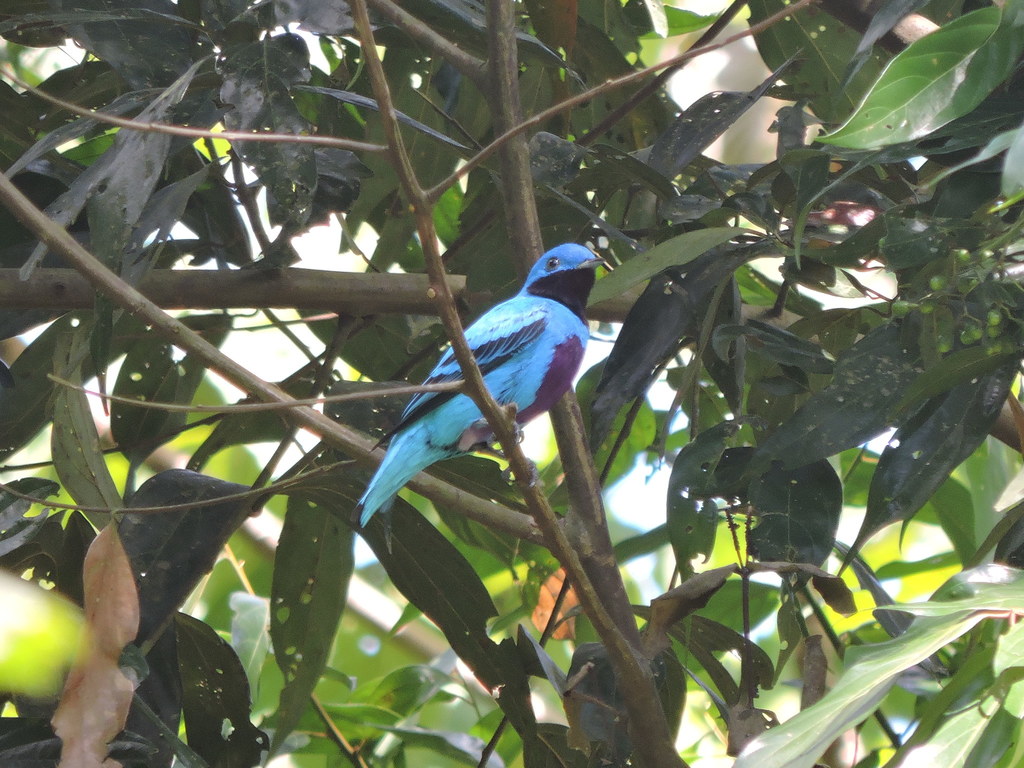
The lovely cotinga (Cotinga amabilis) is a species of bird in the family Cotingidae. It is found in North and Central America from southern Mexico through Guatemala, Belize, Honduras and Nicaragua to Costa Rica with reports from western Panama. Its natural habitats are tropical moist lowland forests and heavily degraded former forest. The male is a bright turquoise blue while the female is greyish-brown with pale underparts. Because of its total population size and wide range,...
From the article Lovely cotinga on Wikipedia (CC BY-SA), quoted section by section
Description
The lovely cotinga is 18 to 20 cm (7.1 to 7.9 in) long and weighs 66 to 75 g (2.3 to 2.6 oz). The sexes are dramatically dimorphic. Adult males have rich bright blue upperparts whose color is slightly deeper on the crown. Their wings' lesser and median coverts are the same bright blue. Their greater coverts, primaries, secondaries, and tertials are black with blue or greenish blue edges. Their tail is black with greenish blue or bluish green edges on the feathers; the uppertail coverts are long and cover the base of the tail. The lower part of their face is glossy purplish black and their chin, throat, and upper breast are dark purple. Their lower breast, flanks, and undertail coverts are the same rich bright blue as their upperparts but for an oval patch of rich purple on the belly. Adult females have mostly dark grayish brown upperparts with whitish feather tips that produce a scalloped appearance. Their wings are mostly dusky grayish brown with usually a greenish tinge on the lesser and median coverts. Their greater coverts and flight feathers have pale grayish brown or buffy edges. Their tail is dusky grayish brown with thin green or greenish gray feather edges. Their underparts are mostly dull white with dusky grayish brown spots that are heaviest on the breast and sides and diminish elsewhere. …
Range & habitat
The lovely cotinga is found in southern Mexico from southern Veracruz across northern Oaxaca and Chiapas south of the Yucatán Peninsula. Its range continues south along the Caribbean through southern Belize and northern Guatemala and northern Honduras and further inland on the Caribbean slope through Nicaragua and Costa Rica. There are also sight records in Panama and on the Pacific side of Costa Rica. It inhabits the tropical zone, where it is found in the interior and edges of lowland evergreen forest and also more open areas with scattered trees. In elevation it ranges from sea level to 1,500 m (4,900 ft) in Mexico and northern Central America and reaches 1,700 m (5,600 ft) in Costa Rica.
Wikipedia: “Distribution and habitat”
What it does
The lovely cotinga's diet is not well known, but is thought to be primarily fruits and also includes invertebrates and occasionally small vertebrates like lizards. It typically forages singly or in pairs but "larger numbers may congregate in fruiting trees". It forages mostly in the canopy, where it perches in the open on bare branches and makes short sallies to pluck fruit or insects.
Wikipedia: “Feeding”
Listen
Looking for field recordings…
Where it lives
Recorded sightings
—
geo-referenced records in GBIF, from museums, herbaria and field observers.
Drag the globe to turn it. Dots are where records exist, not a range map; darker means more records.
In the stacks
Searching the stacks…
Every page naming Cotinga amabilis in the Biodiversity Heritage Library →
This page is assembled live from iNaturalist, GBIF, Wikipedia, the Source Library and the Internet Archive. It is not yet part of the hand-edited codex. iNaturalist taxon 8914.