On eBird ↗
Purple-throated Cotinga
Live sightings near you, the range map, bar charts of when it is seen, and Macaulay Library photos and recordings.
Purple-throated Cotinga
Porphyrolaema porphyrolaema
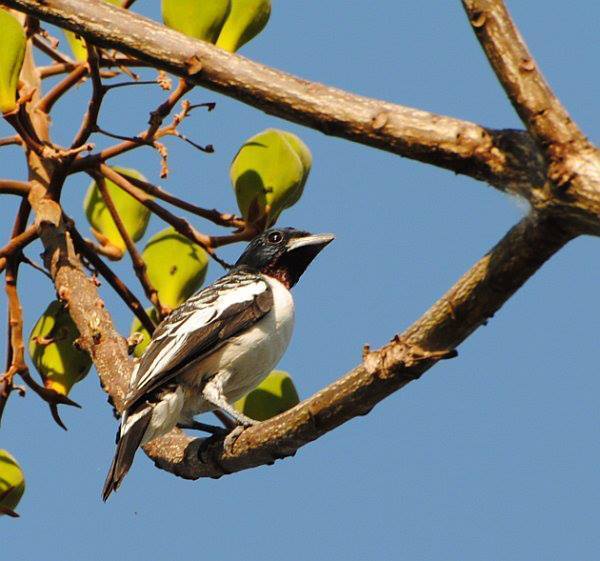
The purple-throated cotinga (Porphyrolaema porphyrolaema) is a species of bird in the cotinga family, Cotingidae. It is found in the western Amazon rainforest of South America; its range extends from southern Colombia south through eastern Ecuador and Peru and east through extreme northwestern Bolivia and into western Amazonian Brazil. It lives in the canopy or along the borders of humid forest throughout its range. The purple-throated cotinga is monotypic within the genus Porphyrolaema and has no known subspecies. It is one of the smaller cotinga species and expresses strong sexual dimorphism. Males have black upperparts with a bold white wingstripe and white edges to the tertial feathers and a white belly with some black barring on the rear flanks. The throat is a deep purple, giving the bird both its common and scientific names. Females are dark brown with pale buffy margins on the upperparts, buffy cinnamon with black barring on the underparts, and rufous on the throat. The male has a powerful voice.
Little research has been done on this species, and not much is known about its ecology. The purple-throated cotinga is primarily frugivorous, although it does occasionally eat small insects. A solitary male attracts a female by perching in the canopy and letting the sunlight reflect off its iridescent feathers. It is suspected to breed year-round and is non-migratory. Despite being considered naturally uncommon or rare across its vast range, the purple-throated cotinga is listed as a species of Least Concern.
From the article Purple-throated cotinga on Wikipedia (CC BY-SA), quoted section by section
Description
The purple-throated cotinga is strongly sexually dimorphic as male and female purple-throated cotingas have few similarities in their plumage. The male has black upperparts, including the head, wings, and tail. The feathers on the bird's back to its uppertail coverts, as well as its upperwing coverts, have white fringes, giving it a scaled appearance. There is also a conspicuous white wingstripe and white edges to the tertial feathers. Additionally, the male has a deeply purple throat and a white belly, with some black barring on its rear flanks. In contrast, the female purple-throated cotinga is a dark brown with pale buffy margins on the upperparts. The underparts are a buffy cinnamon with black barring. The throat is a deeper, unbarred rufous in coloration. The female's tail feathers are longer and more pointed at the tip than those of the male. The juvenile purple-throated cotinga resembles a paler, buffier female; the plumage of the immature is undescribed. The adult purple-throated cotinga is about 16.5 to 18.5 cm (6.5 to 7.3 in) in length and weighs an average of 49 to 60 g (1.7 to 2.1 oz), with males being very slightly smaller than females. The cotinga has a very wide bill with a strongly arched culmen and weakly developed rictal bristles. The bird's iris is dark brown, while the bill and legs are black. …
Range & habitat
The purple-throated cotinga is found throughout western Amazonia from southern Colombia south through eastern Ecuador and Peru to the Madre de Dios region and east through extreme northwestern Bolivia and into western Amazonian Brazil. The eastern boundary of the species appears to be the lower Rio Negro and northern Mato Grosso in Brazil. The purple-throated cotinga's total range covers approximately 2,190,000 km2 (850,000 sq mi), throughout which it occurs in patches at low population densities. In southeastern Peru only two birds were found per 100 ha (250 acres), a ratio which likely is true across its range. The cotinga can be found in the canopy or borders of humid forest up to 900 m (3,000 ft) in elevation, but mostly is restricted to humid forests below 400 m (1,300 ft). It can be found in either unflooded humid forests or in várzea forests, which are seasonally flooded. It is non-migratory.
Wikipedia: “Distribution and habitat”
What it does
The purple-throated cotinga feeds primarily on the fruits of forest trees, most notably those belonging to the genus Cecropia. It also occasionally consumes small invertebrates, such as insects. In portions of its range it is suspected that the cotinga has localized movements as it follows various fruiting events. The cotinga also is known to join mixed-species foraging flocks with other frugivores, including other species of cotinga and toucans. All reported observations of the species feeding involve the cotinga leaning down from its perch to pluck fruit off a tree in the forest canopy. These birds are distinct from similar species in that they are often seen in pairs. This species perches in the canopy to take in the morning sun. A solitary male purple-throated cotinga attracts a female by perching above the canopy and letting the sun highlight its iridescent plumage. The breeding behavior of this species is largely unknown, but the range in molting times implies that this species may breed year-round. The only observed nest was found in a subcanopy tree about 20 m (66 ft) above the ground in December 1997. This nest was placed in the shade to protect it from sunlight at the meeting point of two horizontal branches. Only the female was observed incubating the nest, although the male was frequently seen nearby, possibly watching for predators.
Wikipedia: “Ecology and behavior”
Listen
Looking for field recordings…
Where it lives
Recorded sightings
—
geo-referenced records in GBIF, from museums, herbaria and field observers.
Drag the globe to turn it. Dots are where records exist, not a range map; darker means more records.
In the stacks
Searching the stacks…
Every page naming Porphyrolaema porphyrolaema in the Biodiversity Heritage Library →
This page is assembled live from iNaturalist, GBIF, Wikipedia, the Source Library and the Internet Archive. It is not yet part of the hand-edited codex. iNaturalist taxon 8856.