 NL·0387
Herbarium of the Nature Library
- Name
- Procnias albus
- Family
- Cotingidae
- Native to
- Guiana Shield of Venezuela, Guyana, Suriname, French Guiana and northern Brazil, with an isolated population south of the Amazon in Pará
- Habitat
- Tropical montane forest, Lowland rainforest
On eBird ↗
White Bellbird
Live sightings near you, the range map, bar charts of when it is seen, and Macaulay Library photos and recordings.
White bellbird
Procnias albus
Also calledAraponga-da-amazônia (Portuguese) · Campanero blanco (Spanish) · Cotinga blanc (French)
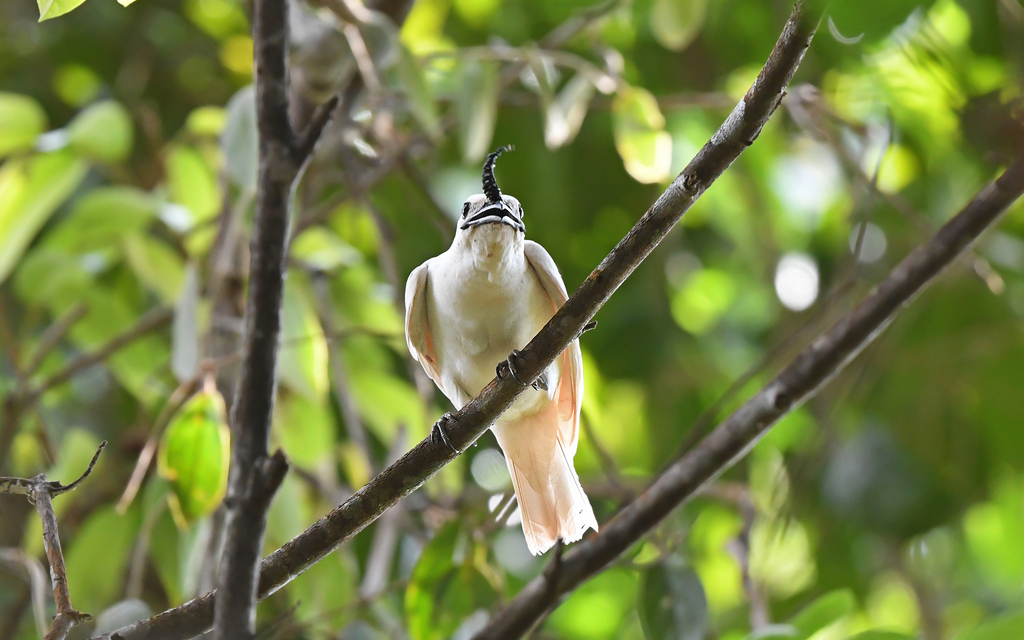
A pure white cotinga with a long, fleshy black wattle dangling from its bill, it has the loudest bird call ever measured — about 125 decibels. Males aim the blast directly at females perched close by.
The white bellbird is a species of bird in the family Cotingidae, the cotingas. It is found in Brazil, French Guiana, Guyana, Suriname, Venezuela, and as a vagrant to Trinidad. Wikipedia
What it can do
- iProduces calls measured at about 125 dB at close range, louder than the Screaming Piha (Podos & Cohn-Haft, Current Biology, 2019)
- iiSwings its head and wattle as it delivers the second note of its call toward a female
- iiiSwallows fruits whole and regurgitates seeds, dispersing forest trees
In the field
Field marks
- aMale: entirely white, with a single long black fleshy wattle hanging from the forehead over the bill
- bFemale: olive-green above with yellowish, olive-streaked underparts
- cLarge dark eye and broad bill
- dStocky, pigeon-like shape
- Voice
- Ear-splitting, bell-like notes — a two-part 'kong-kay' or a single metallic 'boing' that can be heard over long distances.
- Not to be confused with
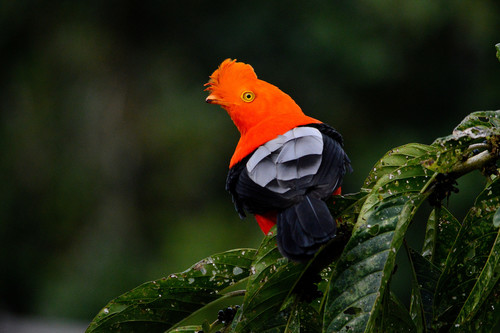
- Bearded Bellbird has a brown head and many short wattles on the throat. Bare-throated Bellbird (Atlantic Forest) has a bare blue-green throat. Three-wattled Bellbird (Central America) is chestnut with a white head and neck and three wattles.
- Where to see it
- Hill forests of the Guiana Shield, e.g. the tepui foothills of Venezuela, the Iwokrama and Kaieteur areas of Guyana, and Roraima in Brazil.
- When
- Resident; calling peaks in the breeding season
Listen
Looking for field recordings…
Life & habits
- Diet
- Fruit, especially of trees in the laurel family
- Habitat
- Canopy of humid hill and montane forest
- Size
- 27–29 cm
Males call from exposed perches high in the canopy for hours each day.
Where it lives
Recorded sightings
—
geo-referenced records in GBIF, from museums, herbaria and field observers.
Native range
Guiana Shield of Venezuela, Guyana, Suriname, French Guiana and northern Brazil, with an isolated population south of the Amazon in Pará
Drag the globe to turn it. Dots are where records exist, not a range map; darker means more records.
In the stacks
Searching the stacks…
Every page naming Procnias albus in the Biodiversity Heritage Library →
Marginalia
Curiosity
Researchers found the loudest calls are the shortest, suggesting a trade-off between volume and duration.
Kinship




Fact-checked: 1 correction made to this sheet. Photographs: iNaturalist contributors under the licences shown. Records: GBIF.org. Historical plates: Source Library (CC BY-SA 4.0; originals public domain). Summary text: Nature Library editors and Wikipedia (CC BY-SA). Medicinal and edibility notes are historical and educational, not advice. iNaturalist taxon 8848.