On eBird ↗
Orange-breasted Fruiteater
Live sightings near you, the range map, bar charts of when it is seen, and Macaulay Library photos and recordings.
Orange-breasted Fruiteater
Pipreola jucunda
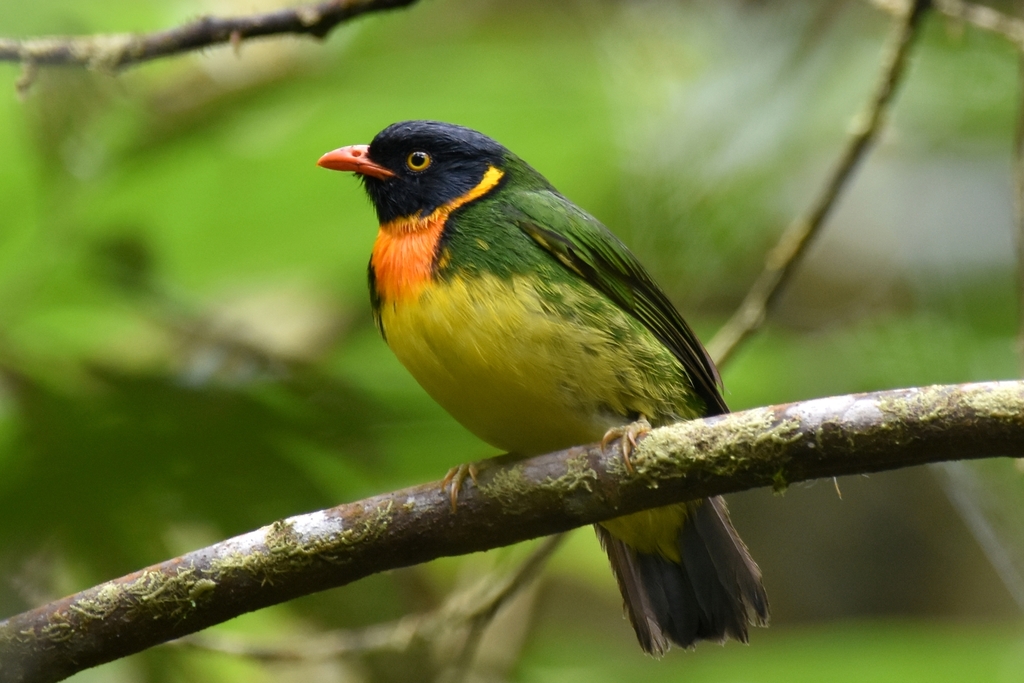
The orange-breasted fruiteater (Pipreola jucunda) is a species of bird in the family Cotingidae native to Colombia and Ecuador. Its natural habitat is subtropical or tropical moist montane forests. It is a plump green bird about 18 centimetres (7 in) long. Males have a glossy black head and bib, an orange throat and yellow belly. Females lack the dark head and have green upper parts and green and yellow streaked underparts. Both sexes have orange beaks and greyish-green legs. This is a relatively common species with a wide range, and the International Union for Conservation of Nature has rated its conservation status as being of "least concern".
From the article Orange-breasted fruiteater on Wikipedia (CC BY-SA), quoted section by section
Description
The male orange-breasted fruiteater has a glossy black head and throat and green upper parts. The breast is bright orange and the belly yellow with green mottling at the side. The female is similar in appearance to the female masked fruiteater with green upper parts and green and yellow streaked underparts. Both sexes have yellow eyes, orange bill and greyish-green legs. This bird grows to a length of about 18 centimetres (7 in). The song is similar to that of the black-chested fruiteater, a high-pitched ascending "pseeeeeweet".
Range & habitat
This species is native to the foothills and slopes of the western side of the Andes in South America. Its range extends from southwestern Colombia to southwestern Ecuador, mainly between the altitudes of 600 and 1,900 metres (2,000 and 6,200 ft) above sea level. This fruiteater is usually found in the understorey of dense, wet, mossy forests.
Wikipedia: “Distribution and habitat”
What it does
The orange-breasted fruiteater is sometimes seen in small flocks with other species. It feeds largely on fruit which it either eats while perching on a branch or while hovering rather clumsily. Cup-shaped nests have been found about 5 metres (16 ft) above the ground but little is known of this bird's breeding habits.
Wikipedia: “Ecology”
Listen
Looking for field recordings…
Where it lives
Recorded sightings
—
geo-referenced records in GBIF, from museums, herbaria and field observers.
Drag the globe to turn it. Dots are where records exist, not a range map; darker means more records.
In the stacks
Searching the stacks…
Every page naming Pipreola jucunda in the Biodiversity Heritage Library →
This page is assembled live from iNaturalist, GBIF, Wikipedia, the Source Library and the Internet Archive. It is not yet part of the hand-edited codex. iNaturalist taxon 8757.