On eBird ↗
Chestnut-capped Piha
Live sightings near you, the range map, bar charts of when it is seen, and Macaulay Library photos and recordings.
Chestnut-capped Piha
Lipaugus weberi
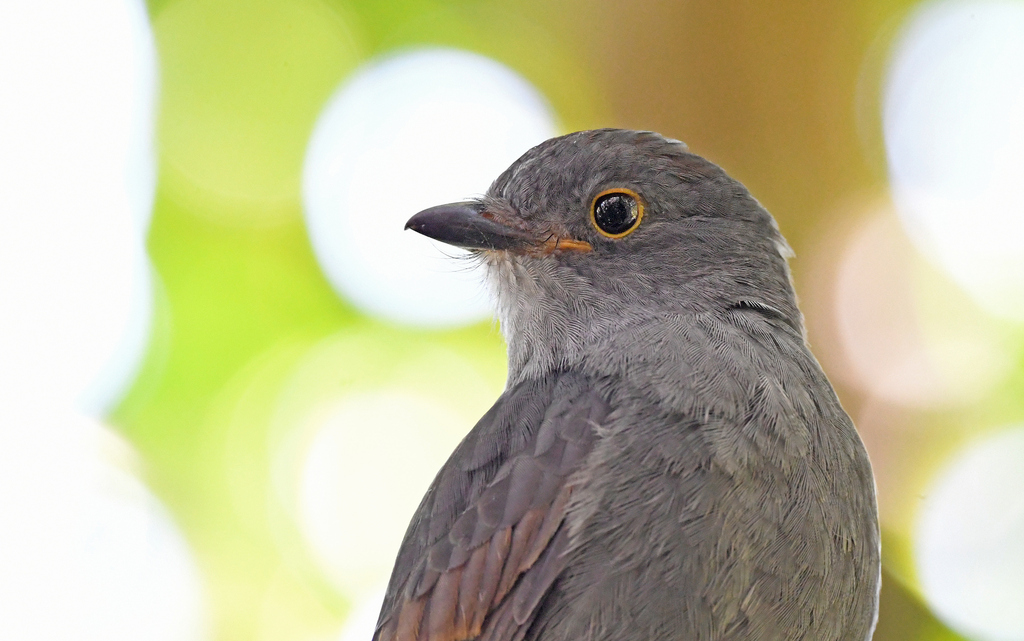
The chestnut-capped piha (Lipaugus weberi) is a species of bird in the family Cotingidae. It is endemic to a small portion of Colombia's central Andes in the department of Antioquia. The chestnut-capped piha resides only in a narrow band of humid premontane cloud forest. It is a dark grey passerine with a notable chestnut crown on the upper nape and pale cinnamon-colored undertail coverts. Adults are small for pihas, measuring about 20 to 25 cm (8 to 10 in) long. Males have modified primary feathers with elongated and stiff barbules that enable them to create a whirring noise with their wings, which the piha likely uses for display purposes. Its call is extremely loud and can be heard over 100 m (330 ft) away. The chestnut-capped piha is mostly frugivorous, although it will eat some invertebrates. Little is known about the species' breeding ecology, although it is believed to be a lekking species.
The chestnut-capped piha was not discovered until 1999, due in large part to the very limited and to political instability in central Colombia. The chestnut-capped piha is considered by the IUCN to be critically endangered, and the population may be as low as 250 birds. It is primarily threatened by habitat destruction as its cloud forests are converted into usage for farming, mining, and agriculture. Although several reserves have been set up to protect portions of its range, more conservation work needs to be done to protect the species from extinction.
From the article Chestnut-capped piha on Wikipedia (CC BY-SA), quoted section by section
Description
Overall the chestnut-capped piha is a dark grey bird with a notable chestnut crown on the upper nape and pale cinnamon-colored undertail coverts. The upperparts and wing coverts are a dark grey with paler fringes to most of the feathers. The flight feathers are a dark brownish grey with cinnamon-colored fringes on the secondaries and tertials. As the bird's feathers wear, the pale fringes tend to darken, leaving the bird even more uniform grey in coloration. The underwing is a pale silvery grey. The underparts are a paler shade of grey than the upperparts, particularly on the throat. The tail is a dark greyish-brown, and is noticeably long and forked. The legs and feet are also dark grey, although they have contrasting yellow soles. In addition to its namesake chestnut crown, the bird's head is marked by a dark brown iris and a narrow orbital ring that is a bright yellow. The bird's beak is black and relatively deep and broad at its base, and has a very hooked tip. It also has short rictal bristles and obvious nostrils. Adult chestnut-capped pihas are small for pihas, measuring about 20 to 25 cm (8 to 10 in) long and weighing between 69.4 and 72.2 g (2.45 and 2.55 oz). The sexes are similar in appearance, although the male is suspected to be slightly larger than the female. …
Range & habitat
The chestnut-capped piha is endemic to the central Andes of Colombia. It is only found on the northern slope of the Cordillera Central mountains near the towns of Amalfi and Anorí in the department of Antioquia. Sixteen distinct populations are known from this area just east of the Nechí River Valley, with most of the populations being located closer to Anorí, likely due to more extensive habitat destruction over a longer period of time near Amalfi. Despite the large number of populations, in 2014 it was estimated that its surviving habitat only covered between 42 and 357.5 km2 (10,400 and 88,300 acres). The species is limited to living in a very narrow band of extremely humid, premontane cloud forest between 1,400 and 1,925 m (4,600 and 6,300 ft) in elevation, although it is suspected that birds may venture as low as 1,200 m (3,900 ft). This piha seems to be most common between 1,600 and 1,750 m (5,200 and 5,700 ft). The cloud forest is dominated by trees in the genera Guarea, Pouteria, Protium, Roucheria, Vochysia, Virola, and Clusia. The species prefers pristine cloud forest, and may need blocks of at least 30 ha (74 acres) of habitat to thrive; however, it may be able to tolerate some selective logging and habitat fragmentation, although as a lower population density. The chestnut-capped piha is non-migratory.
Wikipedia: “Distribution and habitat”
What it does
The piha is typically found between the midstory and lower canopy of its cloud forest, and has been observed joining mixed-species foraging flocks in the upper canopy, although typically only for the amount of time needed for the flock to pass through the piha's territory. The species tends to be sluggish and relatively inactive. While perching, the chestnut-capped piha tends to adapt a more horizontal position than the other pihas, which typically perch very upright. When agitated, the piha flicks its tail upwards and raises its crown feathers. The piha is parasitized by at least one species of tick in the genus Acaro. The chestnut-capped piha is mostly frugivorous, although it will eat some invertebrates. The fruits eaten by this piha are small to medium-sized and come from a variety of plant families, including Myrsinaceae, Euphorbiaceae, Caprifoliaceae, Linaceae, Lauraceae, Aquifoliaceae, and Melastomataceae. The laurels in particular seem to be a preferred fruit for the species. The piha typically picks the fruit by hover-gleaning on short sallying flights, although the species will infrequently eat fruits from a perched position. Larger fruits are occasionally bashed against a branch prior to being eaten. The nest and breeding behavior of the chestnut-capped piha has not been described. …
Wikipedia: “Ecology and behavior”
Listen
Looking for field recordings…
Where it lives
Recorded sightings
—
geo-referenced records in GBIF, from museums, herbaria and field observers.
Drag the globe to turn it. Dots are where records exist, not a range map; darker means more records.
In the stacks
Searching the stacks…
Every page naming Lipaugus weberi in the Biodiversity Heritage Library →
This page is assembled live from iNaturalist, GBIF, Wikipedia, the Source Library and the Internet Archive. It is not yet part of the hand-edited codex. iNaturalist taxon 8751.