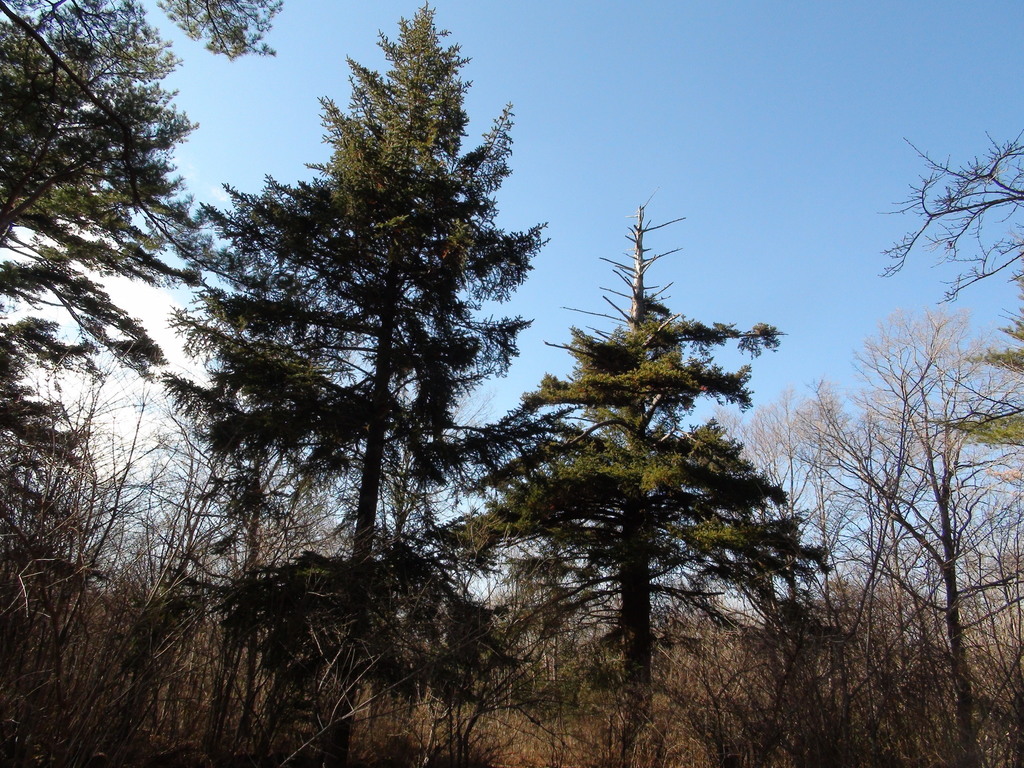
tiger-tail spruce
Picea polita
Picea polita (syn: Picea torano), the tigertail spruce or harimomi (Japanese:ハリモミ), is a species of coniferous tree in the family Pinaceae. It is native to Japan, occurring on the Pacific Ocean side of central Honshu, as well as Shikoku and Kyushu.
From the article Picea polita on Wikipedia (CC BY-SA), quoted section by section
Description
The harimoni typically reaches 30 m, developing a trunk diameter of around 1 m. The crown stays broadly pyramidal in young trees, becoming rounded, domed, or flat-topped with age. The primary branches are long, slender, and mostly horizontal, the secondary branches are shorter, numerous, and spreading to ascending. Vegetative buds are oblong, slightly resinous, with smooth, chestnut-brown scales that persist for several years. Leaves are arranged radially around the shoots, extremely stiff and sharply pointed, quadrangular in cross-section, deep green, usually 15–20 mm long, with several stomatal lines on each face. The unusually rigid and pungent needles are a defining character of the species.
Range & habitat
On Honshu the species is distributed on the Pacific Ocean side of central Honshu, extending westward from Fukushima Prefecture, south through the Japanese Alps and the Kii Peninsula, and is absent from the part of Honshu west of Kyoto. Additional populations occur on Shikoku and Kyushu. It grows in mountainous regions, including the Kanto Mountains and Chubu Mountains, typically around 1,000 m above sea level. The range extends from approximately 600 to 1,700 m, with records from as low as about 400 m and up to nearly 1,850 m, primarily on volcanic soils.
Wikipedia: “Distribution”
Where it lives
Recorded sightings
—
geo-referenced records in GBIF, from museums, herbaria and field observers.
Drag the globe to turn it. Dots are where records exist, not a range map; darker means more records.
In the stacks
Searching the stacks…
Every page naming Picea polita in the Biodiversity Heritage Library →
This page is assembled live from iNaturalist, GBIF, Wikipedia, the Source Library and the Internet Archive. It is not yet part of the hand-edited codex. iNaturalist taxon 873600.