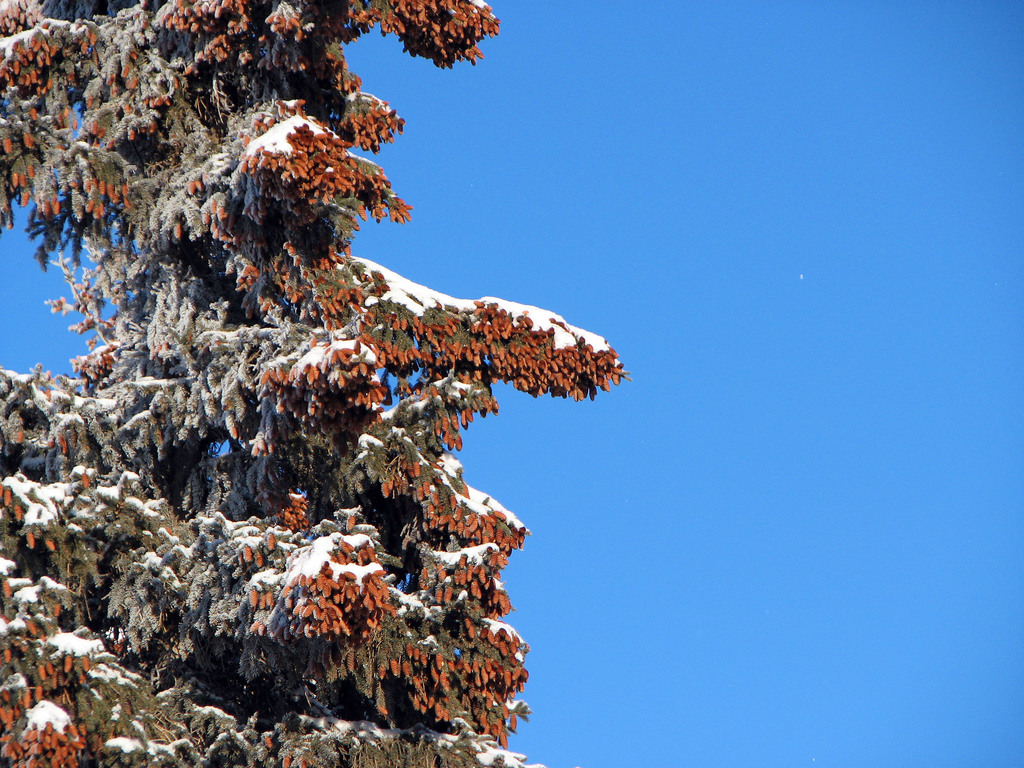
Interior Spruce
Picea × albertiana
Picea × albertiana (Alberta spruce, Interior spruce, or hybrid white spruce) is a nothospecies that is a natural cross between white spruce and Engelmann spruce. It is a dominant forest species in interior British Columbia where the ranges of the two parent species overlap.
From the article Picea × albertiana on Wikipedia (CC BY-SA), quoted section by section
Description
The morphology exhibits characteristics of both parent species. The trees take irregular intermediate forms, which may vary in needle length, cone dimensions, cone scale texture, and twig pubescence. The species can grow up to 48 m (157 ft) in height, and live to be over 100 years old. There is significant evidence that the species complex is locally adapted to cold temperatures, and is specifically adapted to autumn cold hardiness. The species is especially common in Canada, specifically in the Northwest Territories and Yukon, projecting east to Manitoba and down to southern British Columbia. It sporadically appears in the United States within the states of Washington, Montana, Idaho, Wyoming, and western South Dakota. Hybrid populations self-perpetuate without the presence of either parent species.
Wikipedia: “Description and distribution”
What it does
Interior spruce are hosts to the spruce beetle, which are deadly to infected stands of trees. For example, during the infestation that lead to the Bowron clearcut, 60% of mature spruce trees were killed in 175,000 hectares of forest over a few years. Plant tissues of the species are colonized by bacteria of the genera Caballeronia and Paraburkholderia. This association has been studied for the potential nitrogen-fixing benefits to host trees.
Wikipedia: “Ecology”
Where it lives
Recorded sightings
—
geo-referenced records in GBIF, from museums, herbaria and field observers.
Drag the globe to turn it. Dots are where records exist, not a range map; darker means more records.
In the stacks
Searching the stacks…
Every page naming Picea × albertiana in the Biodiversity Heritage Library →
This page is assembled live from iNaturalist, GBIF, Wikipedia, the Source Library and the Internet Archive. It is not yet part of the hand-edited codex. iNaturalist taxon 873597.