On eBird ↗
Cinnamon Becard
Live sightings near you, the range map, bar charts of when it is seen, and Macaulay Library photos and recordings.
Cinnamon Becard
Pachyramphus cinnamomeus
The cinnamon becard (Pachyramphus cinnamomeus) is a passerine bird in the family Tityridae, the tityras, becards, and allies. It is found in Mexico, in every Central American country except El Salvador, and in Colombia, Ecuador, and Venezuela.
From the article Cinnamon becard on Wikipedia (CC BY-SA), quoted section by section
Description
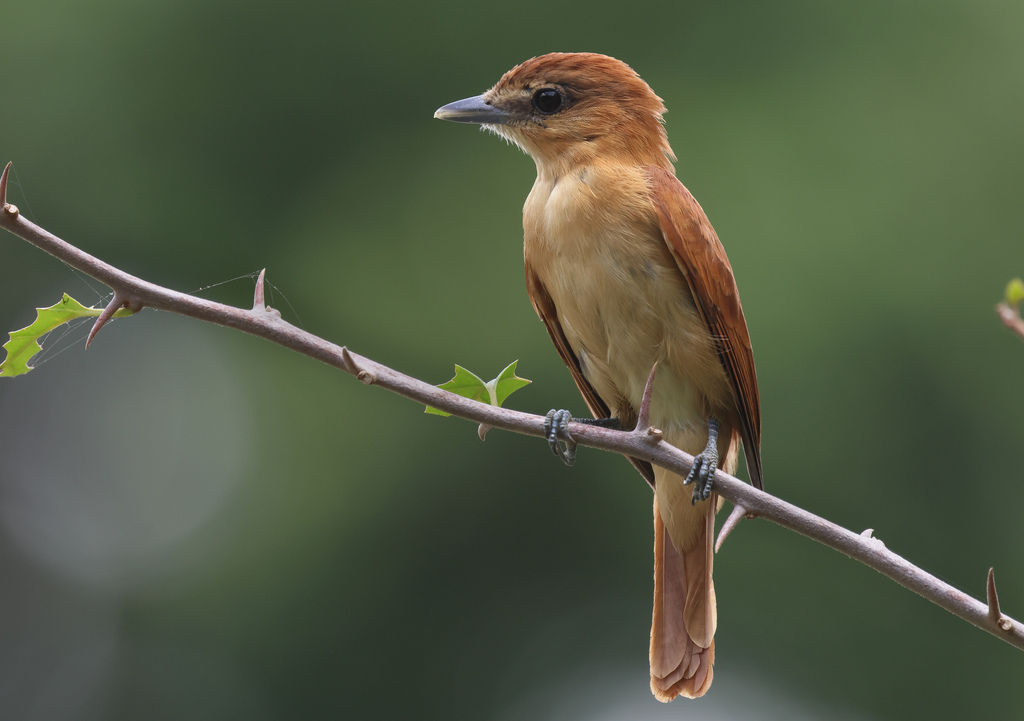
The cinnamon becard is 14 to 15 cm (5.5 to 5.9 in) long and weighs 17 to 22 g (0.60 to 0.78 oz). The sexes have the same plumage. Adults of the nominate subspecies P. c. cinnamomeus have a deep rufous crown, dusky lores, a pale buff line above the lores, and ochraceous tawny cheeks. Their upperparts are mostly rufous or chestnut-rufous to rufous-tawny. Their wings are rufous that is darker and duskier on the primary coverts. Their tail is rufous. Their underparts are ochraceous tawny to cinnamon-buff or to tawny-buff that is paler on the throat and belly and has a rufous tinge across the breast. Subspecies P. c. fulvidior is more richly colored than the nominate. P. c. magdalenae has underparts that are more whitish than the nominate's and with a cinnamon wash. P. c. badius is similar to magdaleneae but slightly darker. All subspecies have a dark iris, a blackish bill with often a paler grayish mandible, and dark gray legs and feet.
Range & habitat
The subspecies of the cinnamon becard are found thus:
P. c. fulvidior: from southeastern Veracruz and northeastern Oaxaca in southeastern Mexico south through central and southern Belize, northern Guatemala, and the Caribbean slopes of Honduras, Nicaragua, and Costa Rica into western Panama; on the Pacific slope from Costa Rica's Puntarenas Province south into western Panama P. c. cinnamomeus: from Darién Province in eastern Panama south into northwestern Colombia; south in Colombia's Eastern Andes regularly to Meta Department and at least occasionally further south; south through western Colombia and through western Ecuador almost to Peru. P. c. magdalenae: northern Colombia's Magdalena River valley and from northern Sucre Department east into western Venezuela's Zulia, Táchira, and Mérida states P. c. badius: western Venezuela on the east slope of the Andes in Táchira The cinnamon becard inhabits the interior and edges of evergreen forest and secondary forest in the tropical and lower subtropical zones. It also occurs in somewhat open woodlands, riparian areas, clearings with tall trees, and coastally in mangroves. In elevation it ranges overall from sea level mostly to 1,200 m (3,900 ft). It reaches 500 m (1,600 ft) in northern Central America, 900 m (3,000 ft) in Costa Rica, 1,300 m (4,300 ft) in Colombia, 800 m (2,600 ft) in Ecuador, and 1,200 m (3,900 ft) in Venezuela.
Wikipedia: “Distribution and habitat”
What it does
The cinnamon becard feeds on a variety of insects, other arthropods, and berries. It usually forages singly or in pairs though sometimes in small groups; it occasionally joins mixed-species feeding flocks. It perches from the forest's mid-story to its canopy and takes its food by gleaning from vegetation and twigs with a short sally from the perch.
Wikipedia: “Feeding”
Listen
Looking for field recordings…
Where it lives
Recorded sightings
—
geo-referenced records in GBIF, from museums, herbaria and field observers.
Drag the globe to turn it. Dots are where records exist, not a range map; darker means more records.
In the stacks
Searching the stacks…
Every page naming Pachyramphus cinnamomeus in the Biodiversity Heritage Library →
This page is assembled live from iNaturalist, GBIF, Wikipedia, the Source Library and the Internet Archive. It is not yet part of the hand-edited codex. iNaturalist taxon 8690.