On eBird ↗
Red-legged Partridge
Live sightings near you, the range map, bar charts of when it is seen, and Macaulay Library photos and recordings.
Red-legged Partridge
Alectoris rufa
The red-legged partridge (Alectoris rufa) is a gamebird in the pheasant family Phasianidae of the order Galliformes, gallinaceous birds. It is sometimes known as French partridge, to distinguish it from the English or grey partridge. The genus name is from Ancient Greek alektoris a farmyard chicken, and rufa is Latin for red or rufous.
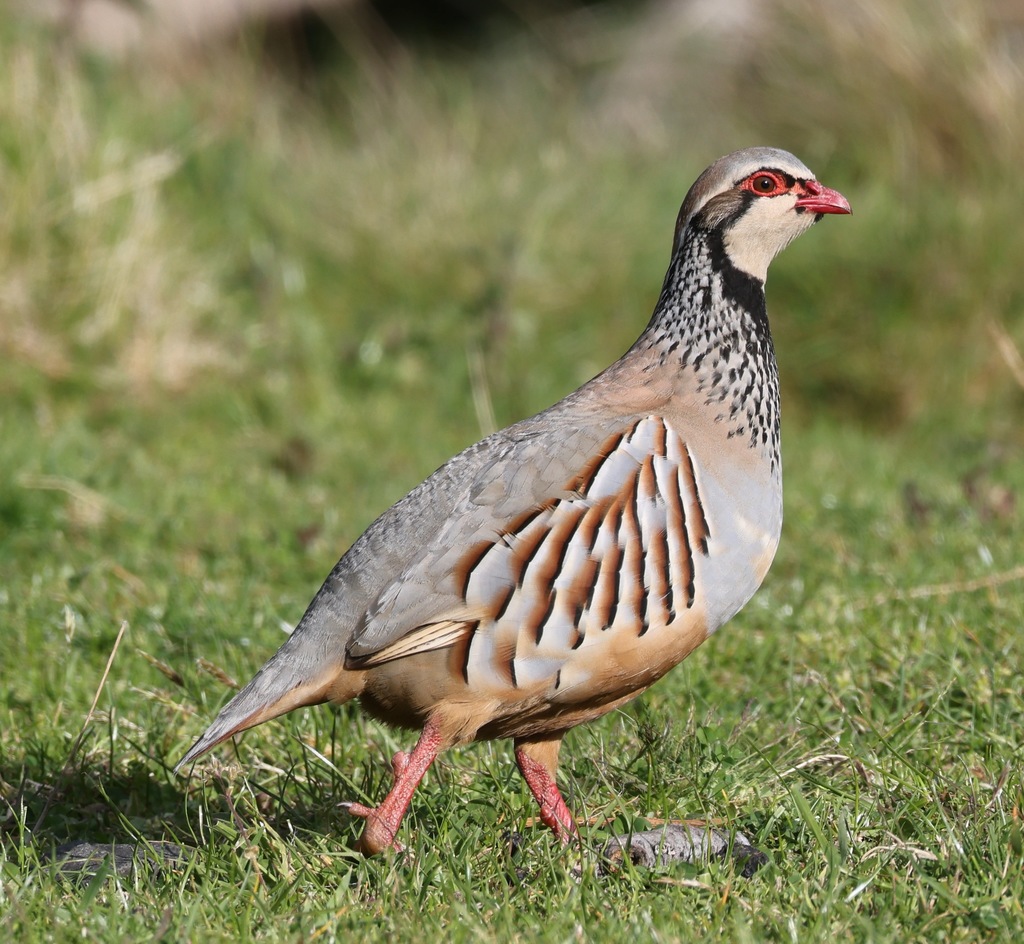
It is a rotund bird, with a light brown back, grey breast and buff belly. The face is white with a black gorget. It has rufous-streaked flanks and red legs. When disturbed, it prefers to run rather than fly, but if necessary it flies a short distance on rounded wings. This is a seed-eating species, but the young in particular take insects as an essential protein supply. The call is a three-syllable ka-chu-chu.
From the article Red-legged partridge on Wikipedia (CC BY-SA), quoted section by section
Description
Adult red-legged partridges are sandy-brown above, pinkish-buff on the belly, and pale grey on the breast, with a prominent gorget of black streaking, bold rufous and black flank-bars, a cream throat, pink legs, and a red bill and eye ring. The crown and upper nape of adult red-legged partridge are a warm pinkish-brown; the fore crown and lateral edges of the crown are pale blue-grey, and the bird has a narrow off-white supercilium running from above the lores to the sides of the lower nape. The lores have a solid bar of black feathering above a patch of pinkish-red skin. This black colouration continues behind the eye, where it broadens, and then extends down around the throat-patch to meet the upper edge of the gorget. There is a patch of pale buff-brown feathering on the ear-coverts, adjoining the black. The eye is surrounded by a bright red eye-ring. The chin and upper throat are creamy-white, and are bordered behind and below by a solid black gorget. The black colour continues down onto the lower throat as a patch of broad triangular black streaks on a pale sandy-grey background. Similar, but narrower, black streaks are present on a pale blue-grey background on the upper neck-sides, while the lower neck-sides are warm pinkish-brown. The breast is pale blue-grey, and the belly pinkish-buff. …
Range & habitat
This partridge breeds naturally in southwestern Europe (France, Iberia and northwest Italy). It has become naturalised in flat areas of England and Wales, where it was introduced as a game species, and has been seen breeding as far north as Sutherland. It is replaced in southeastern Europe by the very similar rock partridge (Alectoris graeca). It is a non-migratory terrestrial species, which forms flocks outside the breeding season. This species breeds on dry lowlands, such as farmland and open stony areas, laying its eggs in a ground nest. They have been known to cohabit with wild rabbits.
Wikipedia: “Distribution and habitat”
Listen
Looking for field recordings…
Where it lives
Recorded sightings
—
geo-referenced records in GBIF, from museums, herbaria and field observers.
Drag the globe to turn it. Dots are where records exist, not a range map; darker means more records.
In the stacks
Searching the stacks…
Every page naming Alectoris rufa in the Biodiversity Heritage Library →
This page is assembled live from iNaturalist, GBIF, Wikipedia, the Source Library and the Internet Archive. It is not yet part of the hand-edited codex. iNaturalist taxon 867.