On eBird ↗
Ethiopian Bushcrow
Live sightings near you, the range map, bar charts of when it is seen, and Macaulay Library photos and recordings.
Ethiopian Bushcrow
Zavattariornis stresemanni
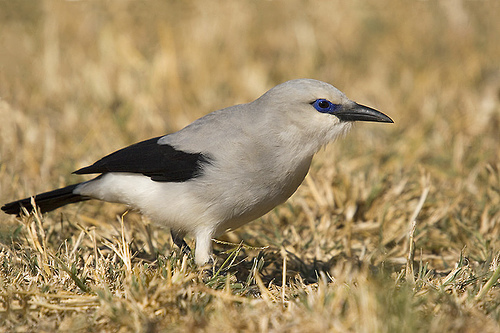
The Ethiopian bushcrow (Zavattariornis stresemanni), also known as the Stresemann's bushcrow, Abyssinian pie, bush crow, or by its generic name Zavattariornis, is a rather starling-like bird, which is a member of the crow family, Corvidae. It is slightly larger than the North American blue jay and is a bluish-grey in overall colour which becomes almost white on the forehead. The throat and chest are creamy-white with the tail and wings a glossy black. The black feathers have a tendency to bleach to brown at their tips. The iris of the bird is brown and the eye is surrounded by a band of naked bright blue skin. The bill, legs, and feet are black.
Feeding is usually in small groups and the bird takes mainly insects. Breeding usually starts in March, with the birds building their nest high in an acacia tree. The birds usually lay five to six cream eggs with lilac blotches. The nest itself is globular in shape with a tubular entrance on top. It is possible that more than just the breeding pair visit the nest and that the young of previous years help in rearing the young.
From the article Ethiopian bushcrow on Wikipedia (CC BY-SA), quoted section by section
Description
The Ethiopian bushcrow is about 28 centimetres (11 in) long and weighs 130 grams (4.6 oz). The sexes look similar and are not sexually dimorphic. Overall it is pale grey with a black tail and wings. The head, mantle, scapulars, back, rump, and uppertail coverts are all a pale grey. The feathers on the forehead, upper ear-coverts, and throat fade into white. The bright azure skin around the bushcrow's eye is featherless and can be inflated, narrowing the blackish-brown eye into a slit. The feathers behind the eye are capable of moving to reveal an oblong pink patch of skin. The bird's black beak decurves into a sharply pointed tip and is relatively small for a corvid. This beak is 33 to 39 millimetres (1.3 to 1.5 in) long. The feathers on the bird's chin are fine and can form a small tuft when erected. The bushcrow's breast and flanks are pale grey, fading into white on the rear flanks, belly, and undertail. On the wings, the lesser and median upper-wing coverts are grey, while the rest of the wing is a slightly glossy blue-black. Its blue-black tail is relatively long and square-ended. Its legs are black. When the plumage becomes worn, the upperparts appear to have a brownish tinge. The juvenile Ethiopian bushcrow is slightly duller than the adult, and the feathers of the body and upperwings are fringed with creamy-fawn. …
Range & habitat
This species is endemic to central-southern Ethiopia. It lives in a small area circumscribed by the towns of Yabelo, Borena, Mega, and Arero in Sidamo Province, and settles in wildlife under protection within Yabelo Wildlife Sanctuary and Borana National Park. Its total range covers about 2,400 square kilometres (930 sq mi). The Ethiopian bushcrow lives in flat savanna covered with mature acacia and Commiphora thornbushes. The bird prefers open short-grass savannas with scattered stands of these mature thornbushes. The soil must be deep and rich to support the bushcrow. It is most numerous when these stands are next to agricultural fields. For many years it was unknown why the species could be completely absent from areas of suitable habitat near seemingly identical but inhabited land. However recent research has revealed that the bird appears to inhabit an area with a very precise average temperature extreme, all of the seemingly suitable but uninhabited surrounding lands actually have a slightly higher average temperature that appears to prevent the birds from successfully colonizing. It is also not found near the scattered broadleaf woodland made up of Combretum and Terminalia. Its habitat is between 1,300 and 1,800 metres (4,300 and 5,900 ft) above sea level.
Wikipedia: “Distribution and habitat”
What it does
The Ethiopian bushcrow is normally found in groups of about six birds. This species does not migrate.
Diet. The bushcrow feeds both on the ground and in trees. It begins foraging at sunrise. While foraging, a bushcrow can be alone, in a pair, or in a group of six or seven other bushcrows. A foraging bushcrow digs vigorously in the soil while its beak is held slightly open to catch any insects it unearths. When it catches something, it carries it to the nearest tree or bush, pins it down with its foot, and kills and eats the prey. This species has also been seen using its beak to tear apart rotten wood and inspecting cattle dung in the search for food. It may also land on the backs of cattle to search for parasites. It can also chase flying insects, which it does on foot, abruptly changing direction and taking flying leaps after its prey. It often mixes with white-crowned starlings, red-billed hornbills, red-billed buffalo weavers, and superb starlings while foraging. When hunting in the trees, it is capable of walking atop horizontal branches and jumping upwards towards the crown, then descending in a glide from the crown to the ground. It eats primarily invertebrates and specifically insects, including termites. Larvae and pupae, especially of Coeloptera moths, are eaten as well as the adults.
Reproduction. …
Wikipedia: “Ecology and behaviour”
Listen
Looking for field recordings…
Where it lives
Recorded sightings
—
geo-referenced records in GBIF, from museums, herbaria and field observers.
Drag the globe to turn it. Dots are where records exist, not a range map; darker means more records.
In the stacks
Searching the stacks…
Every page naming Zavattariornis stresemanni in the Biodiversity Heritage Library →
This page is assembled live from iNaturalist, GBIF, Wikipedia, the Source Library and the Internet Archive. It is not yet part of the hand-edited codex. iNaturalist taxon 8638.