On eBird ↗
King-of-Saxony Bird-of-Paradise
Live sightings near you, the range map, bar charts of when it is seen, and Macaulay Library photos and recordings.
King-of-Saxony Bird-of-Paradise
Pteridophora alberti
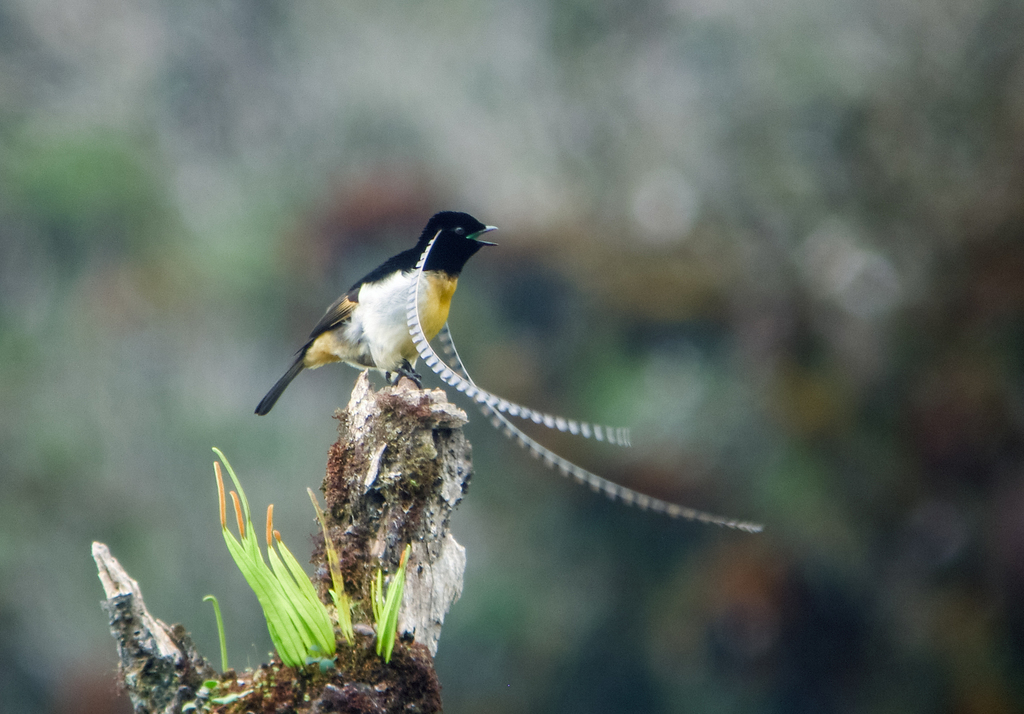
The King of Saxony bird-of-paradise (Pteridophora alberti) is a bird in the bird-of-paradise family (Paradisaeidae). It is the only member in the monotypic genus Pteridophora. It is endemic to montane forest in New Guinea.
From the article King of Saxony bird-of-paradise on Wikipedia (CC BY-SA), quoted section by section
Description
The adult King of Saxony bird-of-paradise is approximately 22 cm long. The male is black and yellow with a dark brown iris, brownish-grey legs, a black bill with a bright aqua-green gape, and two remarkably long (up to 50 cm) scalloped, enamel-blue brow-plumes that can be independently erected at the bird's will. The unadorned female is greyish brown with barred underparts. The male's ornamental head plumes are so bizarre that, when the first specimen was brought to Europe, it was thought to be a fake.
Range & habitat
The King of Saxony bird-of-paradise inhabits the montane forests of New Guinea, and is distributed from the Weyland Mountains in Western New Guinea to the Kratke Range and Mount Giluwe in Papua New Guinea between 1,300–2,850 meters above mean sea level, but usually between 1,800–2,500 meters above sea level. Moulted head-plumes in good condition are sought by male Archbold's bowerbirds for use as decorations, and in turn collected from the courtship bowers by humans. Males are also hunted for their highly prized long plumes used by natives for ceremonial decoration, but despite this the species remains fairly common in parts of its range. It is considered to be of least concern on the IUCN Red List of Threatened Species. It is listed on Appendix II of CITES.
Wikipedia: “Distribution”
What it does
Adult males are territorial. The male guards its territory from perches placed in the tops of tall trees, and from these perches sings to compete with males in neighbouring territories. While singing, the male moves his occipital plumes about. In 1996 David Attenborough filmed the first ever footage of the mating ritual of the bird. The diet consists mainly of fruits, berries and arthropods.
Courtship. The King of Saxony Bird of Paradise's mating courtship behavior consists of a combination of vocalizations and physical maneuvers, enhanced by its magnificent and unique plumage. The King of Saxony's occipital feathers or "head wires" Archived 2018-04-25 at the Wayback Machine are one of a kind as they no longer possess their regular feather structure, but instead are eye-catching ornaments that possess no functionality. These feathers can be twice as long as the body of the male King of Saxony, and have evolved as the result of female selection, in which females select males based upon indirect genetic benefits which increase offspring fitness. This process occurs due to male's lack of participation in the process of raising offspring, forcing females to assess male fitness through courtship rituals, details of which are below.
Song and dance. The male King of Saxony will perch on the forest canopy in exploded leks and sing to attract females. …
Wikipedia: “Behaviour”
Listen
Looking for field recordings…
Where it lives
Recorded sightings
—
geo-referenced records in GBIF, from museums, herbaria and field observers.
Drag the globe to turn it. Dots are where records exist, not a range map; darker means more records.
In the stacks
Searching the stacks…
Every page naming Pteridophora alberti in the Biodiversity Heritage Library →
This page is assembled live from iNaturalist, GBIF, Wikipedia, the Source Library and the Internet Archive. It is not yet part of the hand-edited codex. iNaturalist taxon 8636.