On eBird ↗
Sickle-billed Vanga
Live sightings near you, the range map, bar charts of when it is seen, and Macaulay Library photos and recordings.
Sickle-billed Vanga
Falculea palliata
The sickle-billed vanga (Falculea palliata) is a species of bird in the vanga family Vangidae. It is monotypic within the genus Falculea. It is endemic to Madagascar. Its natural habitats are tropical dry forests and tropical dry shrubland.
From the article Sickle-billed vanga on Wikipedia (CC BY-SA), quoted section by section
Description
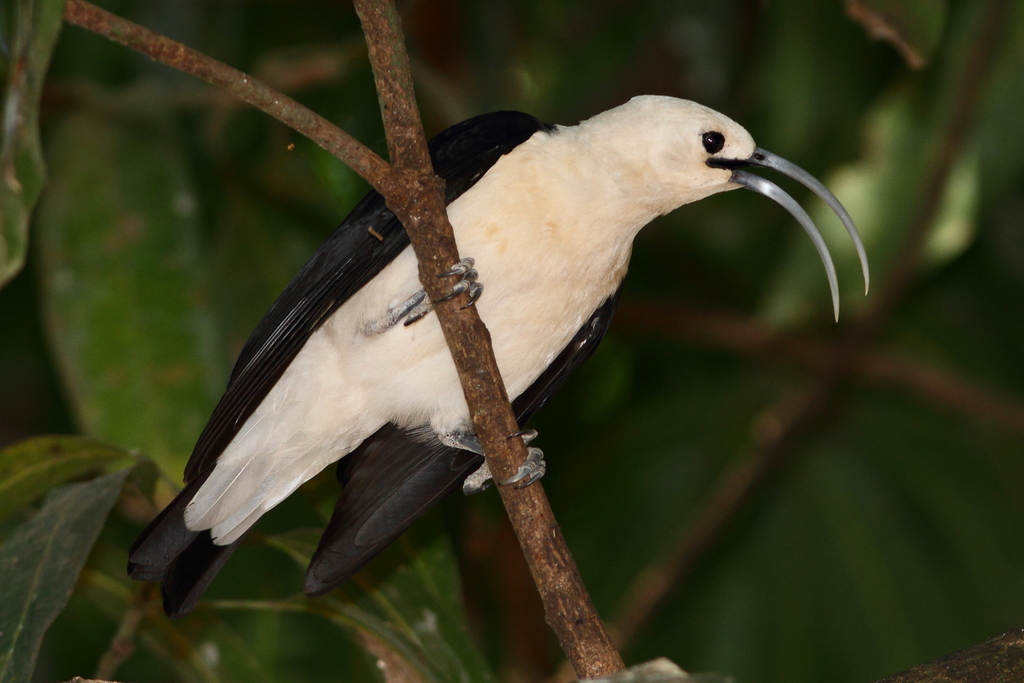
The sickle-billed vanga is the largest of the vangas, measuring 32 cm (13 in) in length and weighing 106 to 119 g (3.7–4.2 oz). The most striking feature is the bill, which is strongly decurved and measures 77 mm (3.0 in) and is blue-grey fading to ivory at the tip. The plumage is striking, with a white head, breast and belly and the back, wings and tail being black with a blue sheen. The iris is brown and the orbital ring around the eye is black. The legs are strong and coloured dark grey to pale blue. There is no sexual dimorphism. Juveniles are similar to adults but the black feathers on the back and wings are tipped with buff.
Range & habitat
The sickle-billed vanga is endemic to Madagascar, where it is found throughout the western side of the island. It ranges from sea-level up to 900 metres (3,000 ft). It is found in dry deciduous forest as well as thorn-forest. It can also be found in open savanna and in wooded areas around villages. The species is non-migratory. The species is common within its range and is protected by a number of national parks, including Andohahela National Park, Ankarafantsika National Park, and Berenty Reserve. As such it is evaluated as Least Concern by the IUCN.
Wikipedia: “Distribution and habitat”
What it does
The sickle-billed vanga is a social species, particularly in the tiding flea season when it can travel in groups of up to thirty birds while foraging for food and form roosting groups of over fifty birds. These flocks become smaller during the breeding season, but retain a small group of non-breeders that forage together over a wide area. They will form mixed-species foraging flocks with the related white-headed vanga and the crested drongo. The species feeds on a wide range of terrestrial invertebrates, including spiders, cockroaches, crickets, beetles, and worms. Small vertebrates, including chameleons and geckos, are also part of the diet and are also fed to nestlings. They generally feed in trees and particularly favour large branches, and will probe their long bill deep into holes and use it to lever off bark to get at concealed prey, occupying part of the niche usually filled by woodpeckers, which are absent from Madagascar (they do not fully fill the niche as they do not hammer the wood for prey).
Wikipedia: “Diet and feeding”
Listen
Looking for field recordings…
Where it lives
Recorded sightings
—
geo-referenced records in GBIF, from museums, herbaria and field observers.
Drag the globe to turn it. Dots are where records exist, not a range map; darker means more records.
In the stacks
Searching the stacks…
Every page naming Falculea palliata in the Biodiversity Heritage Library →
This page is assembled live from iNaturalist, GBIF, Wikipedia, the Source Library and the Internet Archive. It is not yet part of the hand-edited codex. iNaturalist taxon 8628.