On eBird ↗
Rarotonga Monarch
Live sightings near you, the range map, bar charts of when it is seen, and Macaulay Library photos and recordings.
Rarotonga Monarch
Pomarea dimidiata
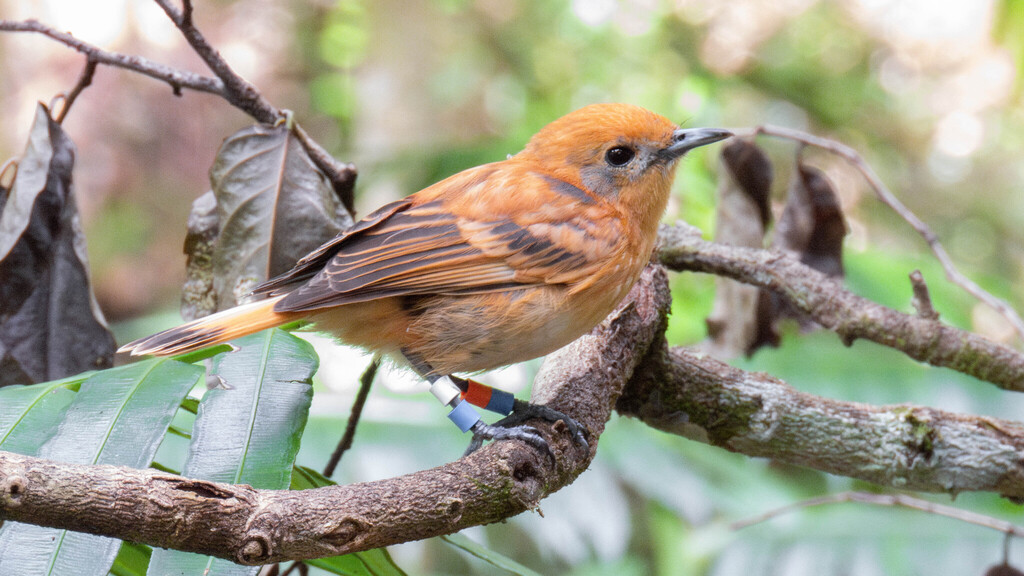
The Rarotonga monarch (Pomarea dimidiata), also known as the Rarotonga flycatcher or kākerōri, is a species of bird in the monarch flycatcher family Monarchidae. It is endemic to Rarotonga in the Cook Islands, and has been introduced to Atiu, also in the Cook Islands.
From the article Rarotonga monarch on Wikipedia (CC BY-SA), quoted section by section
Description
The Rarotonga monarch is an insectivorous passerine which is 10 cm tall, with an adult mass of 20 grams (0.7 oz) for female birds, and 25 grams (0.9 oz) for large male birds. Hunting mainly consists of foraging for insects within foliage, and occasionally taking insects during flight.
The Rarotonga monarch is unusual as its plumage and beak undergoes a sequential colour change as the bird matures. The initial plumage of orange changes to orange-grey mixed, then finally grey when maturity is reached, after four years. Initially, the grey and orange birds were attributed to different species. Later, it was thought that grey plumage birds were male, while the orange birds were females or juveniles of the same species, but this was corrected to being age-based plumage in 1983. Another bird in the Pomarea genus, the Fatu Hiva monarch, also undergoes a sequential colour change as it ages.
What it does
Owing to its tropical oceanic island location, the Rarotonga monarch is exceptionally long-lived, with an adult survival of between 85 and 89 percent, a life expectancy of seven to nine years, and a maximum known lifespan of around 24 years and 8 months. These figures are comparable to large Australian passerines like the superb lyrebird or satin bowerbird and more than ten times the life expectancies of similar sized Holarctic songbirds.
Breeding. The extraordinary longevity of these birds may explain the evolution of helpers at the nest, a feature otherwise completely absent from the Monarchidae family. Males can breed at one year, but do not do so in practice until they are four years old. Breeding season is between October and February, but most eggs are laid between October and early November. Nests are mossy deep cups which are built in the fork of a tree branch, often constructed above creeks, and take about 7 days to build. Incubation last 13–14 days. Clutches are 1–2 eggs. In Rarotonga, many nest failures are attributed to predation by black rats or kiore, as birds sit on the nest.
Threats. …
Wikipedia: “Behaviour and ecology”
Listen
Looking for field recordings…
Where it lives
Recorded sightings
—
geo-referenced records in GBIF, from museums, herbaria and field observers.
Drag the globe to turn it. Dots are where records exist, not a range map; darker means more records.
In the stacks
Searching the stacks…
Every page naming Pomarea dimidiata in the Biodiversity Heritage Library →
This page is assembled live from iNaturalist, GBIF, Wikipedia, the Source Library and the Internet Archive. It is not yet part of the hand-edited codex. iNaturalist taxon 8587.