On eBird ↗
Magpie-lark
Live sightings near you, the range map, bar charts of when it is seen, and Macaulay Library photos and recordings.
Magpie-lark
Grallina cyanoleuca
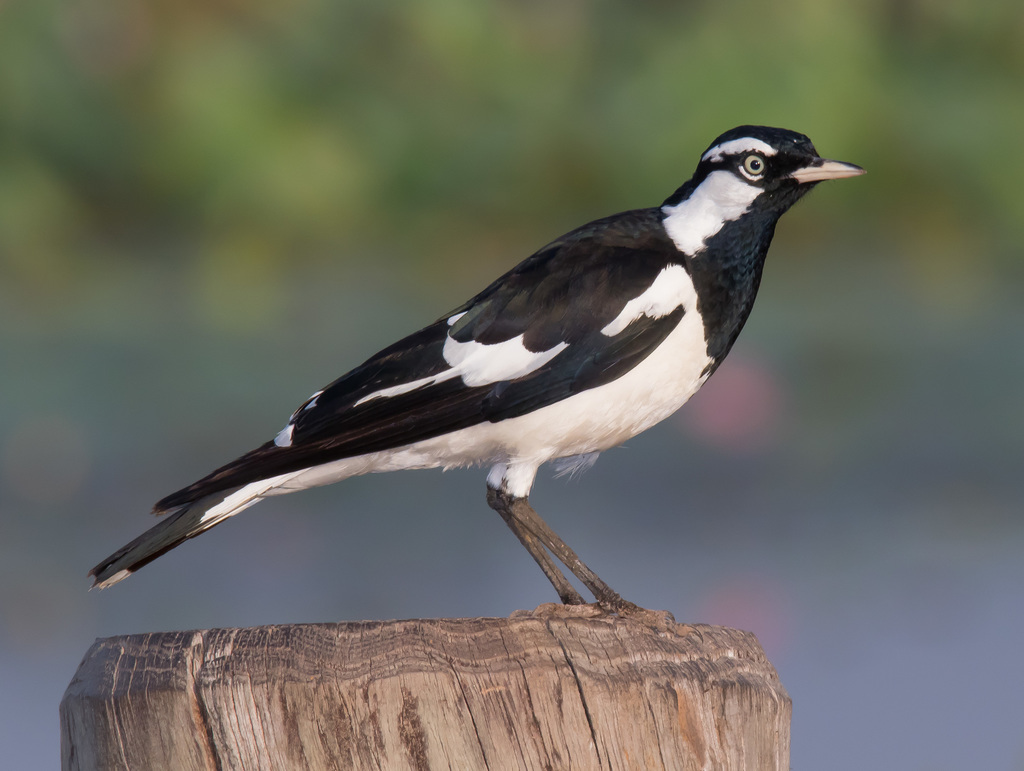
The magpie-lark (Grallina cyanoleuca), also known as wee magpie, peewee, peewit, mudlark or Murray magpie, is a passerine bird native to Australia, Timor, and southern New Guinea. The male and female both have black and white plumage, though with different patterns. John Latham described the species in 1801. Long thought to be a member of the mudnest builder family Corcoracidae, it has been reclassified in the family Monarchidae (the monarch flycatchers). Two subspecies are recognized.
From the article Magpie-lark on Wikipedia (CC BY-SA), quoted section by section
Description
The magpie-lark is a small to medium size bird, reaching 25 to 30 cm (9.8 to 11.8 in) long when fully grown, or about the same size as a European common blackbird, and boldly pied in black and white; the weight range is 63.9 to 118 g (2.25 to 4.16 oz) for males, and 70 to 94.5 g (2.47 to 3.33 oz) for females. The sexes are similar from a distance but easy to tell apart: the female has a white throat, the male a black throat and a white "eyebrow". Juveniles and immatures of either sex have the white throat of the female and the black eyestripe of the male, and a white belly.
Range & habitat
The magpie-lark is a common and very widespread bird both in urban and rural areas, occupying all parts of Australia except for Tasmania and some of the inland desert in the far north-west of Western Australia, and appears to have adapted well to the presence of humans. It is also found in southern New Guinea and on the island of Timor. In 1924 it was introduced onto Lord Howe Island which lies 600 km (370 mi) to the east of Australia in the Tasman Sea. It is now widespread on the island. The magpie-lark is a familiar sight around Australia; sitting on telephone wires either alone or in pairs, or patrolling patches of bare ground, especially foreshores or swamps. It has been recorded as a vagrant to New Zealand once.
Wikipedia: “Distribution and habitat”
What it does
A primarily carnivorous species that eats all sorts of small creatures, the magpie-lark can adapt to a wide range of different habitats, requiring only some soft, bare ground for foraging, a supply of mud for making a nest, and a tree to make it in. It has benefited from agriculture: both the clearing of dense forest in fertile zones and the provision of artesian water in arid areas (although a disaster for other species) have been a boon for bare-ground and short-grass feeders like magpies and magpie-larks. Group gatherings of magpie-larks have been observed, with loose "flocks" comprising dozens of individuals being observed perched on vantage points. They sit near houses and on fences to mark their territory and look for mates. This behaviour can be frustrating to residents in suburban areas because of their high pitched shrieks. Such behaviour is common, particularly in rural and suburban environments. This behaviour may be pairing or breeding related or simply indicate a bountiful feeding area.
The magpie-lark is aggressively territorial, and will fearlessly defend its territory against larger species such as magpies, ravens, kookaburras, and even the wedge-tailed eagle. They are also known to attack people to defend their nesting area. …
Wikipedia: “Behaviour and ecology”
Listen
Looking for field recordings…
Where it lives
Recorded sightings
—
geo-referenced records in GBIF, from museums, herbaria and field observers.
Drag the globe to turn it. Dots are where records exist, not a range map; darker means more records.
In the stacks
Searching the stacks…
Every page naming Grallina cyanoleuca in the Biodiversity Heritage Library →
This page is assembled live from iNaturalist, GBIF, Wikipedia, the Source Library and the Internet Archive. It is not yet part of the hand-edited codex. iNaturalist taxon 8583.