On eBird ↗
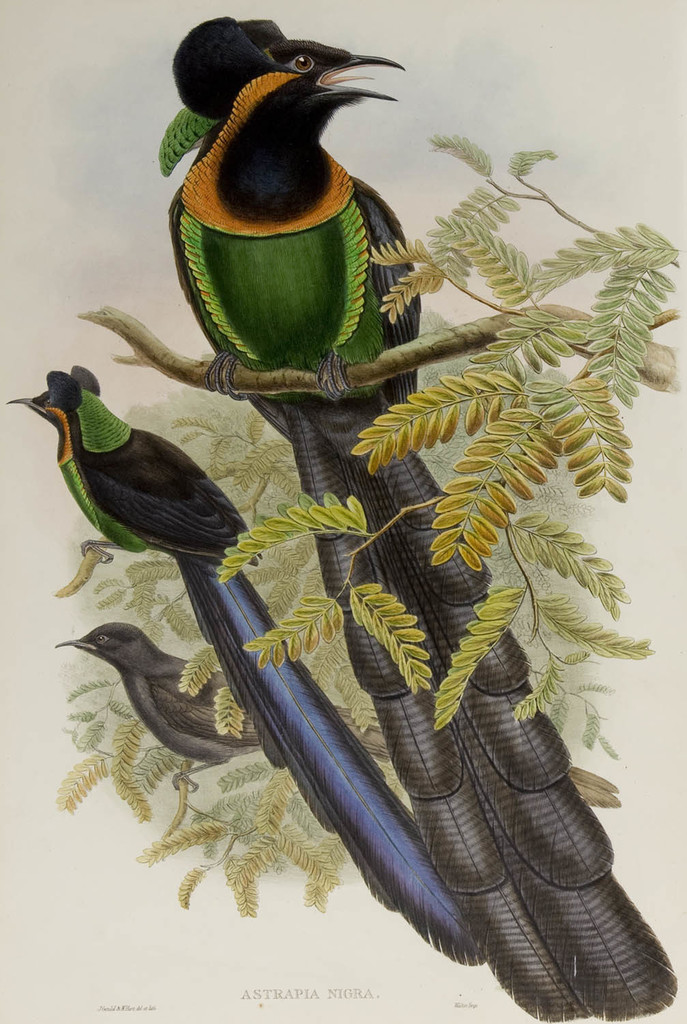
Arfak Astrapia
Live sightings near you, the range map, bar charts of when it is seen, and Macaulay Library photos and recordings.
Arfak Astrapia
Astrapia nigra
The Arfak astrapia (Astrapia nigra) is a species of astrapia, a group of birds found in the birds-of-paradise family Paradiseidae.
From the article Arfak astrapia on Wikipedia (CC BY-SA), quoted section by section
Description
The Arfak astrapia is the third largest of its genus, being approximately 76 cm (30 in) long, including the tail. The male has a black head with a bluish-purple sheen, or iridescence, an elongated jet-black nape crests extending up along the sides of the up to the eyes on each side, a shiny, metallic greenish-yellow cape from the mantle up to the nape, very black, dense and elongated upper breast feathers, and an almost exaggeratedly long tail almost two times the length of its body. The female is less appealing, being dark brown over most of its body and a blackish head, and sporting much shorter tail feathers. The female is also exceptionally shorter than the male. Levaillant of France described this bird as L'Incomparable or Incomparable bird-of-paradise.
Range & habitat
Astrapia nigra is endemic to the Arfak Mountains in Vogelkop Peninsula, West Papua.
Wikipedia: “Distribution”
What it does
The habits of the Arfak astrapia are very little known. The birds are found mostly in cloud forests at 1,700 to 2,250 m (5,580 to 7,380 ft) at the apex of the Arfak Mountains. Foraging habits observed include the birds probing fruits, mostly pandanus fruits, off of moss and epiphytes in the montane canopy. Arthropods also recorded in the diet. Breeding habits mostly unknown; female definitely builds the nests and tend the chicks, as with most other birds-of-paradise, though the exact rearing period is unknown. All that is known about the courtship display is that the males display on a branch upside-down with their nape crests spread out, dense breast feathers flared up, and tail standing vertically upwards above the branch. No other information.
Wikipedia: “Behaviour and ecology”
Listen
Looking for field recordings…
Where it lives
Recorded sightings
—
geo-referenced records in GBIF, from museums, herbaria and field observers.
Drag the globe to turn it. Dots are where records exist, not a range map; darker means more records.
In the stacks
Searching the stacks…
Every page naming Astrapia nigra in the Biodiversity Heritage Library →
This page is assembled live from iNaturalist, GBIF, Wikipedia, the Source Library and the Internet Archive. It is not yet part of the hand-edited codex. iNaturalist taxon 8554.