On eBird ↗
Ribbon-tailed Astrapia
Live sightings near you, the range map, bar charts of when it is seen, and Macaulay Library photos and recordings.
Ribbon-tailed Astrapia
Astrapia mayeri
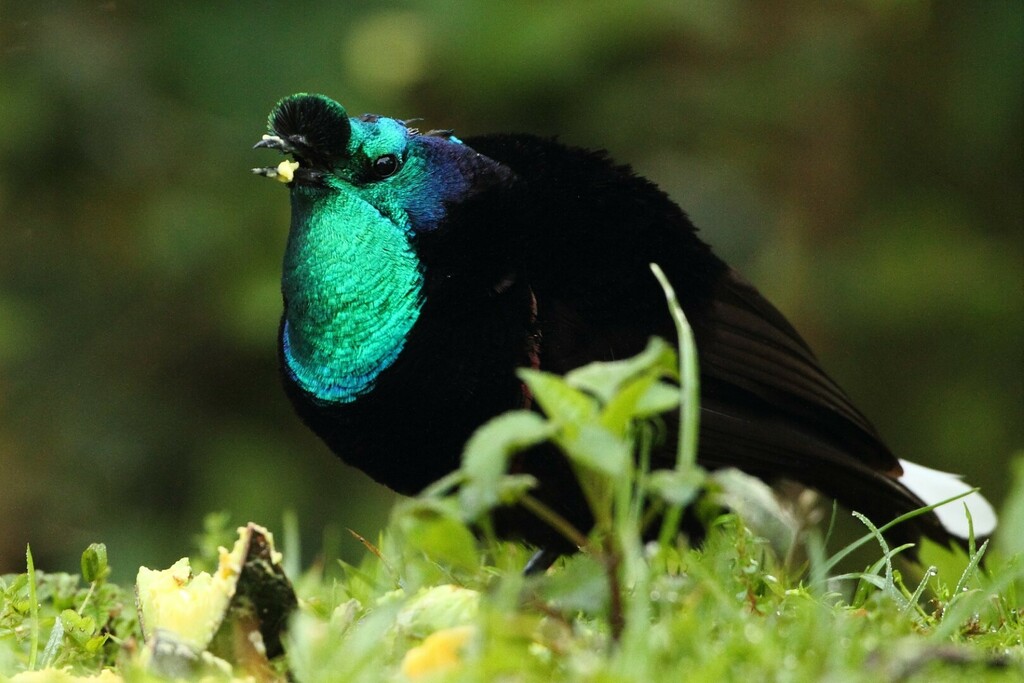
The ribbon-tailed astrapia, also known as Shaw Mayer's astrapia (Astrapia mayeri), is a species of bird-of-paradise.
The ribbon-tailed astrapia is distributed and endemic to subalpine forests in western part of the central highlands of Papua New Guinea. Like many other ornamental birds-of-paradise, the male is polygamous. The ribbon-tailed astrapia is the most recently discovered bird-of-paradise.
From the article Ribbon-tailed astrapia on Wikipedia (CC BY-SA), quoted section by section
Description
The ribbon-tailed astrapia is medium-sized, up to 32 cm long (without including the tail of the male, which can be over 1 metre). Male ribbon-tailed astrapia are generally around 125 cm whereas females are around 35 cm. The body of males are velvet black. The male has an iridescent olive green and bronze plumage, and is adorned with ornamental "ball" plume above its bill and two extremely long, ribbon-like white tail feathers. The female has a much duller brown and black body with an iridescent head. Unlike males, females do not have the long white tails. Hybrids between this species and the Princess Stephanie's astrapia, in the small area where their ranges overlap, have been named Barnes's astrapia. One of the most spectacular birds-of-paradise, the male ribbon-tailed astrapia has the longest tail feathers in relation to body size of any bird, over three times the length of its body.
Listen
Looking for field recordings…
Where it lives
Recorded sightings
—
geo-referenced records in GBIF, from museums, herbaria and field observers.
Drag the globe to turn it. Dots are where records exist, not a range map; darker means more records.
In the stacks
Searching the stacks…
Every page naming Astrapia mayeri in the Biodiversity Heritage Library →
This page is assembled live from iNaturalist, GBIF, Wikipedia, the Source Library and the Internet Archive. It is not yet part of the hand-edited codex. iNaturalist taxon 8553.