On eBird ↗
Stephanie's Astrapia
Live sightings near you, the range map, bar charts of when it is seen, and Macaulay Library photos and recordings.
Stephanie's Astrapia
Astrapia stephaniae
Stephanie's astrapia (Astrapia stephaniae), also known as Princess Stephanie's astrapia, is a species of bird-of-paradise of the family Paradisaeidae, native to the Bird's Tail Peninsula (Papua New Guinea). This species was first described by Carl Hunstein in 1884.
A common species throughout its range, Princess Stephanie's astrapia is listed as Least Concern on the IUCN Red List of Threatened Species. It is listed on Appendix II of CITES.
From the article Stephanie's astrapia on Wikipedia (CC BY-SA), quoted section by section
Description
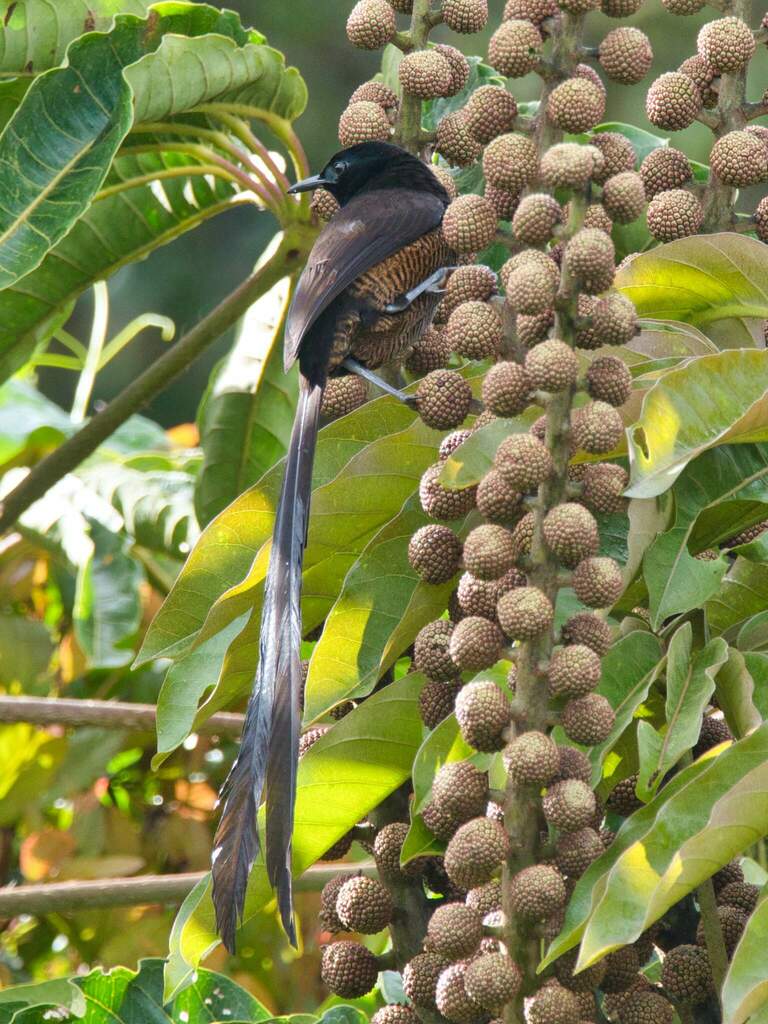
Stephanie's astrapia is a most distinctive bird-of-paradise, and extremely unmistakable to recognize. The males of this species reach around 84 cm (33 inches) in length, and a considerable portion of its length comes from the long, 47 cm (18 inches), glossy, black central tail feathers, which almost compete with the exaggerated, white tail feathers of the male Ribbon-tailed astrapias. The upper head of the male is an iridescent greenish-blue, shading to indigo blue in the back; the chin to the upper breast section is an iridescent aqua to greenish-blue, though the throat area is usually a dark, shaded tint depending on the angle of view. Below the iridescent upper breast section, dense, black feathers lie beneath it, and underneath the dense feathers lies a narrow, iridescent, coppery-red to orange-reddish band. The rest of the underparts are an iridescent, dull coppery-red to black (again, depending on the angle of view). The upperparts, namely the mantle (or back), are a dull light-green, but may appear brownish or black in some views. The upperwing is black, with a conspicuous purple gloss, the underwing is a lighter shade of black. The most distinctive feature, the extremely exaggerated central tail plumes, are wholly black with a purple gloss, and white rachides. The feet are grey-blackish, the bill is blackish, the mouth is pale green, and the eyes are dark brown. …
What it does
Stephanie's astrapia, like a majority of its relatives, are shown to be predominantly frugivorous, particularly favoring members of the genus Heptapleurum. Animal prey takes up the other portion of the diet. Recorded prey includes frogs, insects, spiders, and some skink species. The birds typically feed alone, occasionally associating with other Paradisaeids, like the Brown sicklebill, and other bird species.
Wikipedia: “Feeding”
In human culture
The scientific name of Stephanie's astrapia is Astrapia stephaniae. Its genus name, Astrapia, means "flash of lightning", referring to the brilliant iridescent plumage present in some form on all astapias. Its specific name, stephaniae, honors Princess Stephanie of Belgium, the wife of Crown Prince Rudolf of Austria, who also was honored in the Blue bird-of-paradise's scientific name, rudolphi. Upon discovery, its former genus name was Astarchia, meaning "Queen of Stars" (a nickname for the moon) or "Star chief".
Wikipedia: “Etymology”
Listen
Looking for field recordings…
Where it lives
Recorded sightings
—
geo-referenced records in GBIF, from museums, herbaria and field observers.
Drag the globe to turn it. Dots are where records exist, not a range map; darker means more records.
In the stacks
Searching the stacks…
Every page naming Astrapia stephaniae in the Biodiversity Heritage Library →
This page is assembled live from iNaturalist, GBIF, Wikipedia, the Source Library and the Internet Archive. It is not yet part of the hand-edited codex. iNaturalist taxon 8551.