- Animals
- ›Chordates
- ›Vertebrates
- ›Mammals
- ›Therians
- ›Placental Mammals
- ›Ungulates, Carnivorans, and Allies
- ›Carnivorans
- ›Canids
- ›Canis
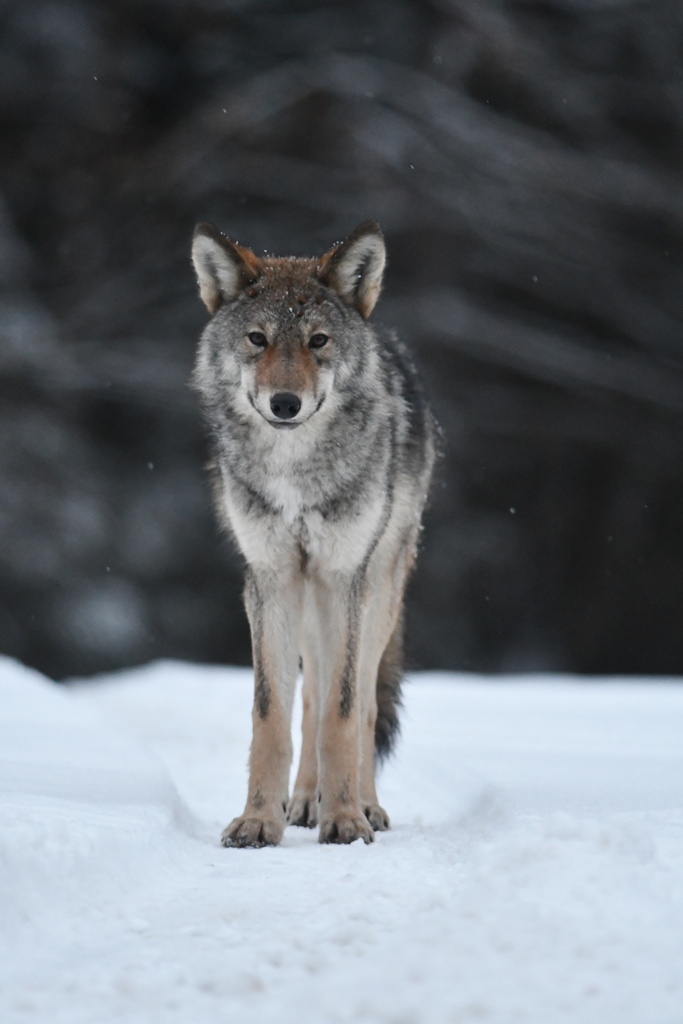
Eastern Wolf
Canis lycaon
The eastern wolf (Canis lycaon or Canis lupus lycaon), also known as the timber wolf, Algonquin wolf and eastern timber wolf, is a canine of debated taxonomy native to the Great Lakes region and southeastern Canada. It is considered either a unique subspecies of gray wolf, or red wolf, or a separate species from both. Many studies have found the eastern wolf to be the product of ancient and recent genetic admixture between the gray wolf and the coyote, while other studies have found some or all populations of the eastern wolf, as well as coyotes, originally separated from a common ancestor with the wolf over 1 million years ago and that these populations of the eastern wolf may be the same species as or a closely related species to the red wolf (Canis lupus rufus or Canis rufus) of the Southeastern United States. Regardless of its status, it is regarded as unique and therefore worthy of conservation with Canada citing the population in eastern Canada (also known as the "Algonquin wolf") as being the eastern wolf population subject to protection.
There are two forms, the larger being referred to as the Great Lakes-boreal wolf, which is generally found in Minnesota, Wisconsin, the Upper Peninsula of Michigan, southeastern Manitoba and northern Ontario, and the smaller being the Algonquin wolf, which inhabits eastern Canada, specifically central and eastern Ontario and southwestern Quebec, with some overlapping and mixing of the two types in the southern portions of northeastern and northwestern Ontario.
From the article Eastern wolf on Wikipedia (CC BY-SA), quoted section by section
Description
Charles Darwin was told that there were two types of wolf living in the Catskill Mountains, one being a lightly-built, greyhound-like animal that pursued deer, and the other being a bulkier, shorter-legged wolf. The eastern wolf's fur is typically of a grizzled grayish-brown coloration, mixed with cinnamon. The flanks and chest are rufous or creamy, while the nape, shoulder and tail region are a mix of black and gray. Unlike gray wolves, eastern wolves rarely produce melanistic individuals. The first documented all-black eastern wolf was found to have been an eastern wolf–gray wolf hybrid. Like the red wolf, the eastern wolf is intermediate in size between the coyote and gray wolf, with females weighing 23.9 kilograms (53 lb) on average and males 30.3 kilograms (67 lb). Like the gray wolf, its average lifespan is 3–4 years, with a maximum of 15 years. Their physical sizes that sets them intermediate between gray wolves and coyotes are actually believed to be more related to their adaptations to an environment with predominately medium-sized prey (similar to the case with the Mexican wolf in the southwestern US) rather than their close relationship to red wolves and coyotes.
Range & habitat
The past range of the eastern wolf included southern Quebec, most of Ontario, the Great Lakes states, New York State and New England. Today, the Great Lakes wolf is generally found in the northern halves of Minnesota and Wisconsin and Upper Peninsula of Michigan (where it coexists with the Great Plains wolf), southeastern Manitoba and northern Ontario, and the Algonquin wolf inhabits central and eastern Ontario as well as southwestern Quebec north of the St. Lawrence River. Algonquin wolves are particularly concentrated in Algonquin Provincial Park and other nearby protected areas, such as Killarney, Kawartha Highlands and Queen Elizabeth II Wildlands Provincial Parks and recent surveys also reveal small numbers of Algonquin wolves in the southern areas of northeastern Ontario and northwestern Ontario as far west as the Lake of the Woods near the border with Manitoba, where there is some mixing with Great Lakes wolves, and into southcentral Ontario, where there is some mixing with eastern coyotes. There are some reports of eastern wolf sightings and of wolves being shot by hunters in Quebec south of the St. Lawrence River, New Brunswick, New York State, northern Vermont and Maine. …
Wikipedia: “Distribution”
What it does
The eastern wolf primarily targets small to medium-sized prey items like white-tailed deer and beavers, unlike the gray wolf, which can effectively hunt large ungulates like caribou, elk, moose and bison. Despite being carnivores, packs in Voyageurs National Park forage for blueberries in much of July and August, when the berries are in season. Packs carefully avoid each other; only lone wolves sometimes enter other packs' territories. The average territory ranges 118–185 km2 (46–71 sq mi), and the earliest age of dispersal for young eastern wolves is 15 weeks, much earlier than gray wolves.
Wikipedia: “Ecology and behaviour”
In human culture
Mitochondrial DNA indicates that before the arrival of Europeans, eastern wolves may have numbered at 64,500 to 90,200 individuals. In 1942 it was believed that, before European settlement, the wolf had ranged throughout the wooded and open areas of eastern North America from what is now southern Quebec westward to the Great Plains and towards the Southeastern Woodlands (the southern extent was uncertain, but was believed to around what is now Kentucky, Tennessee and North Carolina). The region's indigenous human populations did not fear eastern wolves, though they did occasionally catch them in traps, and their bones occur in native shell heaps. Early European settlers often kept their livestock on eastern wolf-free outer islands, though animals kept in pasture on the mainland were vulnerable, to the point that a campaign against eastern wolves was launched in the early years of the Plymouth and Massachusetts Bay Colonies, in which both settlers and natives participated. A bounty system was put into effect, offering higher rewards for adult wolves, with their heads exposed on hooks in meetinghouses. Nevertheless, wolves were still plentiful enough in New England in the early 18th century to warrant the settlers of Cape Cod discussing the building of a high fence between Sandwich and Wareham to keep them out of grazing lands. …
Wikipedia: “History, hybridization and conservation”
Listen
Looking for field recordings…
Where it lives
Recorded sightings
—
geo-referenced records in GBIF, from museums, herbaria and field observers.
Drag the globe to turn it. Dots are where records exist, not a range map; darker means more records.
In the stacks
Searching the stacks…
Every page naming Canis lycaon in the Biodiversity Heritage Library →
This page is assembled live from iNaturalist, GBIF, Wikipedia, the Source Library and the Internet Archive. It is not yet part of the hand-edited codex. iNaturalist taxon 853952.