- Plants
- ›Vascular Plants
- ›flowering plants
- ›Dicots
- ›Sunflowers, Bellflowers, Fanflowers, and Allies
- ›Sunflowers, Daisies, Asters, and Allies
- ›Asteroideae
- ›bonesets, blazingstars, and allies
- ›Eupatoriinae
- ›Eutrochium
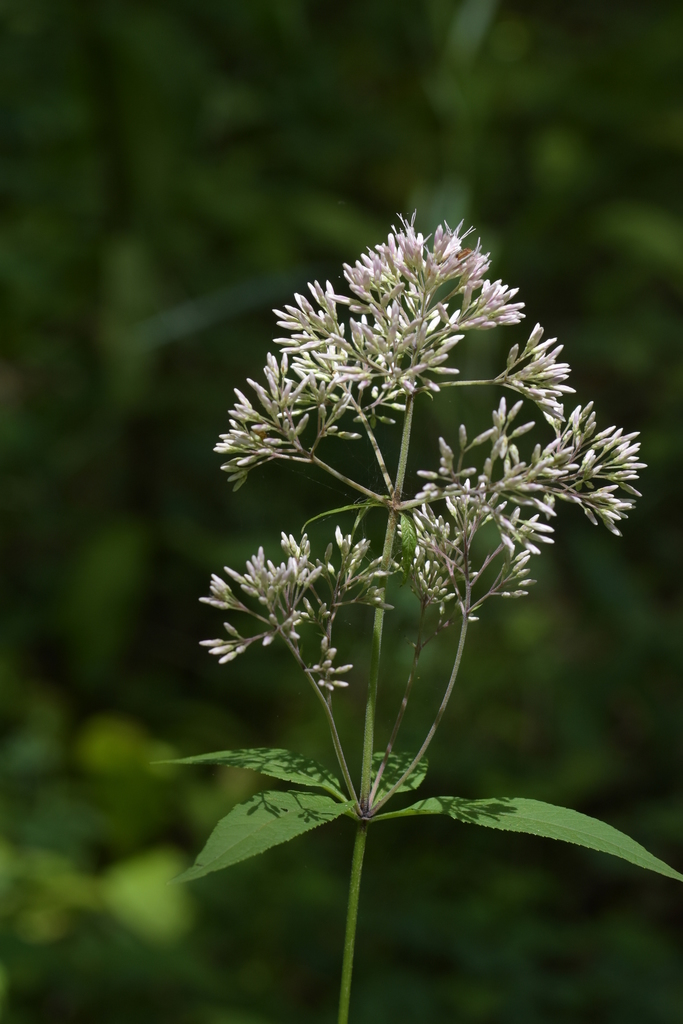
sweet Joe-Pye-weed
Eutrochium purpureum
Eutrochium purpureum, commonly known as sweet Joe Pye weed, sweet-scented Joe Pye weed or purple Joe Pye weed, is an herbaceous perennial plant in the family Asteraceae. It is native to eastern and central North America, from Ontario east to New Hampshire and south as far as Florida, Louisiana, and Oklahoma.
From the article Eutrochium purpureum on Wikipedia (CC BY-SA), quoted section by section
Description
Eutrochium purpureum is a clump-forming herb that grows to 1.5–2.4 meters (4.9–7.9 ft) tall and about 1.2 meters (3.9 feet) wide. Plants are found in full sun to part shade in mesic to wet soils. Stems are upright, thick, round, and purple, with whorls of leaves at each node. As the plant begins to bloom the stems often bend downward under the weight of the flowers. The leaves grow to 30 cm (12 in) long and have a somewhat wrinkled texture. The purplish flowers are produced in large loose, convex shaped compound corymbiform arrays. Plants bloom mid to late summer and attract much activity from insects that feed on the nectar produced by the flowers.
What it does
Many species of butterflies, moths, bees, and flies visit the flowers. It is larval host to the eupatorium borer moth (Carmenta bassiformis), the red groundling moth (Perigea xanthioides), the ruby tiger moth (Phragmatobia fuliginosa), and the three-lined flower moth (Schinia trifascia). The larvae of Calycomyza flavinotum, a leaf miner fly, create blotch-shaped mines on the leaves.
Wikipedia: “Ecology”
How it is grown
Like other Joe Pye weed (Eutrochium) species, Eutrochium purpureum is cultivated as an ornamental landscape plant, and has escaped from cultivation in parts of New Zealand. E. purpureum and E. maculatum (spotted Joe Pye weed) are sometimes confused with each other or treated interchangeably in the gardening world due to their similar appearance.
== References ==
Wikipedia: “Cultivation”
Where it lives
Recorded sightings
—
geo-referenced records in GBIF, from museums, herbaria and field observers.
Drag the globe to turn it. Dots are where records exist, not a range map; darker means more records.
In the stacks
Searching the stacks…
Every page naming Eutrochium purpureum in the Biodiversity Heritage Library →
This page is assembled live from iNaturalist, GBIF, Wikipedia, the Source Library and the Internet Archive. It is not yet part of the hand-edited codex. iNaturalist taxon 85378.