- Animals
- ›Arthropods
- ›Hexapods
- ›Insects
- ›Winged and Once-winged Insects
- ›Grasshoppers, Crickets, and Katydids
- ›Katydids, Crickets, and Allies
- ›Katydids, wētā, and allies
- ›Camel Crickets, Cave Crickets, and Cave Wetas
- ›Camel Crickets, Cave Crickets, and Cave Wēta
- ›Cave Wētā
- ›Talitropsini
- ›Talitropsis
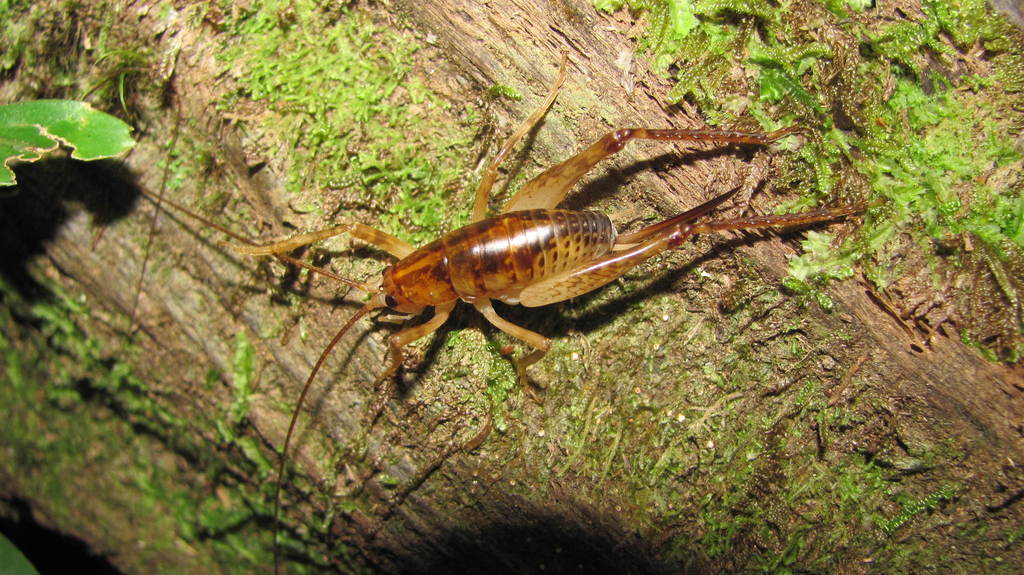
Talitropsis sedilloti
Talitropsis sedilloti is a species of flightless wētā, in the family Rhaphidophoridae (cave crickets, cave wētā, or camel crickets), endemic to Aotearoa New Zealand. This species is common in forests throughout New Zealand and during the day can be found hiding in holes in tree branches.
From the article Talitropsis sedilloti on Wikipedia (CC BY-SA), quoted section by section
Description
Cave wētā have extra-long antennae and long, slender legs. They lack hearing organs (tympana), but they are sensitive to ground vibrations, this is enabled by pads on their feet. Specialised hairs on the cerci and organs on the antennae are also good at capture of low frequency vibrations in the air. Talitropsis sedilloti adults range from about 14mm for females to 18mm for males. Adults are a shiny, pale orange brown. Their hind tibiae have two rows of prominent spines on either side down most of the length. This feature helps distinguish them from other tokoriro (cave wētā) as others species have very fine spines. Juveniles are darker in colour with an evident yellow diamond on the dorsal abdominal surface.
Range & habitat
Talitropsis sedilloti is widely spread throughout New Zealand's main islands and several small islands. In general cave wētā love damp, dark, cool environments, and are only active at night. Talitropsis sedilloti are found in rain forest habitats where they hide during the day in hollow tree branches using the same sort of tree holes as used by tree wētā (Hemideina). Talitropsis sedilloti is common in various forest types on both main islands of New Zealand, and occurs in low numbers on Stewart Island. Juvenile T. sedilloti are observed in the leaf litter of mixed podocarp-coastal forests and at night on tree trunks of tree-ferns (whekī, Dicksonia squarrosa), miro (P. ferruginea), kāmahi (Pterophylla racemosa), and Hall's tōtara (Podocarpus laetus). Adults are found on trunks of miro (Prumnopitys ferruginea) and rimu (Dacrydium cupressinum), both of the tree species are characterised by thick flaky bark that can provide ideal microhabitats for these wētā.
Wikipedia: “Habitats”
What it does
Cave wētā have small mouths. Although they are arboreal, they do not appear to utilise leaves as a nutrient source to any extent, instead, they eat fungi, algae and lichens growing on trees and rocks. Although protein is a preferred meal, they are not known to attack, but scavenge on any dead insects that they come across. Some observations suggests that cave wētā "lick" native slugs, however, this is not officially reported. The licking behaviour in cave wētā is suspected as they can gain moisture and some nutrients from the slime.
Wikipedia: “Diet”
In human culture
The life cycle of T. sedilloti is usually complete in about two years. They need eight months to hatch from eggs from the time of laying, however, time span of the juveniles and adult is hard to assess. December and January is the optimal time of the year that adult start to be observed at night foraging. Mating has been observed in April. Female T. sedilloti have long ovipositors used for laying eggs into soft wood, moss and soil. Palps and ovipositor are used to find a suitable spot, as the correct texture are a prerequisite for egg-laying, they are particularly choosy on the spot, often testing before selecting. There are maximum of two eggs laid in the same spot. Oviposition reach its peak between April and June, and hatching usually peak between December and January. Compound eyes of the embryo become visible through the chorion during embryo development stage. A dark brown cap appear at the vegetal pole of the egg just before hatching. Sometime the chorion becomes transparent and the embryo can be seen quite clearly through it. The number of pre-adult instars is variable both inter- and intraspecifically.
Wikipedia: “Life history”
Listen
Looking for field recordings…
Where it lives
Recorded sightings
—
geo-referenced records in GBIF, from museums, herbaria and field observers.
Drag the globe to turn it. Dots are where records exist, not a range map; darker means more records.
In the stacks
Searching the stacks…
Every page naming Talitropsis sedilloti in the Biodiversity Heritage Library →
This page is assembled live from iNaturalist, GBIF, Wikipedia, the Source Library and the Internet Archive. It is not yet part of the hand-edited codex. iNaturalist taxon 85198.