- Animals
- ›Chordates
- ›Vertebrates
- ›Birds
- ›Perching Birds
- ›Woodswallows, Butcherbirds, and Currawongs
- ›Cracticus
On eBird ↗
Hooded Butcherbird
Live sightings near you, the range map, bar charts of when it is seen, and Macaulay Library photos and recordings.
Hooded Butcherbird
Cracticus cassicus
The hooded butcherbird (Cracticus cassicus) is a species of passerine bird in the family Artamidae. It is found in New Guinea. Its natural habitat is subtropical or tropical moist lowland forests.
From the article Hooded butcherbird on Wikipedia (CC BY-SA), quoted section by section
Description
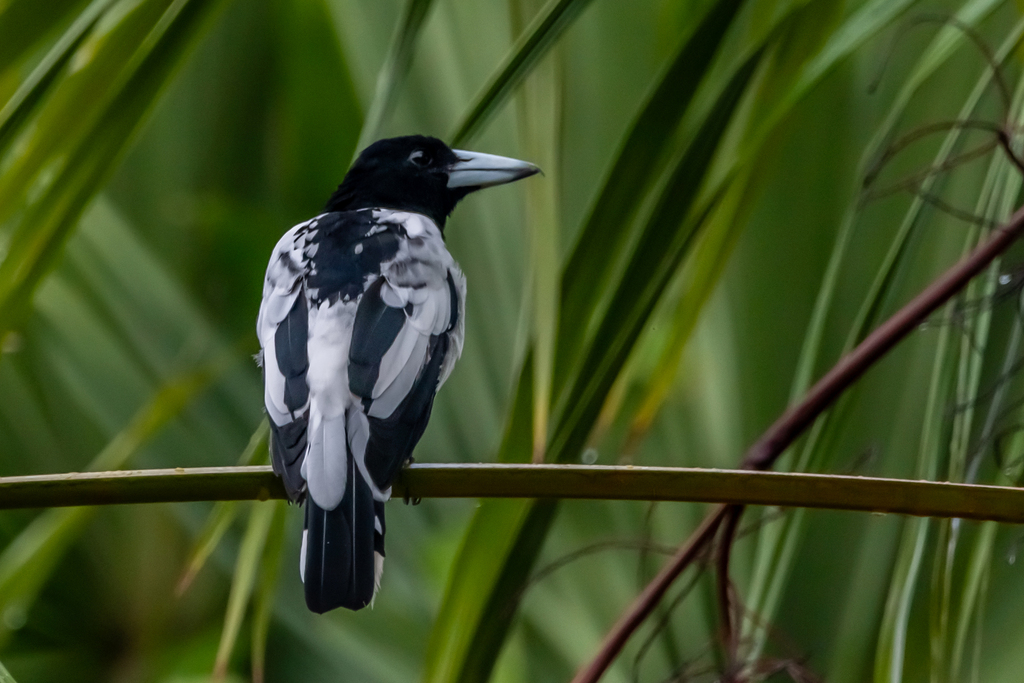
Measuring 32–35 cm in length, the male and female are similar in appearance. The plumage is predominantly black and white, the bird bearing a black head, nape and throat, white underparts, rump, and back, and black and white mantle. The tail is black, with a broad white tip. The robust pale bluish-grey bill is hooked and tipped black. The iris is black or dark brown, and the legs and feet are dark grey to black. It can be distinguished from the black-backed butcherbird by its black throat. The hooded butcherbird has a complex fluting song, made up of many varied components. Birds may duet with each other, or mimic other species such as the rusty pitohui, little shrikethrush, spangled drongo, or helmeted friarbird.
Range & habitat
Found on New Guinea and surrounding islands, the hooded butcherbird inhabits forested country mainly in lowland areas to elevations of 650 m, or occasionally 1450 m. It is fairly common and may also be found close to human habitation in coconut groves.
Wikipedia: “Distribution and habitat”
What it does
The hooded butcherbird is carnivorous. Birds are found in pairs or small family groups. Records indicate breeding may occur at any time. Located on a branch 8.5–25 m above ground, the nest is a bowl constructed of twigs and sticks. Two or three pale olive-brown or -green eggs are laid, blotched darker brown and measuring 31.8-35.6 x 23.7-25.6 mm.
== References ==
Wikipedia: “Behaviour”
Listen
Looking for field recordings…
Where it lives
Recorded sightings
—
geo-referenced records in GBIF, from museums, herbaria and field observers.
Drag the globe to turn it. Dots are where records exist, not a range map; darker means more records.
In the stacks
Searching the stacks…
Every page naming Cracticus cassicus in the Biodiversity Heritage Library →
This page is assembled live from iNaturalist, GBIF, Wikipedia, the Source Library and the Internet Archive. It is not yet part of the hand-edited codex. iNaturalist taxon 8498.