- Animals
- ›Arthropods
- ›Hexapods
- ›Insects
- ›Winged and Once-winged Insects
- ›Butterflies and Moths
- ›Owlet Moths and Allies
- ›Underwing, Tiger, Tussock, and Allied Moths
- ›Tiger Moths and Allies
- ›Tiger Moths
- ›Phaegopterina
- ›Lophocampa
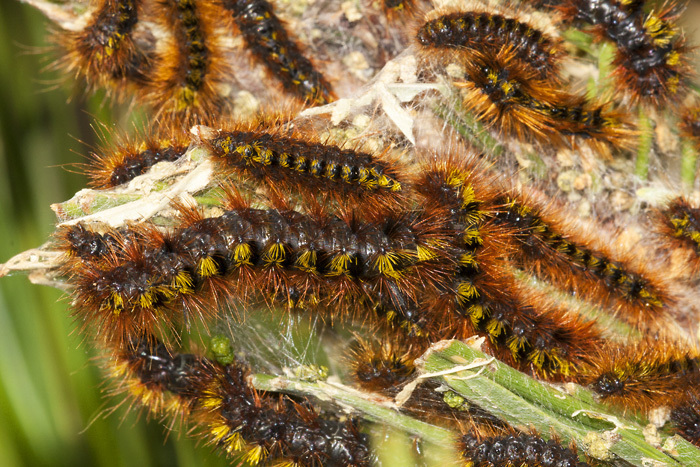
Silver-spotted Tiger Moth
Lophocampa argentata
Lophocampa argentata, the silver-spotted tiger moth, is a species of moth in the family Erebidae. It was described by Packard in 1864. It is found from British Columbia to southern California, and east to Arizona, Nevada, New Mexico, Colorado, Utah, Wyoming and possibly to northern Mexico.
From the article Lophocampa argentata on Wikipedia (CC BY-SA), quoted section by section
Description
Caterpillars are brown or reddish-brown and very hairy, with bundles of black and yellow hairs along the back. The hairs on caterpillars and pupae can irritate human skin. Adult moths have brown forewings with silvery spots. There are light brown and dark brown variations. The spots are irregular, each outlined in black and aligned in loose rows. The hair-like scales on the head and thorax (dorsal tuft) have a unique pattern that can be useful in identification.
Original species description by Alpheus Packard in 1864:
"Halesidota argentata n. sp. - [Female]. Head and thorax pale buff yellow. Base and side of the front walnut brown. Centre of prothoracic pieces brown. Patagia margined with brown, within very broadly so. Primaries walnut brown, with five rows of large irregular round or ovate silver white spots, except the costal spots, which are buff yellow. Two basal spots yellow. Internal margin buff as far as the first line, which is slightly curved, the middle dot of which last is much smaller than the others. In the second line, which is straight, the submedian spot is transversely broad, oblong. Costal spot largest. The third row does not extend to the inner margin. The spots making up the marginal and last row are uniformly round. Fringe and termination of nervules pale buff.
Secondaries white. Middle of the costa and apex and discal dot brown. …
Range & habitat
Larvae of this moth utilize numerous host plants in western North America, generally conifers, and notably the Douglas fir. Larvae feeding on host plant needles can cause defoliation. Lophocampa argentata is found from British Columbia to southern California, and east to Arizona, Nevada, New Mexico, Colorado, Utah, Wyoming and possibly to northern Mexico. The subspecies L. a. subalpina occurs in the Rocky Mountain region, where it feeds on pinyon and juniper; L. a. sobrina is found in California and feeds on Monterey pine.
Wikipedia: “Distribution and host plants”
What it does
Lophocampa argentata produce one generation per year. In mid-summer, moths lay clusters of eggs on needles and small branches. Larvae hatch within around three weeks. Groups of larvae produce tents in their host plants, remaining in the tent through winter and re-emerging in the spring. In the warmer weather, the larvae feed individually before pupating in late spring in brown cocoons attached to plants or on the forest floor.
Wikipedia: “Life cycle”
Listen
Looking for field recordings…
Where it lives
Recorded sightings
—
geo-referenced records in GBIF, from museums, herbaria and field observers.
Drag the globe to turn it. Dots are where records exist, not a range map; darker means more records.
In the stacks
Searching the stacks…
Every page naming Lophocampa argentata in the Biodiversity Heritage Library →
This page is assembled live from iNaturalist, GBIF, Wikipedia, the Source Library and the Internet Archive. It is not yet part of the hand-edited codex. iNaturalist taxon 84792.