- Animals
- ›Arthropods
- ›Hexapods
- ›Insects
- ›Winged and Once-winged Insects
- ›Butterflies and Moths
- ›Butterflies
- ›Gossamer-winged Butterflies
- ›Hairstreaks
- ›Eumaeini
- ›Callophryidina
- ›Callophrys
- ›Mitoura
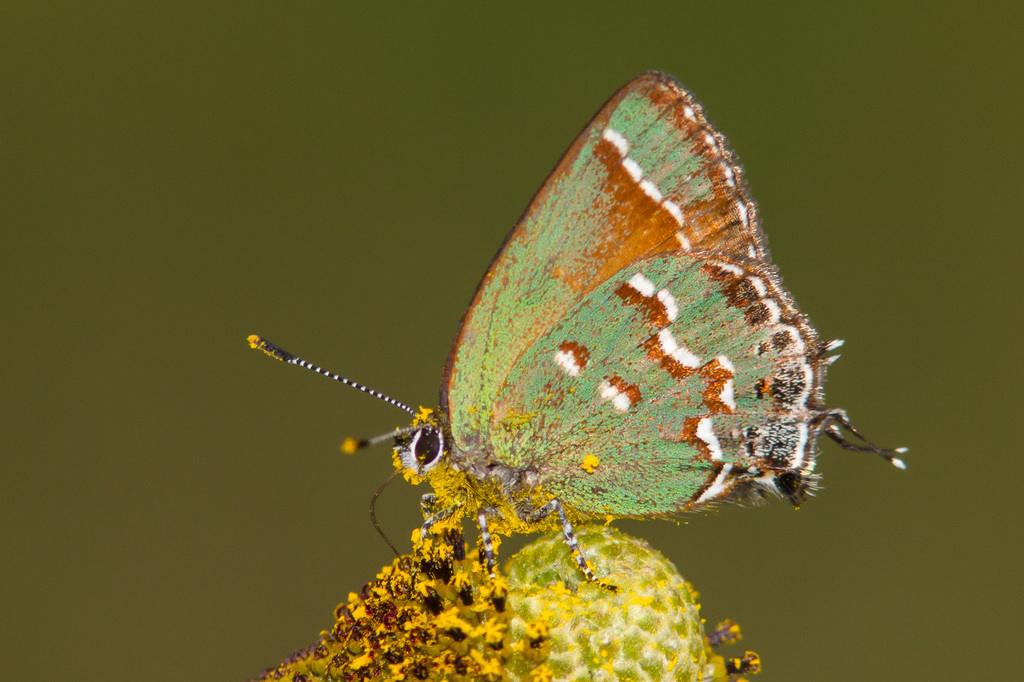
Juniper Hairstreak
Callophrys gryneus
Callophrys gryneus, the juniper hairstreak or olive hairstreak, is a butterfly native to North America. It belongs in the family Lycaenidae.
From the article Callophrys gryneus on Wikipedia (CC BY-SA), quoted section by section
Description
The juniper hairstreak has many subspecies or races, some of which may even be separate species. The upper side of the "olive" juniper hairstreak (C. g. gryneus) is tawny orange or a bronzy color in males, and blackish brown in females. The underside of the wings is bright green with a variable amount of brown scaling. There are two white postbasal spots and a white zigzag postmedian line edged inward with brown on the hindwing. "Sweadner's" juniper hairstreak (C. g. sweadneri) is very similar to the gryneus race except the two white postbasal spots are reduced. The "Siva" juniper hairstreak (C. g. siva) is also similar to the gryneus race. It lacks the postbasal spots, the postmedian line is straight, and some individuals are brown. Intermediates of the gryneus and siva races occur in west Texas and New Mexico. The underside of "Nelson's" juniper hairstreak (C. g. nelsoni) is brown with a violet sheen; the white postmedian line is faint, sometimes partial or absent; and the postbasal spots are lacking. "Muir's" juniper hairstreak (C. g. muiri) is similar to the nelsoni race except the underside of the wings are a darker brown with a purplish-greenish tint, and the postmedian line is partial to complete. The underside of the "Loki" juniper hairstreak (C. g. loki) is green to purplish brown. …
Range & habitat
Habitats include bluffs, open fields, barrens, and dry or rocky open places. They are almost always found near or on junipers in these habitats.
Wikipedia: “Habitat”
What it does
Males are highly territorial on cedar trees, where they perch in search of females. Often, males can be set in flight by gently shaking the trees. Females lay their eggs singly at the tip of host plant leaves. The eggs are pale green with white ridges. The larvae are vivid green with a faint middorsal stripe that begins at the thorax and runs down the abdomen. Whitish-yellow spots occur on either side of the middorsal stripe. A whitish-yellow subspiracular stripe (sometimes broken between segments) runs the length of the body. The chrysalis of the gryneus race is brown to pale brown and is mottled with black with the abdomen being a bit reddish. Chrysalids of western races are dark brown. The juniper hairstreak overwinters as a chrysalis. The gryneus race has two broods per year; sweadneri, two broods per year; siva, two or three broods per year; nelsoni, one brood; muiri, one brood; loki, one or two broods; and the thornei race has one brood per year.
Wikipedia: “Life cycle”
Listen
Looking for field recordings…
Where it lives
Recorded sightings
—
geo-referenced records in GBIF, from museums, herbaria and field observers.
Drag the globe to turn it. Dots are where records exist, not a range map; darker means more records.
In the stacks
Searching the stacks…
Every page naming Callophrys gryneus in the Biodiversity Heritage Library →
This page is assembled live from iNaturalist, GBIF, Wikipedia, the Source Library and the Internet Archive. It is not yet part of the hand-edited codex. iNaturalist taxon 84239.