- Animals
- ›Arthropods
- ›Hexapods
- ›Insects
- ›Winged and Once-winged Insects
- ›Butterflies and Moths
- ›Butterflies
- ›Gossamer-winged Butterflies
- ›Hairstreaks
- ›Eumaeini
- ›Callophryidina
- ›Callophrys
- ›Mitoura
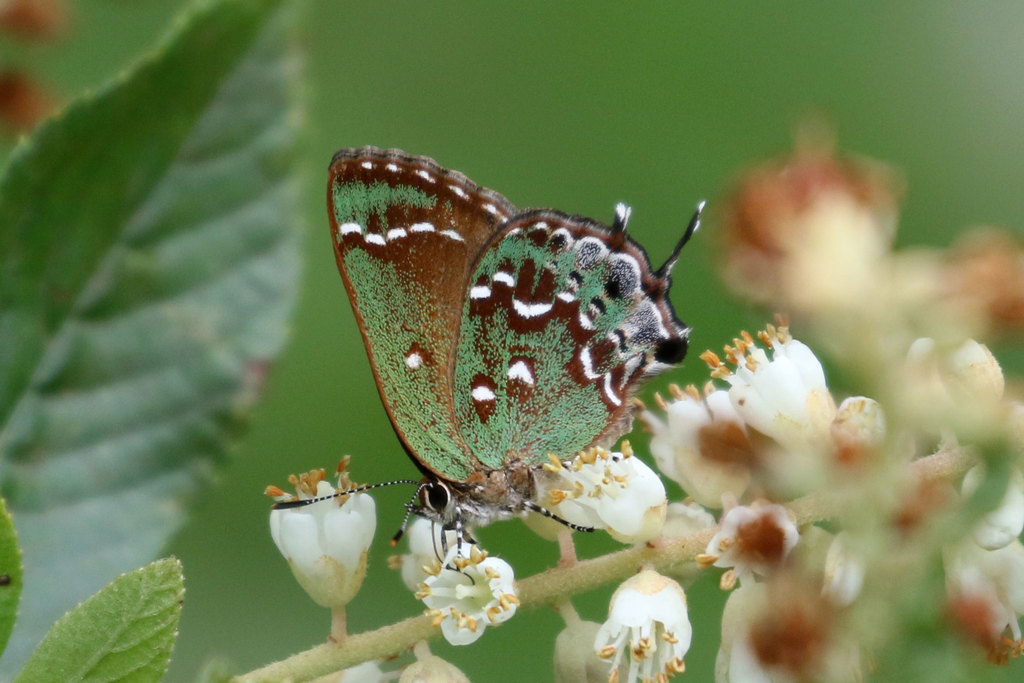
Hessel's Hairstreak
Callophrys hesseli
Callophrys hesseli, or Hessel's hairstreak, is a butterfly of the family Lycaenidae. It ranges from southern Maine south along the Atlantic coastal plain to the Florida Panhandle on the Gulf Coast. The species was first described (as Mitoura hesseli) by George W. Rawson and J. Benjamin Ziegler in 1950, in honor of the lepidopterist Sidney Adolphus Hessel. It is listed as endangered in Connecticut by state authorities due factors such as logging and insecticide.
These butterflies live in wetlands, as that is where the Atlantic white-cedar (Chamaecyparis thyoides) thrives. The whole lifecycle of these butterflies depends on this tree. The caterpillars feed off the foliage of the tree, then the adult butterflies will mate and lay their eggs on the tree. Adults consume nectar from flowers including swamp milkweed, shadbush, sand myrtle, sweet pepperbush, highbush blueberry, buttonbush, and dogbane.
From the article Callophrys hesseli on Wikipedia (CC BY-SA), quoted section by section
Description
The Adult Hessel's hairstreaks wings have a base of a rusty brown color with many Olive green dots throughout. There are also white bands towards the ends of the wing. They have a wingspan of about 1 inch. The caterpillars are fluorescent green, with thick white dashes down its sides.
Subspecies variation. Within the species Callophrys hesseli there are two proposed subspecies, Hesseli hesseli and Hesseli angulata. If these two subspecies were to be accepted, the populations of Callophrys hesseli in Florida, Georgia, and South Carolina (specifically along the border of Georgia) would be classified as Callophrys Hesseli angulata. Populations elsewhere would be considered the subspecies Hesseli hesseli. The primary difference between the subspecies Hesseli hesseli and Hesseli angulata lies in their wings and tails. Hesseli angulata wings are dark green to brown while in Hesseli hesseli their wings are typically olive green, and the patterns tend to be less defined and vary slightly from Hesseli angulata. Hesselia angulata also tend to be larger with longer tails.
Range & habitat
The habitat of the Hessel's Hairstreaks are terrestrial wetlands such as bogs, riparian, swamps, and forested wetlands. These biomes are home to their preferred plant, the Atlantic white-cedar tree. The extensive habitat of the Hessel's Hairstreaks are confined to the east coast of the United States, from southern Maine to Florida. However, there are many small areas of exception which are unable to support populations for reasons that are not yet understood. The greatest density of population seems to be in the New Jersey area. There is an estimated total of 21-300 populations yet only 13-125 seem to have a strong stability.
Wikipedia: “Habitat and Distribution”
What it does
Hessel's Hairstreaks are often seen when the tree they are perched on is disturbed and they disperse in response. Hessel's Hairstreaks tend to be in close proximity on the tree tops and the swarm of butterflies will swirl together whenever the disturbance occurs. However, in an uninterrupted state, the butterflies typically change their positions on the tree in relation to sunlight levels. Typically, the males are gathered at the top of the tree tops scouting for unmated females who will venture from the lower tree levels during mating seasons. During the middle of the day, both males and females will join at the top of the Atlantic white cedar trees to performing mating rituals where the males compete for the female's attention known as leks. Hessel's Hairstreaks will court, mate, and lay eggs all during this time period.
Lifespan. The lifespan of Hessel's Hairstreaks consist of three stages. During the beginning of May, eggs, inside of a chrysalis, will be spotted on branch tips of 4-6 weeks. They will then evolve into herbivore caterpillars or pupae diapause during the winter months. Nectarivore adults will live between 1-2 weeks.
Wikipedia: “Behavior”
Listen
Looking for field recordings…
Where it lives
Recorded sightings
—
geo-referenced records in GBIF, from museums, herbaria and field observers.
Drag the globe to turn it. Dots are where records exist, not a range map; darker means more records.
In the stacks
Searching the stacks…
Every page naming Callophrys hesseli in the Biodiversity Heritage Library →
This page is assembled live from iNaturalist, GBIF, Wikipedia, the Source Library and the Internet Archive. It is not yet part of the hand-edited codex. iNaturalist taxon 84063.