- Plants
- ›Vascular Plants
- ›flowering plants
- ›Dicots
- ›Sunflowers, Bellflowers, Fanflowers, and Allies
- ›Sunflowers, Daisies, Asters, and Allies
- ›Asteroideae
- ›Chamomiles, yarrows, and allies
- ›Artemisiinae
- ›Chrysanthemum
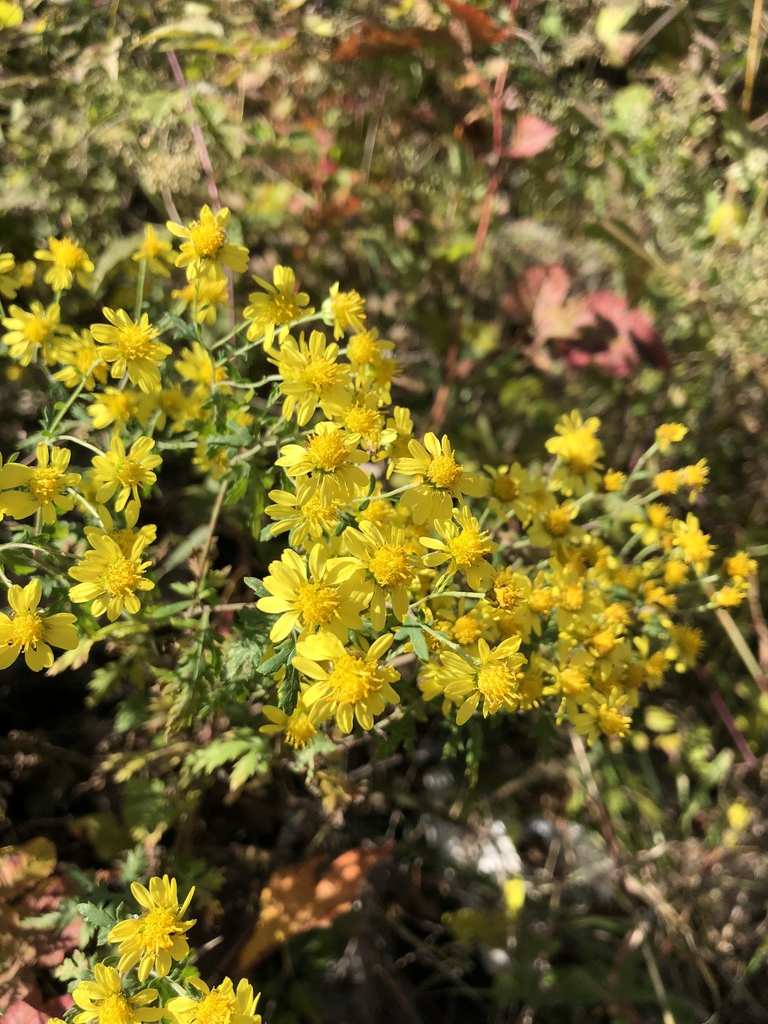
Chrysanthemum lavandulifolium
Chrysanthemum lavandulifolium is a flowering plant within the family Asteraceae and the genus Chrysanthemum. It is a perennial flowering plant that is often noted because of its yellow flowers. It has 18 chromosomes at the diploid stage.
From the article Chrysanthemum lavandulifolium on Wikipedia (CC BY-SA), quoted section by section
Description
The plant grows up to 100–150 centimetres (39–59 in) tall and consists of a herb and its flower. The herb is erect, and the flowers have yellow sepals and multiple carpals. The herb has a green, oblong leaf with pinnate venation. These leaves are about 5–7 centimetres (2–3 in) long and 4–6 cm wide. The leaf blade is broad, while the base is suddenly narrowed and of an ovate or lanceolate lobed shape. The leaves are in alternate arrangement throughout the stem. In addition, it has a broad sinus base with "dorsifixed pubescence" underneath. The petiole is about 1–2 cm long. The rhizome is short, while the stem is erect, long branched, and colored white pubescent. There are only a few stem leaves. The flowers grow in a corymb-style head and are terminal. They also have yellow heads that contain multiple carpals; these stretch from 14–15 mm in diameter. They also contain three or four oblong bracts that have soft tissue and are elliptical and tipped. These bracts have hemispherical involucre or coverings. In addition, the yellow corollas of the flower are about 5–7 mm long and 1.5–2 mm wide These heads stretch to about 1.5 cm in diameter. These bisexual florets have obtuse and irregular anther bases. They have pistillate ray florets that can be yellow or white. From these florets, they produce achenes, which are indehiscent and angled. …
Range & habitat
C. lavandulifolium naturally occurs or is native to regions of eastern Asia such as Korea, Japan, and China. In China, it is found in the provinces of Gansu, Sichuan, and Yunnan. In Japan, it is found primarily in Honshu and Kyushu. In Korea, it is found in Gyeongsangbuk, Gangwon, and Chungcheongbuk. Chrysanthemums may have been introduced to Japan by the Chinese in the eighth century AD. C. lavandulifolium, a perennial plant, grows well in warm climates around East Asia. It flowers from October to November. The plant grows well on moist clayey soils in full sun. It is also quite immune to high temperatures and lack of moisture.
Wikipedia: “Distribution and habitat”
At the table
In Korean traditional medicine, C. lavandulifolium has been used to treat vertigo, a type of dizziness. In addition, its flowers have been used as an antipyretic.
Wikipedia: “Uses”
Where it lives
Recorded sightings
—
geo-referenced records in GBIF, from museums, herbaria and field observers.
Drag the globe to turn it. Dots are where records exist, not a range map; darker means more records.
In the stacks
This page is assembled live from iNaturalist, GBIF, Wikipedia, the Source Library and the Internet Archive. It is not yet part of the hand-edited codex. iNaturalist taxon 840475.