- Animals
- ›Arthropods
- ›Hexapods
- ›Insects
- ›Winged and Once-winged Insects
- ›Butterflies and Moths
- ›Owlet Moths and Allies
- ›Cutworm Moths and Allies
- ›Heliothinae
- ›Helicoverpa
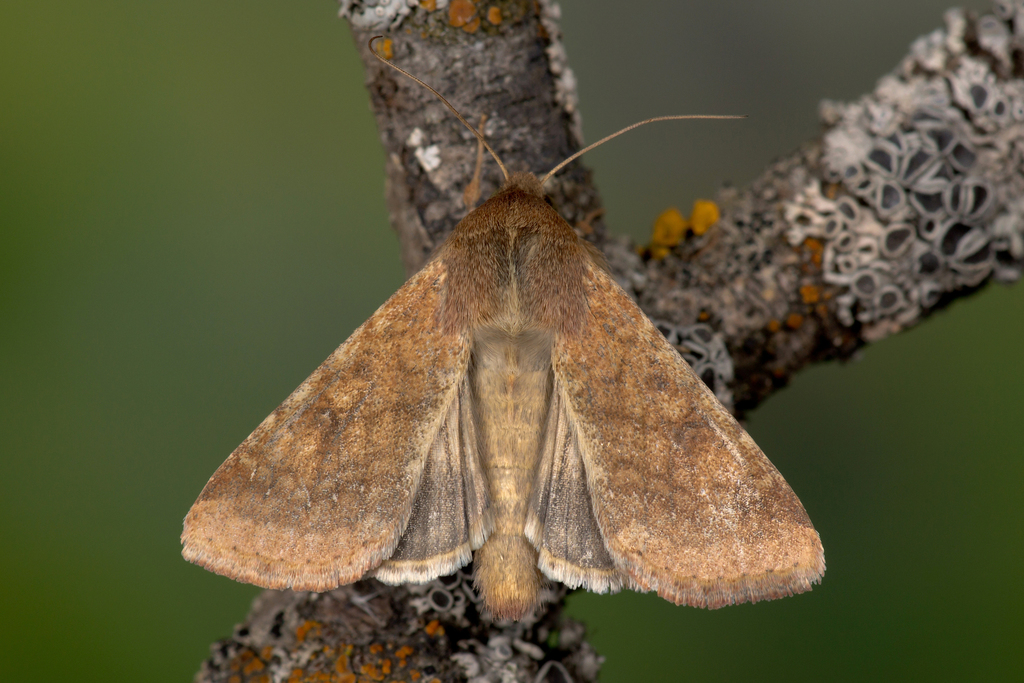
Cotton Bollworm Moth
Helicoverpa armigera
Helicoverpa armigera is a species of moth in the family Noctuidae. It is known as the cotton bollworm, corn earworm, Old World (African) bollworm, or scarce bordered straw (the lattermost in the UK, where it is a migrant). The larvae feed on a wide range of plants, including many important cultivated crops. It is a major pest in cotton and one of the most polyphagous and cosmopolitan pest species. It should not be confused with the similarly named larva of the related species Helicoverpa zea.
From the article Helicoverpa armigera on Wikipedia (CC BY-SA), quoted section by section
Description
The cotton bollworm is very variable in both size and colour. The body length varies between 12 and 20 millimetres (1⁄2 and 3⁄4 in) with a wingspan of 30–40 millimetres (1+1⁄4–1+1⁄2 in). The fore wings are yellowish to orange in females and greenish-gray in males, with a slightly darker transversal band in the distal third. The external transversal and submarginal lines and the reniform spot are diffused. The hind wings are a pale yellow with a narrow brown band at the external edge and a dark round spot in the middle.
Wikipedia: “Morphology”
Range & habitat
This species comprises two sub-species: Helicoverpa armigera armigera is native and widespread in central and southern Europe, temperate Asia and Africa; Helicoverpa armigera conferta is native to Australia, and Oceania. The former sub-species has also recently been confirmed to have successfully invaded Brazil and has since spread across much of South America and reached the Caribbean. It is a migrant species, able to reach Scandinavia and other northern territories.
Wikipedia: “Distribution”
Listen
Looking for field recordings…
Where it lives
Recorded sightings
—
geo-referenced records in GBIF, from museums, herbaria and field observers.
Drag the globe to turn it. Dots are where records exist, not a range map; darker means more records.
In the stacks
Searching the stacks…
Every page naming Helicoverpa armigera in the Biodiversity Heritage Library →
This page is assembled live from iNaturalist, GBIF, Wikipedia, the Source Library and the Internet Archive. It is not yet part of the hand-edited codex. iNaturalist taxon 83806.