On eBird ↗
Spectacled Tyrannulet
Live sightings near you, the range map, bar charts of when it is seen, and Macaulay Library photos and recordings.
Spectacled Tyrannulet
Zimmerius improbus
The spectacled tyrannulet (Zimmerius improbus), also known as the specious tyrannulet, mountain tyrannulet, and Venezuelan tyrannulet, is a small passerine bird in the family Tyrannidae, the tyrant flycatchers. It is found in Colombia and Venezuela.
From the article Spectacled tyrannulet on Wikipedia (CC BY-SA), quoted section by section
Description
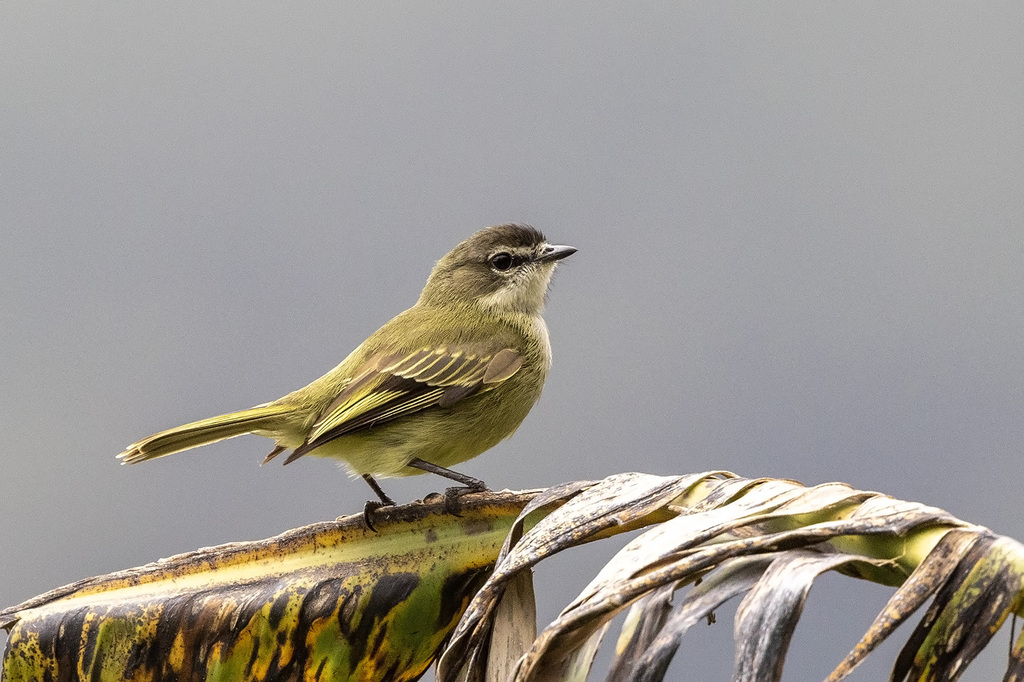
The spectacled tyrannulet is about 11.5 to 12.5 cm (4.5 to 4.9 in) long and weighs about 11 g (0.39 oz). The sexes have the same plumage. Adults of the nominate subspecies have a dark grayish green crown. They have a yellow-tinged white forehead, loral streak, and arcs above and below the eye that give it its common name. Their upperparts are green. Their wings are mostly dusky; the coverts and flight feathers have thin yellow edges. Their tail is rather long compared to those of other flycatchers; it is dark gray with yellow edges on the feathers. Their throat is whitish yellow and the rest of their underparts somewhat yellower. Subspecies Z. i. tamae has pure white lores and eye arcs. They have a darker and more dusky crown, a grayer breast, and paler yellow abdomen and undertail coverts than the nominate. Adults of both subspecies have a dark brown iris, a short, narrow black bill, and longish black legs and feet. Immature birds have duller and somewhat darker colors on their face and upperparts than adults, and their legs and feet are gray.
Range & habitat
The spectacled tyrannulet has a disjunct distribution. The nominate subspecies has one population in northern Colombia's Norte de Santander Department and another in the Andes of northwestern Venezuela between Táchira and Trujillo states. Subspecies Z. i. tamae also has multiple populations. One is in the isolated Sierra Nevada de Santa Marta in northern Colombia, a second in the Serranía del Perijá on the Colombia-Venezuela border, and a third in the Páramo de Tamá in Táchira. The species inhabits the interior and edges of humid montane forest, more open forest and woodlands, and forest openings with scattered trees. In elevation it ranges from 1,500 to 2,400 m (4,900 to 7,900 ft) in Colombia, 1,800 to 3,000 m (5,900 to 9,800 ft) on the Venezuelan side of the Serranía del Perijá, and 800 to 3,000 m (2,600 to 9,800 ft) in the Venezuelan Andes.
Wikipedia: “Distribution and habitat”
What it does
The spectacled tyrannulet's diet has not been detailed but is known to include insects and fruits. Other species in genus Zimmerius rely heavily on mistletoe (Loranthaceae) fruits but it is not known how important they are to this species. It is an active forager, working singly or in pairs, at all levels of the forest but mostly from the forest mid-story to the canopy. It takes food by gleaning while perched and while briefly hovering after a short flight; it less frequently sallies to take insects in mid-air. It sometimes joins mixed-species feeding flocks.
Wikipedia: “Feeding”
Listen
Looking for field recordings…
Where it lives
Recorded sightings
—
geo-referenced records in GBIF, from museums, herbaria and field observers.
Drag the globe to turn it. Dots are where records exist, not a range map; darker means more records.
In the stacks
Searching the stacks…
Every page naming Zimmerius improbus in the Biodiversity Heritage Library →
This page is assembled live from iNaturalist, GBIF, Wikipedia, the Source Library and the Internet Archive. It is not yet part of the hand-edited codex. iNaturalist taxon 827389.