On eBird ↗
Pied Monarch
Live sightings near you, the range map, bar charts of when it is seen, and Macaulay Library photos and recordings.
Pied Monarch
Arses kaupi
The pied monarch (Arses kaupi) is a species of bird in the monarch-flycatcher family, Monarchidae. It is endemic to coastal Queensland in Australia.
From the article Pied monarch on Wikipedia (CC BY-SA), quoted section by section
Description
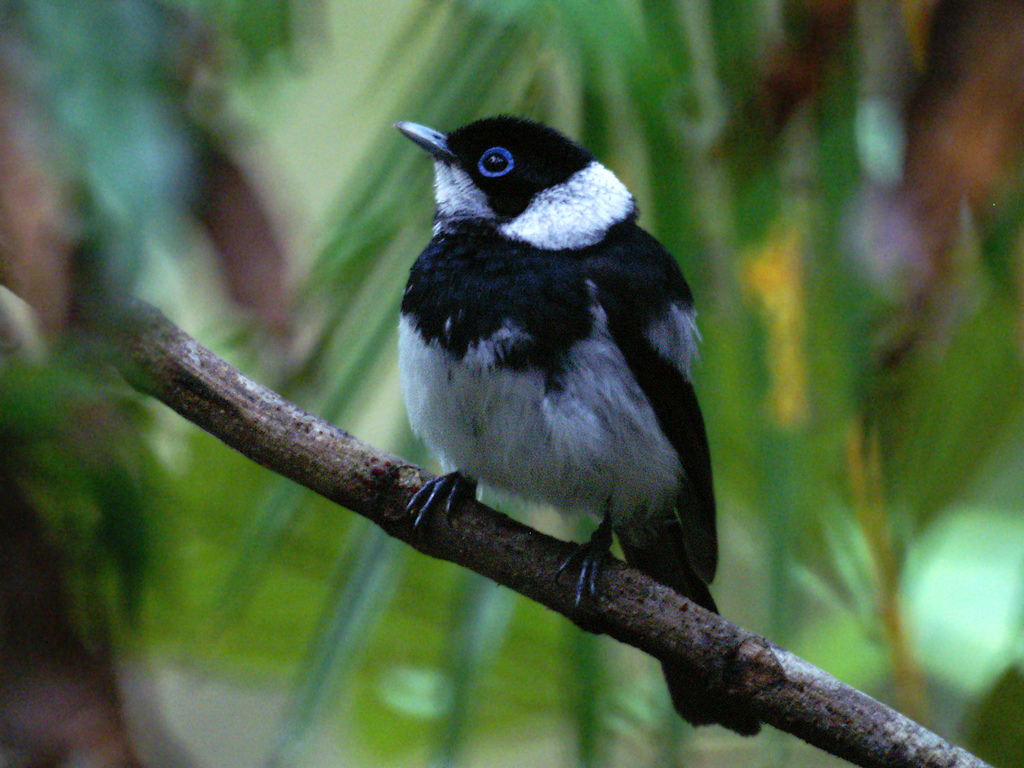
The pied monarch is 15–16 centimetres (5.9–6.3 in) in length and weighs around 12.5–15 grams (0.44–0.53 oz). The plumage is sexually dimorphic. The upperparts and head of the male are black, as is the tail, and the wings are brownish-black with white scapulars (which shows as a white crescent across the back when folded). The collar, which is erectable, is white, and it joins through the neck with a white throat. The breast-band is black, and the belly and underside are white. In the female the white on the throat and collar is less distinct and covers less area, and the collar is incomplete around the neck. The eye is black, and is surrounded by a blue coloured eye-ring, which is less distinct in the female. The bill is blue-grey, and the legs are black. Immature birds look like females but with duller plumage, no blue in the eye-rings, and a horn-coloured bill. Like other members of the genus it has long hind-toes and claws, and in general the size and shape of the feet resemble those of the Australasian treecreepers, and the feet are used for feeding in the same manner on the trunks of trees.
Range & habitat
The pied monarch is found in tropical forest edge habitats and secondary growth in coastal north eastern Queensland, from Cooktown to Ingham. It ranges from sea level up to 900 metres (3,000 ft). It also occurs in palm-vine scrub, gallery forest and along rivers. The species is mostly non-migratory, but some birds disperse to the Eucalyptus woodland in the Atherton Tableland during the winter. The species has a tiny global range, and is described as uncommon and occurring at low densities throughout its range. However much of its range is protected within national parks or World Heritage Sites, and its habitat is thought to be secure. The species is considered to be safe at the moment, and is listed as Least Concern by the IUCN.
Wikipedia: “Distribution and habitat”
What it does
The pied monarch is insectivorous, with beetles (Coleoptera) and moths and butterflies (Lepidoptera) being recorded in its diet. It is usually seen as singles or pairs and small groups (of three to five birds, which may be family groups). They join mixed-species foraging flocks with other monarch flycatchers, fantails, whistlers and shrikethrushes. Within the forest they usually feed at the mid level, and rarely close to the ground. One foraging method typical to the genus is to climb up trunks and the larger branches in the manner of a treecreeper (Climacteris) and probing the bark and lichens, but they also catch prey from the air.
Wikipedia: “Behaviour”
Listen
Looking for field recordings…
Where it lives
Recorded sightings
—
geo-referenced records in GBIF, from museums, herbaria and field observers.
Drag the globe to turn it. Dots are where records exist, not a range map; darker means more records.
In the stacks
Searching the stacks…
Every page naming Arses kaupi in the Biodiversity Heritage Library →
This page is assembled live from iNaturalist, GBIF, Wikipedia, the Source Library and the Internet Archive. It is not yet part of the hand-edited codex. iNaturalist taxon 8253.