- Animals
- ›Arthropods
- ›Hexapods
- ›Insects
- ›Winged and Once-winged Insects
- ›Ants, Bees, Wasps, and Sawflies
- ›Narrow-waisted Wasps, Ants, and Bees
- ›Ants, Bees, and Stinging Wasps
- ›Bees and Apoid Wasps
- ›Bees
- ›Sweat Bees
- ›Sweat and Furrow bees
- ›Augochlorine Sweat Bees
- ›Augochlora
- ›Augochlora
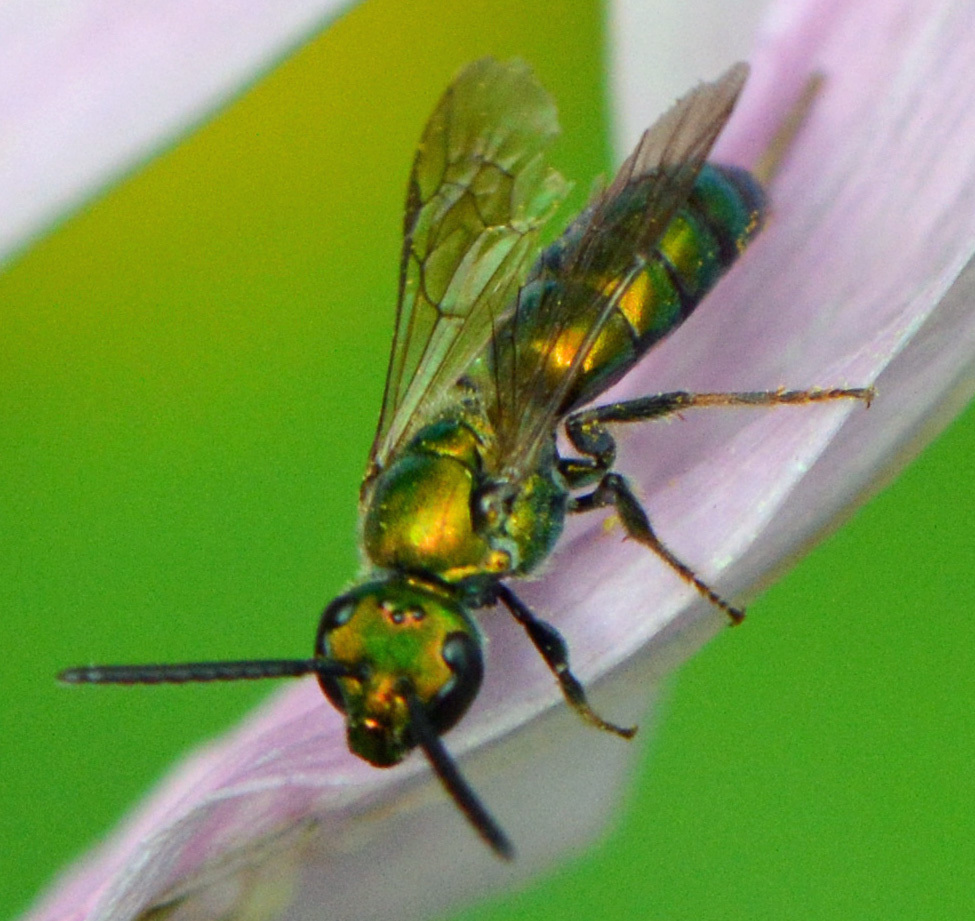
Pure Green Sweat bee
Augochlora pura
Augochlora pura is a solitary sweat bee found primarily in the Eastern United States. It is known for its bright green color and its tendency to forage on a variety of plants. Inhabiting rotting logs, this bee can produce up to three generations per year. Both males and females have been observed licking sweat from human skin, most likely seeking salt.
Augochlora pura was recently suggested the common name Pure Green Sweat Bee, but about it has been written that "...it does not seem to need one with such a musical scientific designation that means 'pure golden green.'"
From the article Augochlora pura on Wikipedia (CC BY-SA), quoted section by section
Description
Both males and females are approximately 8 mm long. Over most of the range of the species, their entire bodies are a shiny, bright green, in contrast to many Lasioglossum species such as L. zephyrus, which are a dull metallic green. Male Augochlora pura tend to have darker mandibles and may be slightly more bluish than females, but otherwise, males and females are similar. Both sexes are a deep blue metallic color in Florida, and this color form was previously treated as a separate taxon, Augochlora pura mosieri.
Wikipedia: “Description and identification”
Range & habitat
A. pura is found mainly in the eastern United States. It ranges from Maine through Minnesota south through Texas and Florida. A. pura has been documented as far north as Quebec. Its active season is February through November, with the longer seasons in the more southern states. A. pura builds its nests in rotting wood in forests and even wood piles in suburbia. It spends most of its time near its nests, but also visits nearby brush and pastures. According to a study on the bottomland hardwood forest of the southeastern United States, A. pura accounted for about 91% of bees collected in the area.
Wikipedia: “Distribution and habitat”
What it does
Augochlora pura has a flight season from early April through September, but nests are active only from early May to early August. Unlike other halictids, A. pura does not take flight in response to warm days later in the fall. There are two to three generations per year in nature, as limited by the seasons, but bees in the laboratory have been shown to produce at least six generations per year. There is no reason to believe these generations would not continue indefinitely. In nature, females become active in August and September, mate, and remain in a state of ovarian diapause on moist soil beneath rotting logs. In contrast, all males die in the fall. Overwintered females found new nests in April. Their offspring emerge in June, and proceed to found nests of their own by the end of the month. Males tend to emerge from the first cells built, and females emerge shortly thereafter. Males in the laboratory live on average about 14.88 days.
Wikipedia: “Life cycle”
Listen
Looking for field recordings…
Where it lives
Recorded sightings
—
geo-referenced records in GBIF, from museums, herbaria and field observers.
Drag the globe to turn it. Dots are where records exist, not a range map; darker means more records.
In the stacks
Searching the stacks…
Every page naming Augochlora pura in the Biodiversity Heritage Library →
This page is assembled live from iNaturalist, GBIF, Wikipedia, the Source Library and the Internet Archive. It is not yet part of the hand-edited codex. iNaturalist taxon 82523.