- Animals
- ›Arthropods
- ›Hexapods
- ›Insects
- ›Winged and Once-winged Insects
- ›Beetles
- ›Ground and Water Beetles
- ›Ground beetles and allies
- ›Tiger Beetles
- ›Cicindelini
- ›Cicindelina
- ›Cicindela
- ›Cicindela
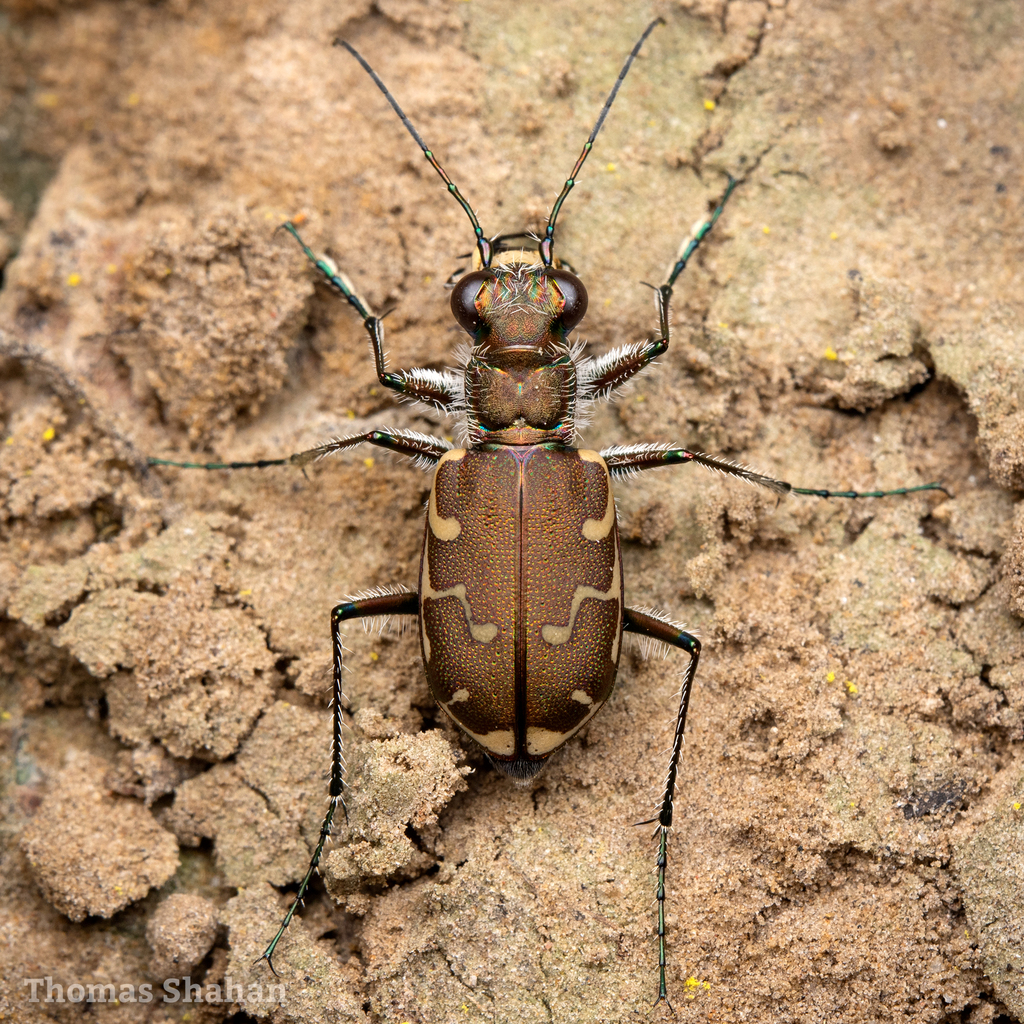
Bronzed Tiger Beetle
Cicindela repanda
Cicindela repanda, commonly known as the bronzed tiger beetle or common shore tiger beetle, is a species of tiger beetle that is 10–13 millimetres (0.39–0.51 in) long and lives in most of North America. It has a small labrum with one tooth and a coppery, hairy pronotum. The shoulder marking usually touches the middle band. It is most often seen in spring and summer, and it lives in sand, gravel, or clay soil. It feeds on many species of insects and even some fruit. The species has a two-year life cycle. It can be found across sand dunes around the Great Lakes. The species comprises three subspecies: C. repanda repanda, C. repanda novascotiae, and C. repanda tanneri.
From the article Cicindela repanda on Wikipedia (CC BY-SA), quoted section by section
Description
C. repanda measures 10–13 millimetres (0.39–0.51 in) long. Its labrum is small with one tooth and the pronotum is coppery and hairy. The shoulder marking touches or nearly touches the middle band. The dorsal surfaces is a bronze brow, while the ventral surfaces are a metallic green or blue. The proepisternum is bronze-brown with reddish reflections.
Elytra. Unlike some other species, C. repanda's elytra exhibit a gradual increase in reflectance towards near-infrared wavelengths, resulting in a unique reflectance curve. The elytral surface of C. repanda, along with C. splendida, features deep alveoli and acute ridges, contributing to its distinctive appearance. Despite some areas of the elytra lacking reflectivity due to wide epicuticular laminations, thinner layers within alveoli still reflect visible wavelengths. This complex interplay of structural elements results in a relatively poor reflectance of any single visible wavelength, giving C. repanda an overall flat brown appearance. However, under microscopic examination, a wide range of reflected colors, mainly red, can be observed, indicating a subtle but complex iridescence that is consistent with other species of Cicindela.
Male genitalia. The male genitalia of C. repanda consists of a sclerotic tube, the aedeagus (Aed), and two narrow parameres (Par), all derived from abdominal segment nine. …
Wikipedia: “Morphology”
Range & habitat
C. repanda are widely distributed across the United States and Canada and are extremely common. Small numbers were also present in a variety of the other habitats, typifying the wide distribution of C. repanda. In comparison to some other species of tiger beetles that prefer open sandy flats, slopes, and dunes, C. repanda prefers fluvial habitats, specifically the edges of lakes, ponds, or streams. With the widespread distribution of these beetles, they are found in virtually any fluvial habitat. They are often found with C. duodecimguttata in clay silt steam beds or with C. hirtcollis in sand substrate streams. They are also very common in the great lake region, specific present on sandy shores, with a special focus on the Indiana Sand Dunes. They are often found directly along the shores, as opposed to other species of Cicindela that are located inland. Therefore, C. repanda are found along the lake edge of the great lakes, as well as along the interdunal pond edge.
Wikipedia: “Habitat”
What it does
Tiger beetles exhibit predatory behavior in both larval and adult stages, with adults known for their rapid movement and colorful appearance. Adult C. repanda primarily feed on a variety of small prey, especially arthropods. Prey detection primarily relies on movement, although dead insects are also readily accepted. Larval tiger beetles dig vertical tunnels in soiland and lie in them with highly modified heads near the surface of the ground. If a prey runs past them on the ground above, the larvae jump out and seek their prey. As such, sandy habitats are suitable to this predatory behavior, and C. repanda larvae are found in sandy areas within their communities. In comparison to other tiger beetle species, C. repanda adults display less aggressive predatory behavior, with a significant portion of encounters resulting in retreat rather than successful capture. The high population density of C. repanda and lack of refuge for prey intensify competition, prompting adults to rely on both dead insects and actively moving prey, while larvae primarily target living prey. This strategic prey selection reduces niche overlap between adult and larval stages, although C. repanda adults still exhibit restraint in predatory behavior compared to congeners and other tiger beetle species documented in the literature. Furthermore, since C. …
Wikipedia: “Predatory behavior”
Listen
Looking for field recordings…
Where it lives
Recorded sightings
—
geo-referenced records in GBIF, from museums, herbaria and field observers.
Drag the globe to turn it. Dots are where records exist, not a range map; darker means more records.
In the stacks
Searching the stacks…
Every page naming Cicindela repanda in the Biodiversity Heritage Library →
This page is assembled live from iNaturalist, GBIF, Wikipedia, the Source Library and the Internet Archive. It is not yet part of the hand-edited codex. iNaturalist taxon 82425.