On eBird ↗
Steller's Jay
Live sightings near you, the range map, bar charts of when it is seen, and Macaulay Library photos and recordings.
Steller's Jay
Cyanocitta stelleri
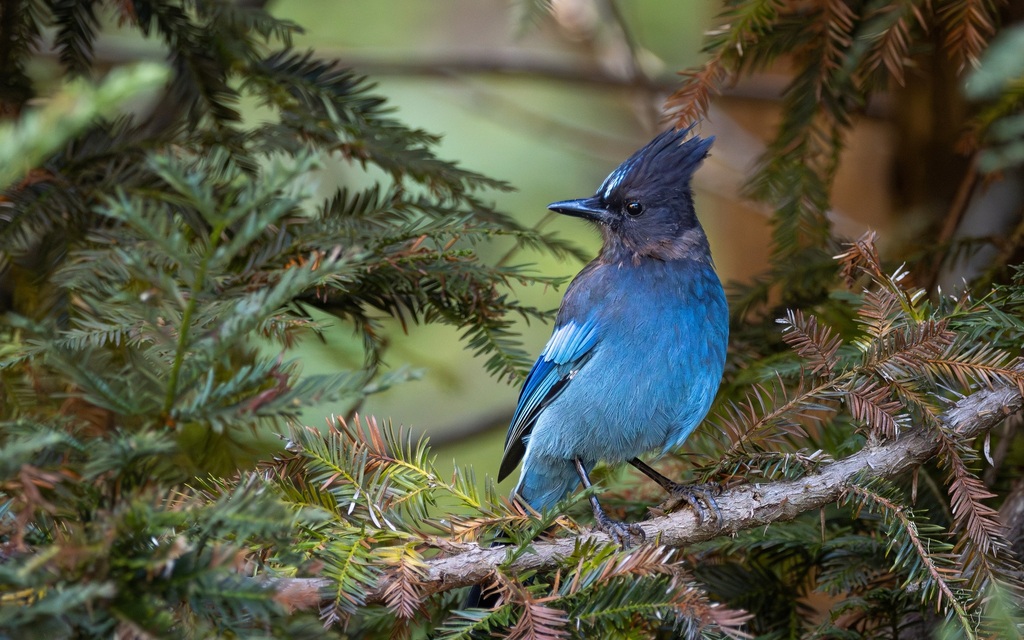
Steller's jay (Cyanocitta stelleri) is a bird native to western North America and the mountains of Central America, closely related to the blue jay (C. cristata) found in eastern North America. It is the only crested jay west of the Rocky Mountains. It is also sometimes colloquially called a "blue jay" in the Pacific Northwest, but is distinct from the blue jay of eastern North America. The species inhabits pine-oak and coniferous forests.
From the article Steller's jay on Wikipedia (CC BY-SA), quoted section by section
Description
Steller's jay is about 30–34 cm (12–13 in) long and weighs about 100–140 g (3.5–4.9 oz). Steller's jay shows a great deal of regional variation throughout its range. Blackish-brown-headed birds from the north gradually become bluer-headed farther south. Steller's jay has a more slender bill and longer legs than the blue jay and, in northern populations, has a much more pronounced crest. It is also somewhat larger than the blue jay's. The head is blackish-brown, black, or dark blue, depending on the subspecies of the bird, with lighter streaks on the forehead. This dark coloring gives way from the shoulders and lower breast to silvery blue. The primaries and tail are a rich blue with darker barring. Birds in the eastern part of its range along the Great Divide have white markings on the head, especially over the eyes; birds further west have light blue markers and birds in the far west along the Pacific Coast have small, very faint, or no white or light markings at all.
Range & habitat
Steller's jay occurs in most of the forested areas of western North America as far east as the eastern foothills of the Rocky Mountains from southern Alaska in the north to northern Nicaragua in the south completely replacing the blue jay prevalent on the rest of the continent in those areas. Its density is lower in the central Rocky Mountain region (Montana, Idaho, Wyoming and eastern Utah) plus the desert or scrubland areas of the Great Basin (e.g. Nevada, western Utah, southern Arizona and parts of California). Some hybridization with the blue jay in eastern foothills of the Rocky Mountains, especially Colorado, has been reported. It is also found in Mexico occurring through the interior highlands in northwestern Mexico as well as patchy populations in the rest of Mexico. In the northern end of its range it appears to be spreading from coastal Southeast Alaska across the Coast Mountains into southern Yukon Territory. Steller's jay is also found in Mexico's interior highlands from Chihuahua and Sonora in the northwest southward to Jalisco, as well as other patchy populations found throughout Mexico. It is also found in south-central Guatemala, northern El Salvador, Honduras and Nicaragua. Although Steller's jay primarily lives in coniferous forests, it can be found in other types of forests as well. …
Wikipedia: “Habitat”
What it does
Steller's jays are omnivores; their diet is about two-thirds plant matter and one-third animal matter. They gather food both from the ground and from trees. Steller's jay's diet includes a wide range of seeds, nuts, berries and other fruit. They also eat many types of invertebrates, small rodents, eggs, and nestlings such as those of the marbled murrelet. There are some accounts of them eating small reptiles, both snakes and lizards. Acorns and conifer seeds are staples during the non-breeding season; these are often cached in the ground or in trees for later consumption. They exploit human-provided food sources, frequently scavenging picnics and campsites, where it competes with the Canada jay. Steller's jays will visit feeders and prefer black-oil sunflower seeds, white striped sunflower seeds, cracked corn, shelled raw peanuts, and are especially attracted to whole raw peanuts. Suet is also consumed but mostly in the winter season.
Wikipedia: “Diet”
Listen
Looking for field recordings…
Where it lives
Recorded sightings
—
geo-referenced records in GBIF, from museums, herbaria and field observers.
Drag the globe to turn it. Dots are where records exist, not a range map; darker means more records.
In the stacks
Searching the stacks…
Every page naming Cyanocitta stelleri in the Biodiversity Heritage Library →
This page is assembled live from iNaturalist, GBIF, Wikipedia, the Source Library and the Internet Archive. It is not yet part of the hand-edited codex. iNaturalist taxon 8234.