On eBird ↗
Crimson-breasted Gonolek
Live sightings near you, the range map, bar charts of when it is seen, and Macaulay Library photos and recordings.
Crimson-breasted Gonolek
Laniarius atrococcineus
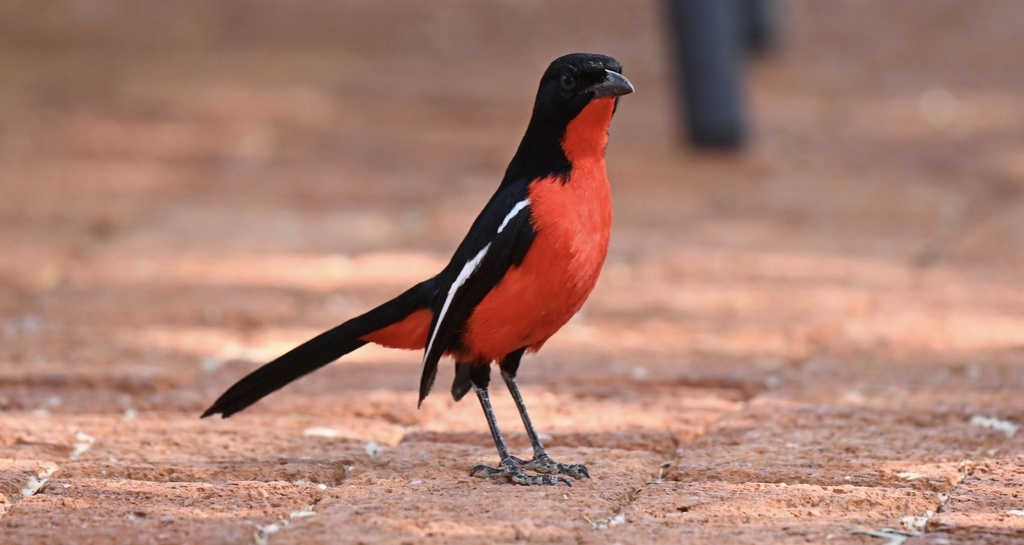
The crimson-breasted shrike (Laniarius atrococcineus) or the crimson-breasted gonolek, ('gonolek' - supposedly imitative of its call), or the crimson-breasted boubou, is a southern African bird. It has black upper parts with a white flash on the wing, and bright scarlet underparts. The International Union for Conservation of Nature has rated it as a "least-concern species".
From the article Crimson-breasted shrike on Wikipedia (CC BY-SA), quoted section by section
Description
The sexes have the same colouration and are indistinguishable from each other. The upper parts, including the wings and tail, are black, the wings having a broad white bar. The underparts are vivid scarlet. A yellow-breasted form is occasionally seen, and was at first thought to be a separate species. Young birds have a mottled and barred buff-brown appearance with a pale bill.
Range & habitat
The crimson-breasted shrike is non-migratory and occurs in a broad swathe from southern Angola to the Free State province in South Africa and Northern Cape. Its preferred habitat is drier thornbush areas, in thickets and riparian scrub. It makes small seasonal migrations, preferring lower altitudes during cold periods.
Wikipedia: “Distribution and habitat”
What it does
This shrike is extremely nimble and restless, its penetrating whistles often being the first sign of its presence, although it is not a shy species.
Wikipedia: “Behaviour”
Listen
Looking for field recordings…
Where it lives
Recorded sightings
—
geo-referenced records in GBIF, from museums, herbaria and field observers.
Drag the globe to turn it. Dots are where records exist, not a range map; darker means more records.
In the stacks
Searching the stacks…
Every page naming Laniarius atrococcineus in the Biodiversity Heritage Library →
This page is assembled live from iNaturalist, GBIF, Wikipedia, the Source Library and the Internet Archive. It is not yet part of the hand-edited codex. iNaturalist taxon 8211.