- Animals
- ›Chordates
- ›Vertebrates
- ›Ray-finned Fishes
- ›Spiny-rayed fishes
- ›Butterflyfishes, Angelfishes, and Allies
- ›Snappers
- ›Fusiliers
- ›Lutjanus
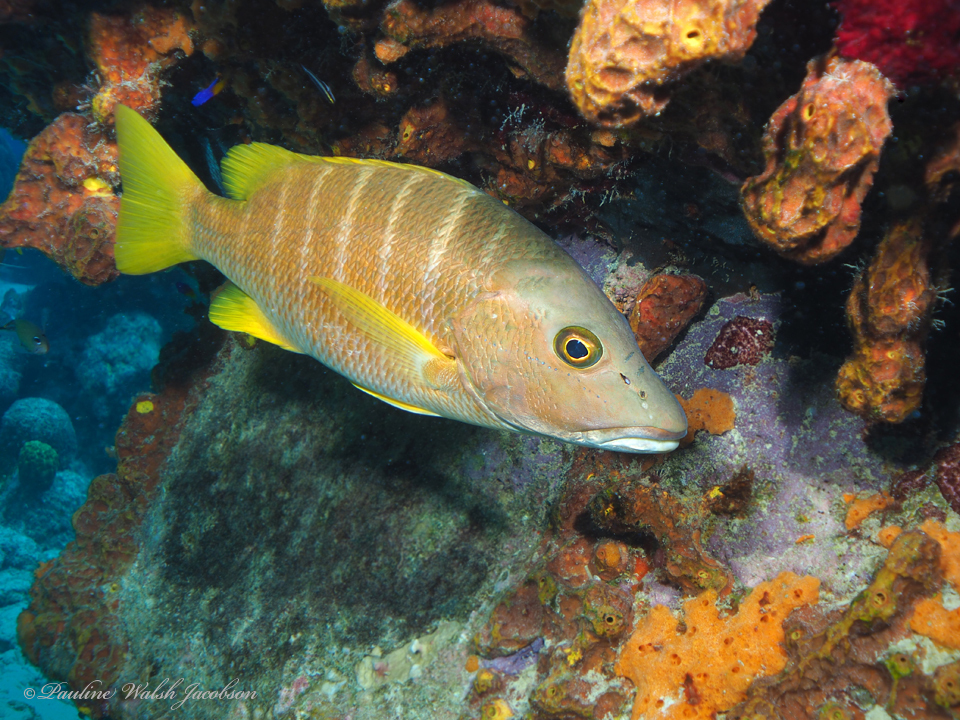
Schoolmaster Snapper
Lutjanus apodus
The schoolmaster snapper (Lutjanus apodus) is a colorful, subtropical fish found over coral reef areas along the coasts of Florida, the Bahamas, and the Caribbean, though it can range northward along the Atlantic coast of the United States. Adults are 12–14 in (30–35 cm) long and weigh 1.0–2.0 lb (0.4–0.8 kg), though rare individuals can weigh 8 lb at 24 in long. It has a robust, slightly compressed body, with a pointed head. Its color varies...
From the article Schoolmaster snapper on Wikipedia (CC BY-SA), quoted section by section
Description
The schoolmaster snapper has a moderately deep body which is robust and slightly compressed with a long. pointed snout and a large mouth. One of the upper pairs of canine teeth is clearly larger than back teeth in the lower jaw and can be seen when mouth is closed. The vomerine teeth are arranged in a chevron or crescent shaped patch with a line of similar teeth extending from the middle of the patch towards the rear. The preoperculum has a weakly developed incision and knob. This species has a protrusible upper jaw which is mostly covered by the cheek bone when the mouth is closed and both pairs of nostrils are simple holes. The dorsal fin is continuous with a slight incision separating the spiny part from the soft rayed part. The dorsal fin has 10 spines and 14 soft rays while the rounded anal fin contains 3 spines and 8 soft rays. The interior scale rows on back are parallel to lateral line. The caudal fin is slight emarginate or truncate. The pectoral fins are longer than the distance from longest point of the snout to tail edge of preopercle, reaching the level of anus. The color is olive gray to brownish on upper back and upper sides, with yellow to reddish mite around the head. The lower sides and belly are lighter; there is no dark lateral spot below the anterior part of soft dorsal fin. …
Range & habitat
The schoolmaster snapper is found in the western Atlantic Bermuda and the southeastern coast of the United States from Cape Canaveral in Florida southwards to the Bahamas and into the Gulf of Mexico where its range runs from the Florida Keys as far north as Tampa, Florida then from Alabama westwards along the coast of the Gulf to the Yucatan Peninsula and northwestern Cuba. It occurs throughout the Caribbean Sea. It has been recorded as far north as Massachusetts but these records involve juveniles that cannot survive the winter. It is typically found at depths between 1 and 50 m (3 ft 3 in and 164 ft 1 in), with one record at 89 m (292 ft). Adults usually stay near shore shelter around elkhorn and gorgonian coral. Large adults are sometimes found on the continental shelf. Typical depths are up to 4 m (13 ft). reported that at night, schoolmaster snapper may increase their range to twice the daytime range, mostly by visiting seagrass beds.
Wikipedia: “Distribution”
What it does
Studies have reported that the diet of the schoolmaster snapper changes ontogenetically, small individuals, less than 70 mm (2.8 in) in length have a 90% of their diet made up of crustaceans, specifically amphipods and crabs. Larger specimens preferred smaller fish. these making up more than 50% of their diet by weight, and also ate crabs, shrimp, and stomatopods. These differences in diets were attributed to the ability of the bigger fish to open their jaws wider for bigger prey.
Wikipedia: “Feeding”
Where it lives
Recorded sightings
—
geo-referenced records in GBIF, from museums, herbaria and field observers.
Drag the globe to turn it. Dots are where records exist, not a range map; darker means more records.
In the stacks
Searching the stacks…
Every page naming Lutjanus apodus in the Biodiversity Heritage Library →
This page is assembled live from iNaturalist, GBIF, Wikipedia, the Source Library and the Internet Archive. It is not yet part of the hand-edited codex. iNaturalist taxon 81989.