On eBird ↗
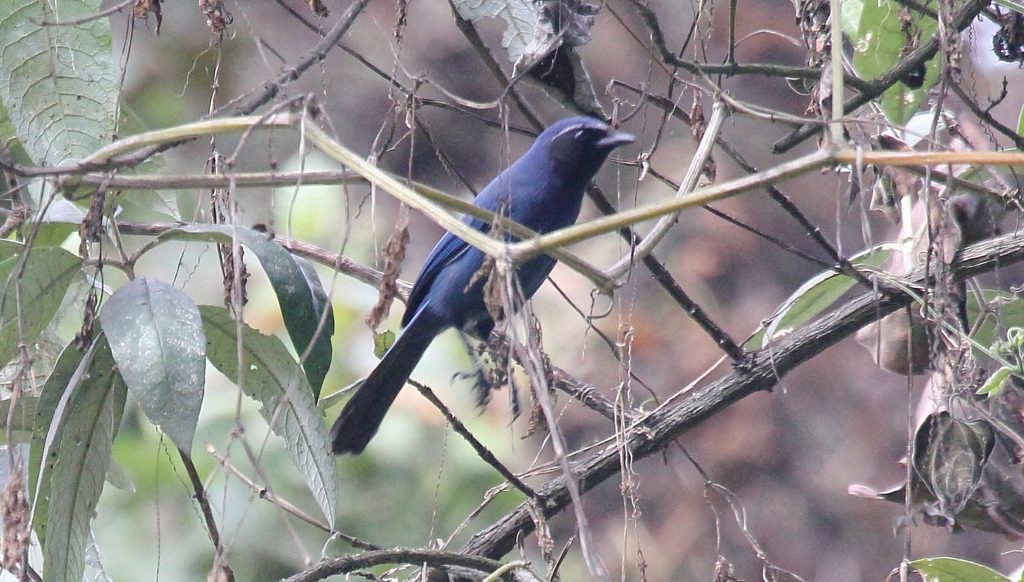
Black-throated Jay
Live sightings near you, the range map, bar charts of when it is seen, and Macaulay Library photos and recordings.
Black-throated Jay
Cyanolyca pumilo
The black-throated jay (Cyanolyca pumilo) is a species of bird in the family Corvidae. It is found in Chiapas, Guatemala and Honduras. Its natural habitat is subtropical or tropical moist montane forests.
From the article Black-throated jay on Wikipedia (CC BY-SA), quoted section by section
Description
The black-throated jay is about 23 to 28 cm (9.1 to 11 in) long and weighs about 47 to 60 g (1.7 to 2.1 oz). The sexes have almost the same plumage; females tend to be slightly more greenish than males. Adults have a black forehead, lores, and sides of the head. Their crown is cobalt blue. They have a thin white line from above the forecrown to around the back of the ear coverts. Their upperparts are mostly deep blue that is less purplish than the crown and with some cerulean on the wings and tail. Their throat and chin are a duller black than their face. Their breast, belly, and undertail coverts are blue that is deeper and more purplish on the breast. They have a dark brown iris, a black bill, and black legs and feet. Immatures have a dusky grayish face and throat without the adult's white line.
Range & habitat
The black-throated jay is found discontinuously in Mexico's Chiapas state, central and southern Guatemala, western and central Honduras, and extreme northern El Salvador. It inhabits montane evergreen cloudforest and pine-oak forest in the subtropical and lower temperate zones. Though some sources state that it ranges in elevation between 1,900 and 3,000 m (6,200 and 9,800 ft) another extends its lower limit to 1,200 m (3,900 ft).
Wikipedia: “Distribution and habitat”
What it does
The black-throated jay's diet has not been studied; the species is believed to be omnivorous. It typically forages singly or in family groups and mostly in the forest's understory.
Wikipedia: “Feeding”
Listen
Looking for field recordings…
Where it lives
Recorded sightings
—
geo-referenced records in GBIF, from museums, herbaria and field observers.
Drag the globe to turn it. Dots are where records exist, not a range map; darker means more records.
In the stacks
Searching the stacks…
Every page naming Cyanolyca pumilo in the Biodiversity Heritage Library →
This page is assembled live from iNaturalist, GBIF, Wikipedia, the Source Library and the Internet Archive. It is not yet part of the hand-edited codex. iNaturalist taxon 8173.