- Animals
- ›Arthropods
- ›Hexapods
- ›Insects
- ›Winged and Once-winged Insects
- ›Ants, Bees, Wasps, and Sawflies
- ›Narrow-waisted Wasps, Ants, and Bees
- ›Ants, Bees, and Stinging Wasps
- ›Formicoidea
- ›Ants
- ›Formicine Ants
- ›Camponotine Ants
- ›Camponotus
- ›Myrmothrix
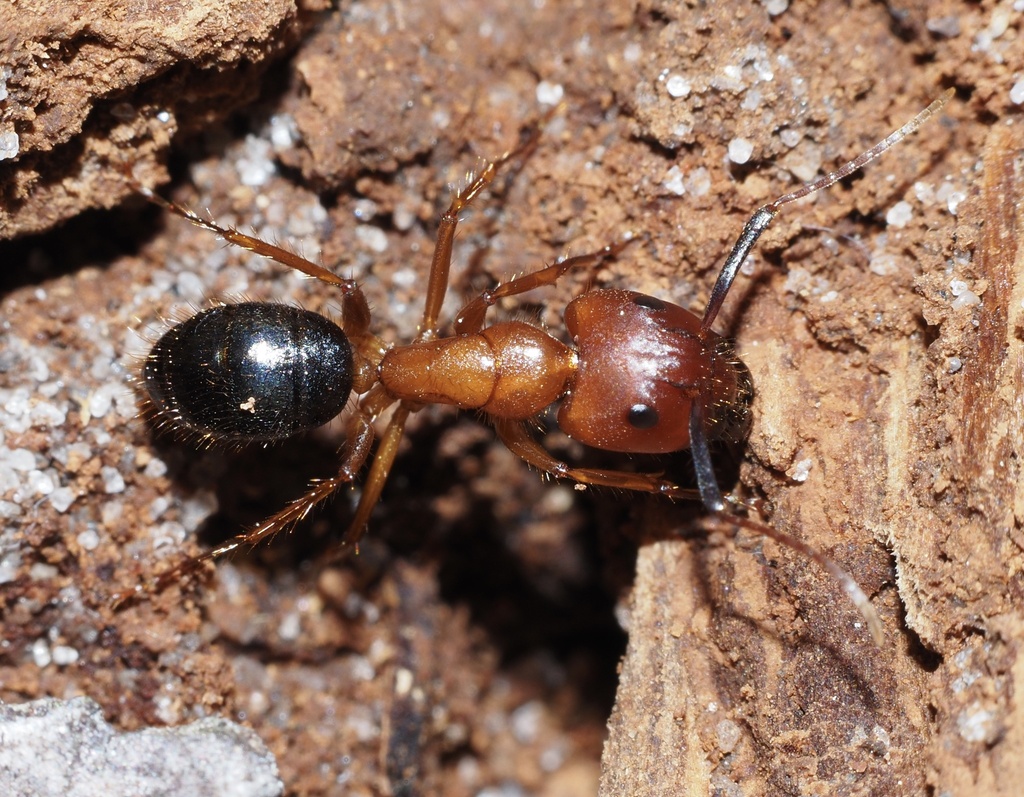
Florida Carpenter Ant
Camponotus floridanus
Camponotus floridanus, or Florida carpenter ant, is a species of ant in the genus Camponotus. First described as Formica floridana by Buckley in 1866, the species was moved to Camponotus by Mayr in 1886. The ant is widespread in Florida and occurs as far north as North Carolina and as far west as Mississippi.
From the article Camponotus floridanus on Wikipedia (CC BY-SA), quoted section by section
Description
Camponotus floridanus is one of the most familiar ant species in Florida owing both to its large size and conspicuous coloration. Workers and queens are bicolored, having a reddish-orange head and a bright to dullish orange colored mesosoma and legs, contrasted sharply by a deep black gaster. Male alates of this species are more concolorous, primarily ranging in the rusty to cider oranges. Camponotus floridanus can be distinguished from its visually similar, but smaller relative Camponotus tortuganus by its wider than long head, smaller but stockier legs relative to the body, and overall stouter build. Queens on average vary 14–16 mm in length, and the highly polymorphic workers can potentially attain similar lengths, with the largest majors reaching 11–13 mm. Minors and mediae are typically around 4–9 mm.
Range & habitat
Florida carpenter ants' native range is most highly concentrated throughout Florida, though it is also spread predominantly along the coastal areas northwards into Georgia and southern South Carolina, with minor reports as far north as Clayton, North Carolina. Their prominent range also spreads west along the Florida panhandle, through southern Alabama's Baldwin and Mobile Counties and into the very southeast of Mississippi. There have also been numerous reports of the species around Houston, Texas.
Wikipedia: “Distribution”
What it does
These ants are highly aggressive and fast moving, being quick to swarm any disturbance to their nest. Workers are relentless as they attack, searching meticulously for weaknesses in the skin and targeting vulnerable areas such as the skin creases or the nail cuticles. Major workers can deliver particularly devastating bites as their mandibles more readily pierce the skin, where bite wounds may draw blood and into which they will attempt to spray noxious formic acid. The unusual aggression of this Camponotus species may be an adaptation in response to its nesting habits, as they commonly inhabit extensively rotted deadwood that can easily be broken apart by hand. Outside of deadwood, colonies may be found nesting underground within the base of a living tree or inside tree cavities. Even artificial structures such as hollow poles or fencing may be taken residence. Colonies prefer shaded areas in which to nest, such as in dense woodlands, though any area with many trees that provide adequate shade is potential suitable habitat. The Florida carpenter ant is readily tolerant of disturbed areas of human habitation, making them a common sight in the densely populated suburbs of Florida. …
Wikipedia: “Behavior”
Listen
Looking for field recordings…
Where it lives
Recorded sightings
—
geo-referenced records in GBIF, from museums, herbaria and field observers.
Drag the globe to turn it. Dots are where records exist, not a range map; darker means more records.
In the stacks
Searching the stacks…
Every page naming Camponotus floridanus in the Biodiversity Heritage Library →
This page is assembled live from iNaturalist, GBIF, Wikipedia, the Source Library and the Internet Archive. It is not yet part of the hand-edited codex. iNaturalist taxon 81709.