On eBird ↗
Azure-hooded Jay
Live sightings near you, the range map, bar charts of when it is seen, and Macaulay Library photos and recordings.
Azure-hooded Jay
Cyanolyca cucullata
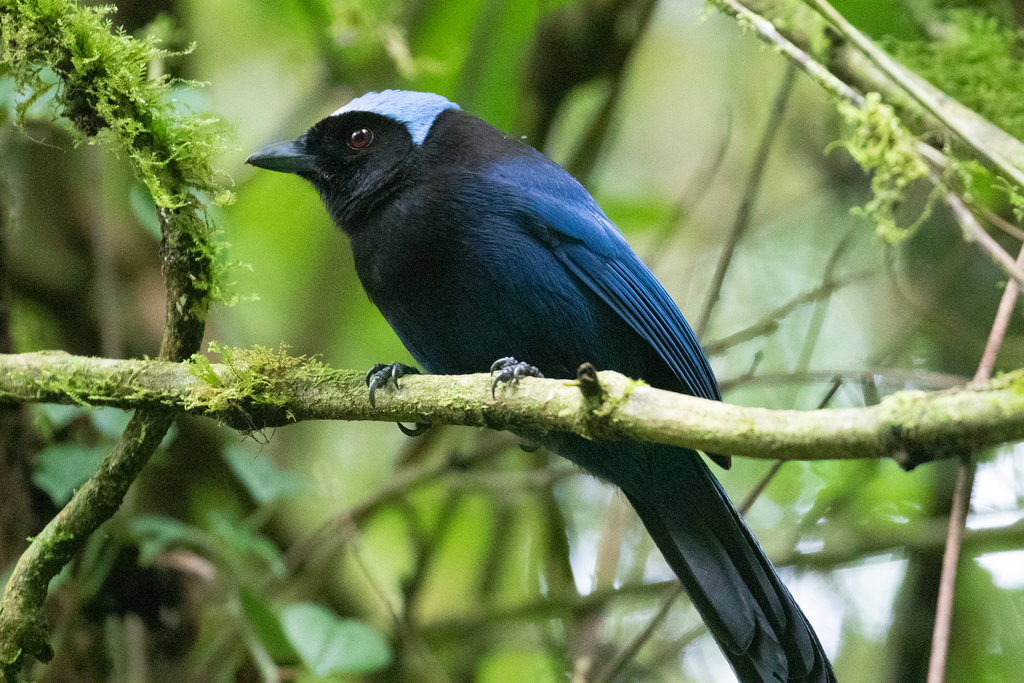
The azure-hooded jay (Cyanolyca cucullata) is a species of bird in the family Corvidae. It is found in Middle America. Its natural habitat is subtropical or tropical moist montane forest. This species is known to have four subspecies. It is 11 to 12 inches (28 to 30 cm) in length and is dark blue with a black head and upper chest. The back of the head and neck are sky blue with a white border.
The jays travel in groups of two to ten individuals and may join mixed-species flocks. It is a secretive species and therefore difficult to observe in the wild. As an omnivore, this jay eats berries, seeds, and small, dead animals. Females lay three to four eggs, and the young fledge after twenty days. This species is listed as Least Concern, meaning it is not threatened with extinction.
From the article Azure-hooded jay on Wikipedia (CC BY-SA), quoted section by section
Description
The azure-hooded jay ranges in length from 11 to 12 inches (28 to 30 cm), and it tends to weigh 3.52 ounces (100 g). Its large size and frame help the bird manage the large amount of flying it does. The adult is dark blue with black on the head and upper chest, while the rear of the crown and nape, or back of the neck, are sky blue with a white border. The legs and bill are black and the eyes are dark red. Both sexes are similar in appearance. Juveniles are duller than adults and their sky blue hood does not possess the white bordering. Its voice has been described as a loud and bright eihnk-eihnk that is typically repeated four to five times. It is also known to repeat a nasal ehr-ehn or eh'enk noise twice and give off a low, gruff, hard cheh-r. The alarm and flock-social calls of this species, characterized as a reek! sound, are "nasal, querulous, and upwardly or double inflected."
Range & habitat
This species is known from Costa Rica, Guatemala, Honduras, southeastern Mexico, and western Panama. It lives in humid evergreen forests that are sometimes interspersed with pine trees. It can be found at the edges of these forests typically in the middle and higher levels within these trees. It is also normally found only where cloud forest is uninterrupted.
Wikipedia: “Distribution and habitat”
What it does
This corvid is known to join mixed-species flocks with other species including unicolored jays and emerald toucanets. It is also known to travel in groups with two to ten other azure-hooded jays. It is a skulking and secretive species, rarely coming out into the open. Because of this habit, the bird is extremely difficult to observe in the wild and not much is known about its ecology. Mates are known to preen each other, a process which entails one bird bending over in front of the other and tugging on its throat feathers. The feathers of the crown are often moving swiftly, and it is believed that the condition of a mate can be determined by this movement. Like other jays, this species is likely extremely intelligent. Similar species are known to use ants to keep their feathers clean, store seeds and nuts for later consumption, and use their toes to hold food. However, due to its secretive nature, these characteristics have not yet been observed in the species. The bird's bright plumage makes it easy for predators to find this species. Whenever the jay feels threatened, it gives off a warning alarm call.
Diet. The azure-hooded jay is omnivorous, eating berries, seeds, and small, dead animals. This species has been known to steal and eat bait from traps set for small mammals. The bird tends to forage in the forest canopy.
Reproduction. …
Wikipedia: “Ecology and behavior”
Listen
Looking for field recordings…
Where it lives
Recorded sightings
—
geo-referenced records in GBIF, from museums, herbaria and field observers.
Drag the globe to turn it. Dots are where records exist, not a range map; darker means more records.
In the stacks
Searching the stacks…
Every page naming Cyanolyca cucullata in the Biodiversity Heritage Library →
This page is assembled live from iNaturalist, GBIF, Wikipedia, the Source Library and the Internet Archive. It is not yet part of the hand-edited codex. iNaturalist taxon 8169.