- Plants
- ›Vascular Plants
- ›flowering plants
- ›Dicots
- ›Sunflowers, Bellflowers, Fanflowers, and Allies
- ›Sunflowers, Daisies, Asters, and Allies
- ›Thistles and Allies
- ›Cardueae
- ›Thistles and Burdocks
- ›Cirsium
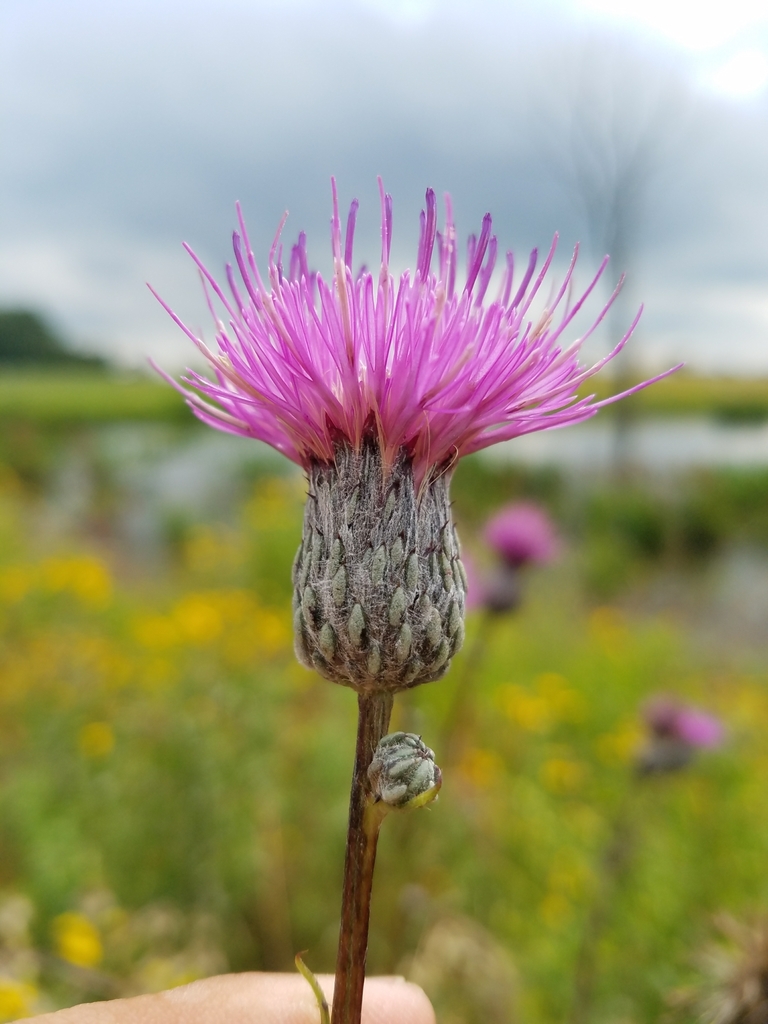
swamp thistle
Cirsium muticum
Cirsium muticum, also known as swamp thistle, marsh thistle, dunce-nettle, or horsetops, is a North American species of plants in the family Asteraceae, native to central and eastern Canada and the central and eastern United States.
From the article Cirsium muticum on Wikipedia (CC BY-SA), quoted section by section
Description
Cirsium muticum is a biennial plant that reaches a height of 180 centimetres (71 in). Its taproot is fleshy and its stem is ridged with hairs toward the base. The leaves are alternate in position, pinnately lobed, and ovate in shape. The leaf lobes are often asymmetrical and forked irregularly with the angles containing fine trichomes (multicellular hairs). The leaves become progressively smaller towards the inflorescence; there are often a few trichomes on the underside. The peduncles are 0–15 cm (0.0–5.9 in), each with an inflorescence made up of many tiny florets; the involucre has cobwebby white hairs, and it is often slightly sticky. The purple florets can be up to 27 mm (1.1 in) long.
Range & habitat
Cirsium muticum has been found across every province of Canada from Labrador and Newfoundland to Saskatchewan. In the United States, it grows primarily in the Northeast, the Great Lakes region, and the Appalachians, with isolated populations scattered across the South from Texas to the Carolinas. Cirsium muticum is found mostly in alkaline swamps, wetlands, marshes and low forests but some races have been known to grow in wet alpine climates.
Wikipedia: “Distribution and habitat”
What it does
Cirsium muticum is as host for some species of butterflies and moths, including the swamp metalmark butterfly (Calephelis muticum), a species that is currently undergoing risk assessment in the United States. The butterfly lays its eggs on the swamp thistle, and when the eggs hatch, the flowers are the only food source for the caterpillars. It is also a larval host to the painted lady butterfly, and songbirds eat its seeds. Species that grow with it include Aster umbellatus (flat-topped white aster), Solidago patula (rough-leaved goldenrod), Lysimachia quadrifolia (prairie loosestrife), and Gentiana procera (smaller fringed gentian).
Wikipedia: “Ecology”
Where it lives
Recorded sightings
—
geo-referenced records in GBIF, from museums, herbaria and field observers.
Drag the globe to turn it. Dots are where records exist, not a range map; darker means more records.
In the stacks
Searching the stacks…
Every page naming Cirsium muticum in the Biodiversity Heritage Library →
This page is assembled live from iNaturalist, GBIF, Wikipedia, the Source Library and the Internet Archive. It is not yet part of the hand-edited codex. iNaturalist taxon 81603.