- Animals
- ›Chordates
- ›Vertebrates
- ›Ray-finned Fishes
- ›Carps, Characins, Catfishes and Allies
- ›Catfishes
- ›Siluroidei
- ›North American Freshwater Catfishes
- ›Ictalurus
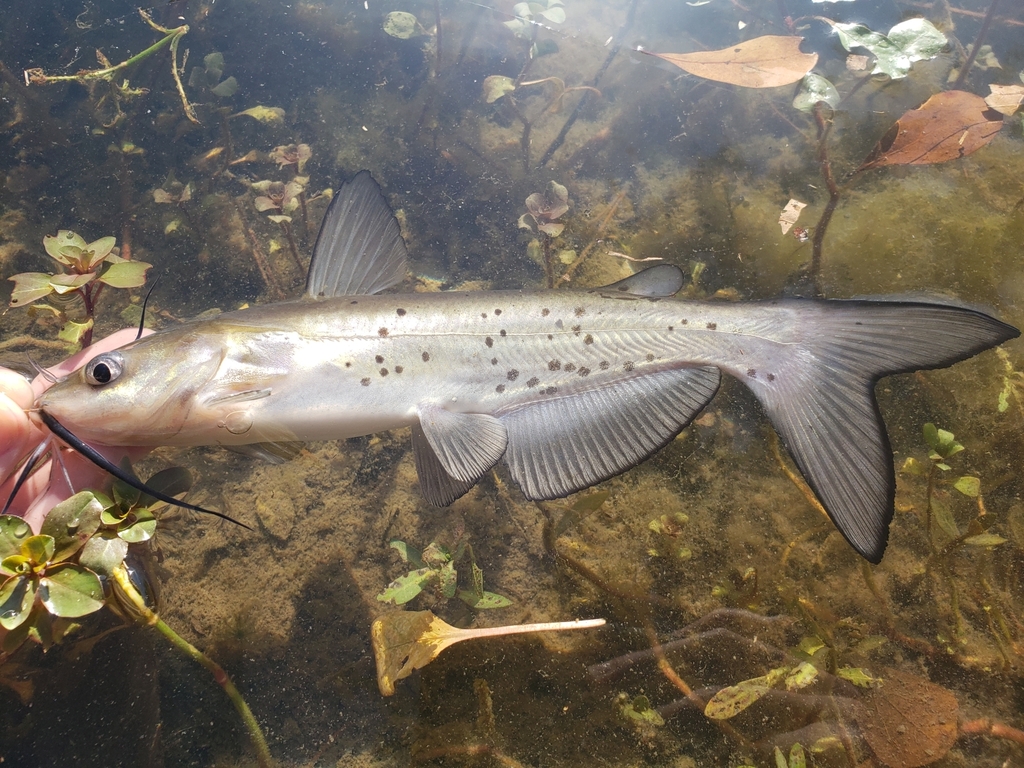
Channel Catfish
Ictalurus punctatus
The channel catfish (Ictalurus punctatus), known informally as the "channel cat", is a species of catfish native to North America. They are North America's most abundant catfish species, and the official state fish of Kansas, Missouri, Nebraska and Tennessee. The channel catfish is the most fished species of catfish in the United States, with around 8 million anglers angling them per year. The popularity of channel catfish for food has contributed to the rapid expansion of this species' aquaculture in the United States. It has also been widely introduced to Europe, Asia and South America, and many countries consider it an invasive species.
From the article Channel catfish on Wikipedia (CC BY-SA), quoted section by section
Description
Channel catfish have a well developed sense of smell and taste. Their nostril pits (nares) contain sense organs with high concentrations of olfactory receptors. In channel catfish, these organs are sensitive enough to detect several amino acids at about one part per 100 million in water. Also, the channel catfish has taste buds distributed over the surface of its entire body. These buds are especially concentrated on the four pairs of barbels (whiskers) surrounding the mouth, which have about 25 buds per square millimeter. This combination of strong senses of taste and smell allows the channel catfish to find food in dark, stained, or muddy water with relative ease. They also possess a Weberian apparatus, which amplifies sound waves that would otherwise not be perceptible. There is a misconception that the barbels of channel catfish sting upon contact. The barbels lack such capabilities and cannot sting. However, these catfish do have spines on their pectoral and dorsal fins which may cause injury if the fish is handled improperly. There is a common misconception that being pricked by a catfish spine is dangerous: it is no more dangerous than a sting from a mosquito.
Length and weight. An average adult channel catfish measures at least 12 inches (30 centimeters) long, and weighs between 2 and 4 pounds (0.91 and 1.81 kg). …
Wikipedia: “Characteristics”
Range & habitat
Channel catfish are native to the Nearctic realm and are widely distributed in southern Canada, the eastern and northern United States, and parts of northern Mexico. They have an extensive native range consisting of almost all of the United States west of the Appalachian Mountains and east of the Rocky Mountains, roughly following the Mississippi River Basin. They are also native to peninsular Florida. They have also been widely introduced to Atlantic-draining rivers east of the Appalachians and Pacific-draining rivers west of the Rockies, giving them a continent-spanning range. Although they are officially considered introduced to this region, it has been suggested that they may also be native to the Atlantic-draining rivers from the Susquehanna south to the Neuse. Its range in southern Canada includes the Great Lakes (excluding Lake Superior) and parts of the Quebec, Ontario, and Manitoba provinces. They have also been introduced into some waters of the Czech Republic and Romania, as well as parts of Malaysia and Indonesia. This species thrives in rivers, reservoirs, lakes, and ponds. Channel catfish are cavity nesters, which means that they lay their eggs in crevices, hollows, or debris to protect them from swift currents.
Wikipedia: “Distribution and habitat”
What it does
Catfish have a well-developed taste perception and are called "swimming tongues" due to the presence of taste buds all over the skin and inside the oropharyngeal cavity. Specifically, they have high sensitivity to amino acids, which explains their unique communication methods as follows. The catfish has a facial taste system that is extremely responsive to L-alanine and L-arginine. More specifically, their facial taste system senses heightened levels of L-amino acids in freshwater. Feeding behavior to food is due to amino acids released by food. This is reported to cause maxillary and mandibular barbel movements, which orient the catfish's posture and food search. When the food stimulates the taste receptors, it causes more excitation which is seen in exaggerated biting, turning, or mastication. Like other catfish, channel catfish feed through suction by opening their mouth quickly to create a current into which prey and water rapidly flows. They lack large mouths and, rather than biting and chewing, swallow their prey whole.
Diet. Adult channel catfish, over 45 centimetres (18 in), prey on fishes such as yellow perch and sunfish. The diet of adults consists of snails, clams, crustaceans (such as crayfish), snakes, frogs, small fish, insects, aquatic plants, algae, seeds, grains, nuts, and occasionally even small birds and small mammals. …
Wikipedia: “Feeding”
In human culture
The channel catfish is an important food source in the southern United States and is valued for the quality of its meat. In the United States, catfish is the largest aquaculture industry, and channel catfish make up 90% of farm-raised catfish. In 2021, catfish farmers in the United States made $421 million in sales. Most catfish farming in the United States occurs in the southeast: Alabama, Arkansas, Louisiana, and Mississippi produce 94% of American farm-raised catfish, with Mississippi responsible for over 50%.
Wikipedia: “Cultural & economic significance”
Where it lives
Recorded sightings
—
geo-referenced records in GBIF, from museums, herbaria and field observers.
Drag the globe to turn it. Dots are where records exist, not a range map; darker means more records.
In the stacks
Searching the stacks…
Every page naming Ictalurus punctatus in the Biodiversity Heritage Library →
This page is assembled live from iNaturalist, GBIF, Wikipedia, the Source Library and the Internet Archive. It is not yet part of the hand-edited codex. iNaturalist taxon 81554.