On eBird ↗
Manus Fantail
Live sightings near you, the range map, bar charts of when it is seen, and Macaulay Library photos and recordings.
Manus Fantail
Rhipidura semirubra
The Manus fantail (Rhipidura semirubra) is a bird species endemic to the Admiralty Islands of Papua New Guinea. It is a monotypic species, meaning it is the only one of its kind within its genus. Historically, the Manus fantail has been seen on Manus Island itself, but more recently it has been sighted on smaller surrounding islands like Tong, Rambutyo, and others in the San Miguel and Fedarb groups.
From the article Manus fantail on Wikipedia (CC BY-SA), quoted section by section
Description
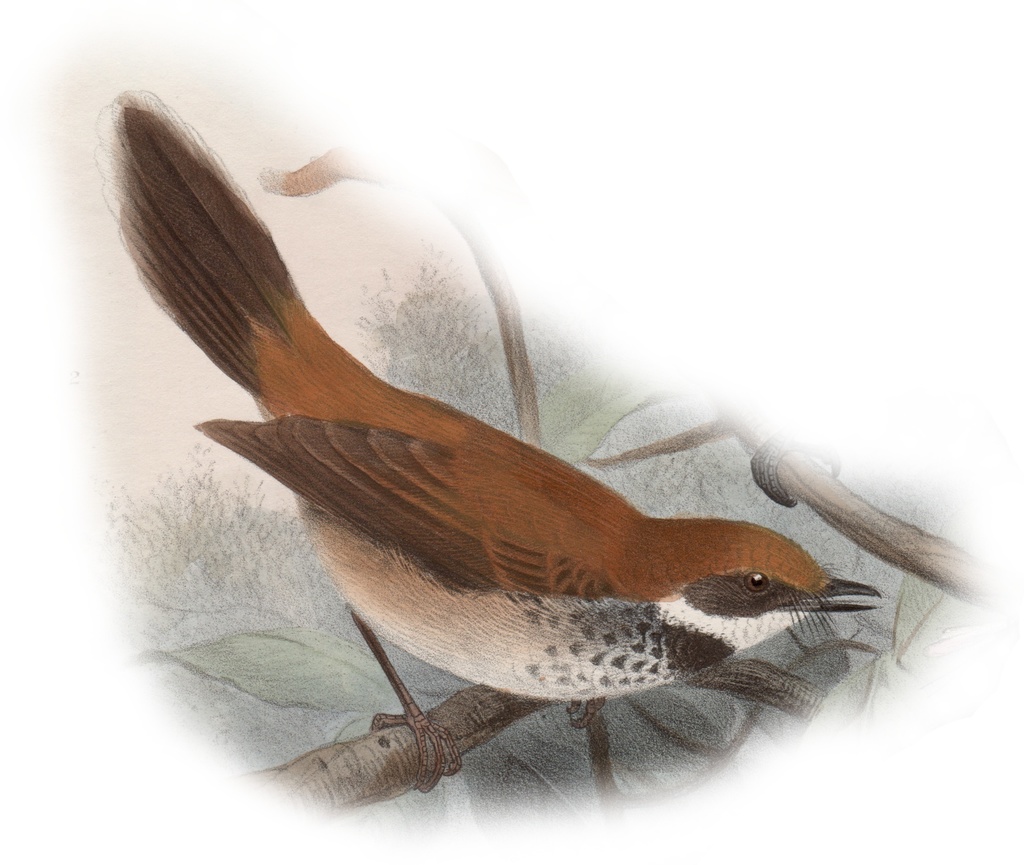
The Manus Fantail is a small, agile bird, measuring approximately 14.5 centimeters in length and weighing about 8.0 grams. Both males and females are identical in plumage. The upperparts, including the crown, nape, and back, are a bright, uniform cinnamon-red. The area between the eye and the bill is dark sooty-grey which makes their bright white cheeks stand out. The upper breast features a prominent black band, which transitions to a white lower breast and belly that is heavily marked with black spotting. It is dark brown with a rufous base and pale ashy-grey tips. The wings are a darker brown compared to the bright back.
Range & habitat
Earlier records show that Manus Fantail appeared on the main island of Manus. In recent decades, the species has predominantly been observed on smaller offshore islands. Key locations include the islands of Tong, Rambutyo, Pak, and Anobat in the San Miguel Islands, as well as Sivisa in the Fedarb Islands. It is often seen by observers chartering boats to these smaller islands. The species inhabits lowland primary forests but demonstrates a notable tolerance for disturbed habitats. It is frequently found in degraded secondary growth, dense scrub, and overgrown coconut plantations. The Manus Fantail is currently listed as Least Concern. The population, estimated to number between 1,500 and 7,000 mature individuals, is believed to be stable. The bird's ability to thrive in degraded forests and secondary growth reduces its immediate vulnerability to habitat modification. However, its extremely small global range and the fragmentation of its populations across several small islands allow researchers to believe that they may be affected by severe storms, or the introduction of predators or diseases.
Wikipedia: “Habitat and Distribution”
Listen
Looking for field recordings…
Where it lives
Recorded sightings
—
geo-referenced records in GBIF, from museums, herbaria and field observers.
Drag the globe to turn it. Dots are where records exist, not a range map; darker means more records.
In the stacks
Searching the stacks…
Every page naming Rhipidura semirubra in the Biodiversity Heritage Library →
This page is assembled live from iNaturalist, GBIF, Wikipedia, the Source Library and the Internet Archive. It is not yet part of the hand-edited codex. iNaturalist taxon 8139.