On eBird ↗
Black-headed Jay
Live sightings near you, the range map, bar charts of when it is seen, and Macaulay Library photos and recordings.
Black-headed Jay
Garrulus lanceolatus
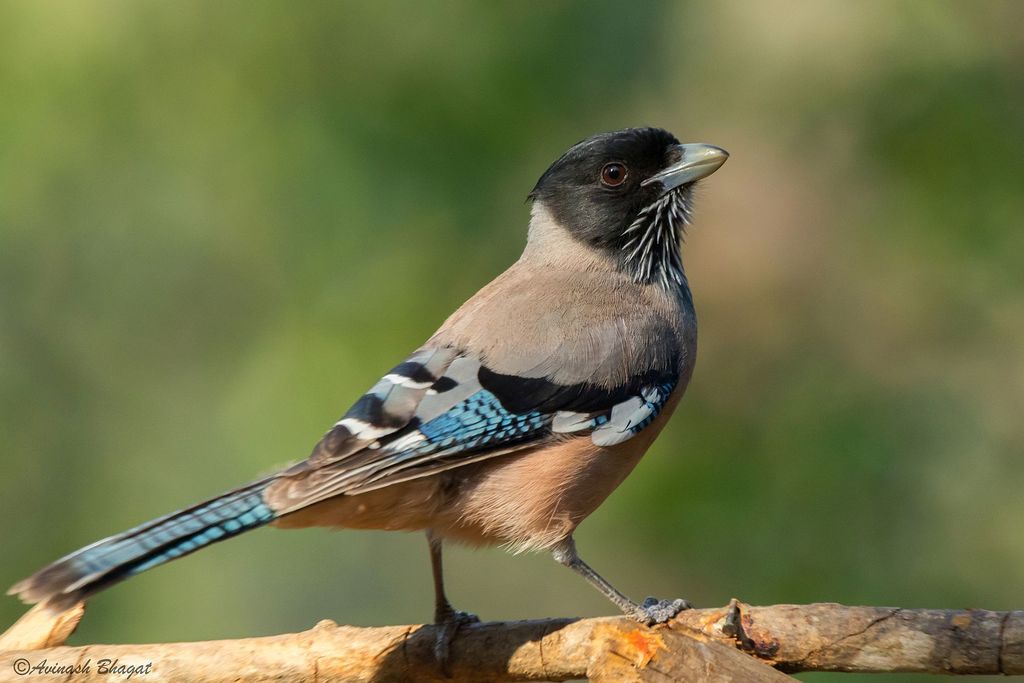
The black-headed jay or lanceolated jay (Garrulus lanceolatus) is a species of passerine bird in the crow family Corvidae. It is found in open wooded country across the Himalayas and into eastern Afghanistan. A relatively large songbird, it has a largely grey body with a black head, an untidy crest, white streaks on the throat, and a pale bill. It is roughly the same size as its close relative the Eurasian jay, but a little more slender overall.
From the article Black-headed jay on Wikipedia (CC BY-SA), quoted section by section
Description
The black-headed jay is roughly the same size as its close relative the Eurasian jay, but a little more slender overall. The head is mostly black with white streaks on the throat and a more obvious crest compared to the Eurasian jay. The bill is pale and slightly shorter and thicker compared to its close relative. The tail is also longer. It has a very similar voice to the Eurasian jay, but with longer pauses between calls. The call is most often a harsh "kraaa", which can sound either raspy or more nasal.
Range & habitat
Black-headed jays are non-migratory and range from eastern Afghanistan eastwards, across the Himalayas, from India to Nepal and Bhutan. They occur in wooded country with large areas of open ground rather than dense forest, and at elevations ranging from 570-4000m. They also occur in some cultivated areas and even near villages as long as there are enough trees and scrubland nearby. They may even visit agricultural land and garbage dumps to feed.
Wikipedia: “Distribution and habitat”
What it does
Black-headed jays are omnivores; they feed both on the ground and in trees, and take virtually the same wide range of plant and animal foods as the Eurasian jay, including eggs and nestlings. They can be quite bold and frequent human habitation, where they are known to feed off agricultural land and garbage dumps. They nest in trees and suitable bushes and in this resemble the Eurasian jay in every respect. Their nests are made of sticks plastered together with mud and lined with weeds and rootlets. They usually lay 3–5 eggs, which are incubated over a period of 16 days. Both parents feed the young.
Wikipedia: “Behavior”
Listen
Looking for field recordings…
Where it lives
Recorded sightings
—
geo-referenced records in GBIF, from museums, herbaria and field observers.
Drag the globe to turn it. Dots are where records exist, not a range map; darker means more records.
In the stacks
Searching the stacks…
Every page naming Garrulus lanceolatus in the Biodiversity Heritage Library →
This page is assembled live from iNaturalist, GBIF, Wikipedia, the Source Library and the Internet Archive. It is not yet part of the hand-edited codex. iNaturalist taxon 8087.