- Animals
- ›Chordates
- ›Vertebrates
- ›Birds
- ›Perching Birds
- ›Woodswallows, Butcherbirds, and Currawongs
- ›Artamus
On eBird ↗
Fiji Woodswallow
Live sightings near you, the range map, bar charts of when it is seen, and Macaulay Library photos and recordings.
Fiji Woodswallow
Artamus mentalis
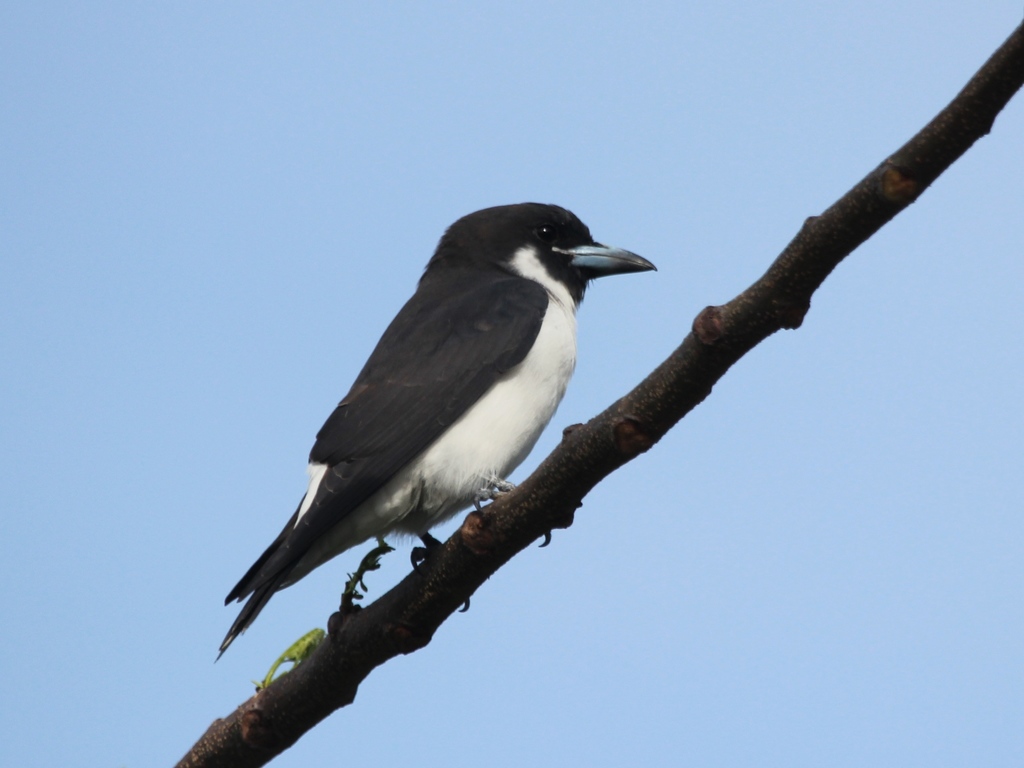
The Fiji woodswallow (Artamus mentalis) is a species of woodswallow in the family Artamidae. It is endemic to most of the islands of Fiji, although it is absent from Kadavu Archipelago and the Lau Archipelago. The species was once considered a race of the white-breasted woodswallow, which breeds from Australia, New Caledonia and Vanuatu through to Borneo and the Philippines. Some authors retain it in that species.
The Fiji woodswallow is a chunky bird 18 centimetres (7 in) long with a heavy black-tipped blue bill. The plumage is sooty dark above, with a white belly, rump and throat. It is distinguished from the white-breasted woodswallow by the amount of white on the throat, which in the Fiji woodswallow comes up to the level of the bill.
From the article Fiji woodswallow on Wikipedia (CC BY-SA), quoted section by section
Range & habitat
The Fiji woodswallow is endemic to the major islands of Fiji, namely Viti Levu, Vanua Levu and Taveuni. It is absent from the fourth largest island, Kadavu, but is present on smaller Gau in the Lomaiviti Archipelago. Its natural habitat is tropical moist lowland forests and savannahs, but it has adjusted to human-altered habitats and also lives in cultivated areas; there are even urban populations in Suva and Nadi. In Viti Levu it is found in the highlands, but not on the highlands of Taveuni. Unlike the nomadic populations of Australian white-breasted woodswallows, the Fiji woodswallow is sedentary. Family groups will occupy a tree in which they roost and nest in over several years. It is thought that this is because the climatic conditions in Fiji are less extreme.
Wikipedia: “Distribution and habitat”
What it does
The Fiji woodswallow feeds on insects, with moths, butterflies, dragonflies, and grasshoppers being the main prey taken. Most of the prey is obtained by hawking, with birds sitting on prominent perches and sallying after flying insect prey. Prey is usually taken out in the open away from obstacles but is occasionally taken from near the ground. Alternatively the woodswallow may make sweeps over flowering plants and snap at insects. It seldom lands to catch prey. Smaller items of prey are swallowed whole, whereas larger items are taken to a perch and dismembered, with the insect held on the perch with a foot and pecked apart. The wings of some species, such as dragonflies, are often stripped off before swallowing. Family groups will feed each other during the breeding season, and injured birds are fed while they recover.
Wikipedia: “Diet”
Listen
Looking for field recordings…
Where it lives
Recorded sightings
—
geo-referenced records in GBIF, from museums, herbaria and field observers.
Drag the globe to turn it. Dots are where records exist, not a range map; darker means more records.
In the stacks
Searching the stacks…
Every page naming Artamus mentalis in the Biodiversity Heritage Library →
This page is assembled live from iNaturalist, GBIF, Wikipedia, the Source Library and the Internet Archive. It is not yet part of the hand-edited codex. iNaturalist taxon 8084.